
Enhanced with market attractiveness analysis, total addressable market evaluation, company benchmarking matrices, interactive Excel dashboards, expanded supply chain intelligence, emerging startup coverage, and detailed product insights, The Business Research Company’s 2026 market reports deliver more actionable and strategically valuable research.
Hydrolyzed Vegetable Proteins Market Size, Value And Growth Trends Through 2030
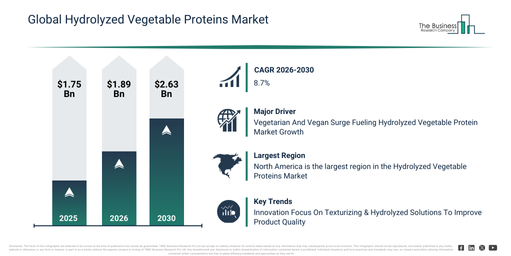
The hydrolyzed vegetable proteins market size has shown significant growth over recent years. It is anticipated to increase from $1.75 billion in 2025 to $1.89 billion in 2026, achieving a compound annual growth rate (CAGR) of 7.4%. This historical growth can be linked to the expansion of processed food manufacturing, the increasing incorporation of flavor enhancers in packaged foods, the readily available sources of soy and wheat protein, the rising consumption of convenience foods, and the implementation of industrial food processing methods.
The market for hydrolyzed vegetable proteins is anticipated to experience substantial expansion over the coming years. This market is projected to reach $2.63 billion by 2030, exhibiting a compound annual growth rate (CAGR) of 8.7%. This projected growth is driven by factors such as a surge in demand for plant-derived foods, a heightened emphasis on natural flavor solutions, the proliferation of meat substitute products, increasing investments in food ingredient innovation, and closer regulatory examination of synthetic additives. Key trends during this period encompass the growing utilization of plant-sourced flavor enhancers, an escalating demand for clean-label food components, broader integration into meat substitute recipes, the widening scope of hydrolyzed protein applications, and a sharper focus on optimizing umami flavors.
Download A Free Sample Report For Comprehensive Market Insights:
Hydrolyzed Vegetable Proteins Market Growth Drivers: What Factors Are Accelerating Expansion?
The increasing adoption of vegetarian and vegan eating habits is anticipated to fuel expansion within the hydrolyzed vegetable protein market in the future. These dietary approaches encompass various forms of vegetarianism where animal-derived products are entirely excluded. Obtained from plants, hydrolyzed vegetable protein offers an adaptable and eco-friendly solution to satisfy the protein requirements of individuals following vegetarian and vegan lifestyles. For example, data from Veganuary, a UK non-profit promoting veganism via its January campaign, indicated a rise in official participant numbers from 629,000 in 2022 to 706,965 in 2023, as reported in February 2023. Consequently, the expanding appeal of vegetarian and vegan diets is a key factor propelling the development of the hydrolyzed vegetable protein market.
Hydrolyzed Vegetable Proteins Market Segmentation: How Is The Market Structured Across Key Categories?
The hydrolyzed vegetable proteins market covered in this report is segmented –
1) By Source: Soy, Wheat, Corn, Pea, Other Sources
2) By Form: Dry Powder, Liquid
3) By Function: Flavoring Agent, Emulsifying Agent
4) By Application: Processed Food Products, Meat Substitutes
Subsegments:
1) By Soy: Hydrolyzed Soy Protein (Acid-Hydrolyzed), Hydrolyzed Soy Protein (Enzyme-Hydrolyzed), Partially Hydrolyzed Soy Protein
2) By Wheat: Hydrolyzed Wheat Protein (Acid-Hydrolyzed), Hydrolyzed Wheat Protein (Enzyme-Hydrolyzed)
3) By Corn: Hydrolyzed Corn Protein, Hydrolyzed Corn Gluten
4) By Pea: Hydrolyzed Pea Protein, Enzyme-Hydrolyzed Pea Protein
5) By Other Sources: Hydrolyzed Rice Protein, Hydrolyzed Potato Protein, Hydrolyzed Sunflower Protein, Hydrolyzed Mixed Vegetable Proteins
Hydrolyzed Vegetable Proteins Market Trends: What Is Shaping Future Industry Growth?
Companies operating within the hydrolyzed vegetable proteins (HVP) market are increasingly focused on developing innovative products, such as clean-label flavor-enhancing HVP blends. This strategic shift aims to address the growing consumer demand for natural, plant-based ingredients and savory profiles in processed and convenience foods. These clean-label HVP blends are naturally derived formulations of hydrolyzed vegetable protein, specifically engineered to amplify umami and savory tastes without the addition of artificial additives. They empower food manufacturers to achieve richer, more authentic flavors while satisfying consumer preferences for clear and simple ingredient lists. For example, in January 2024, Herbal Isolates PVT Ltd., an India-based ingredients and flavor-technology company, introduced Savouron, an innovative solution for flavor enhancement that heralds a new era of plant-derived taste modulation. Savouron is crafted from a proprietary blend of hydrolyzed plant proteins and natural taste-active compounds, designed to deliver clean umami, kokumi depth, and enhanced savory complexity in diverse applications like snacks, seasonings, sauces, and ready meals. It boasts a clean-label profile, eliminates the need for monosodium glutamate (MSG), offers high flavor stability during heat processing, and improves mouthfeel without obscuring the base recipe. The technology distinguishes itself by its ability to reduce sodium content, enhance overall taste harmonization, and offer a natural, label-friendly alternative to traditional flavor enhancers.
Hydrolyzed Vegetable Proteins Market Competitive Landscape And Leading Companies
Major companies operating in the hydrolyzed vegetable proteins market are Cargill Inc., Archer Daniels Midland Company, Ajinomoto Co. Inc., Kerry Group plc, Symrise AG, Koninklijke DSM N.V., Givaudan SA, Tate and Lyle plc, Sensient Technologies Corporation, Griffith Foods Inc., Caremoli S.p.A., Caremoli Dien Inc., Dien Inc., Nactis Flavours, Aipu Food Industry Co. Ltd., Titan Biotech Limited, Chaitanya Biologicals Pvt. Ltd., Aarkay Food Products Ltd., PMV Nutrient Products Pvt. Ltd., Henan Hengernuo Biotechnology Co. Ltd., Shandong Jianyuan Group Co. Ltd., Jones-Hamilton Co., Sun Impex International Foods LLC, Shanghai Bichain Industrial Chemical Co. Ltd., Astron Chemicals S.A.
Access The Complete Hydrolyzed Vegetable Proteins Market Report:
Hydrolyzed Vegetable Proteins Market Regional Distribution: Which Areas Drive Market Expansion?
North America was the largest region in the hydrolyzed vegetable proteins market in 2025. Asia-Pacific is expected to be the fastest-growing region in the forecast period. The regions covered in the hydrolyzed vegetable proteins market report are Asia-Pacific, South East Asia, Western Europe, Eastern Europe, North America, South America, Middle East and Africa.
Get in touch with us:
The Business Research Company: https://www.thebusinessresearchcompany.com/
Americas: +1 310-496-7795
Asia: +44 7882 955267 & +91 8897263534
Europe: +44 7882 955267
Email us at: marketing@tbrc.info
Follow us on:
LinkedIn: https://in.linkedin.com/company/the-business-research-company
YouTube: https://www.youtube.com/channel/UC24_fI0rV8cR5DxlCpgmyFQ
Global Market Model: https://www.thebusinessresearchcompany.com/global-market-model

Wasay has over a decade of experience in market research, data modelling, and analytics, with prior experience at GlobalData and Decision Tree Consulting Services. At The Business Research Company , he leads research operations across syndicated studies, customized consulting engagements, and the Global Market Model platform. His professional experience includes supporting organizations such as Boston Consulting Group, KPMG, and Ernst & Young. Wasay holds a degree in Electronics and Communications Engineering, postgraduate management qualifications from International Management Institute Belgium and Indian School of Business and Entrepreneurship, and completed the Integrated Program in Business Analytics from Indian Institute of Management Indore.