Enhanced with market attractiveness analysis, total addressable market evaluation, company benchmarking matrices, interactive Excel dashboards, expanded supply chain intelligence, emerging startup coverage, and detailed product insights, The Business Research Company’s 2026 market reports deliver more actionable and strategically valuable research.
Robotic Automated Meat Trimming Market Value Analysis: What Growth Is Expected Over The Forecast Period?
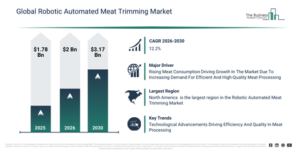
The robotic automated meat trimming market has experienced substantial growth in recent years. It is projected to expand from $1.78 billion in 2025 to $2 billion by 2026, achieving a compound annual growth rate (CAGR) of 12.4%. This historical expansion can be attributed to several factors, including increasing labor shortages in meat processing plants, a heightened demand for processing efficiency, the proliferation of large-scale meat production facilities, more rigorous food safety regulations, and the early adoption of industrial robotics.
The robotic automated meat trimming market is poised for substantial expansion in the coming years, with projections indicating a rise to $3.17 billion by 2030, achieving a compound annual growth rate (CAGR) of 12.2%. This growth over the forecast period is fueled by escalating investments in intelligent meat processing facilities, an increasing demand for uniform product quality, the widening scope of automation within protein processing, a heightened emphasis on ensuring worker safety and reducing costs, and the accelerated integration of data-driven processing systems. Significant developments anticipated during this period include the expanding deployment of vision-guided trimming robots, the increasing adoption of completely automated meat processing lines, the progressive integration of AI-based quality detection systems, the wider availability of high-speed robotic cutting solutions, and a stronger focus on maintaining hygiene and controlling contamination.
Download A Free Sample Report For Comprehensive Market Insights:
Robotic Automated Meat Trimming Market Industry Drivers: What Is Driving Revenue Growth?
An anticipated rise in meat consumption is projected to drive the expansion of the robotic automated meat trimming market moving forward. Meat consumption refers to the quantity of meat products ingested by individuals or populations as part of their daily diet. This surge in meat consumption is primarily propelled by increased incomes, which enables more people to incorporate protein-rich foods such as meat into their regular meals. Higher meat intake necessitates robotic automated meat trimming, as automation allows for the efficient, precise, and hygienic processing of large volumes of meat, ensuring producers can meet demand while consistently maintaining quality and safety standards. For instance, in March 2025, as reported by the Australian Bureau of Statistics, an Australia-based government agency, during the 2023–24 financial year, Australians consumed 2.3% more meat and poultry than in the preceding year, averaging 145 grams per person per day. Therefore, the increasing consumption of meat is a significant factor driving the growth of the robotic automated meat trimming market.
Robotic Automated Meat Trimming Market Segment Breakdown: Which Categories Generate The Most Revenue?
The robotic automated meat trimming market covered in this report is segmented –
1) By Product: Beef Trimming Robots, Pork Trimming Robots, Poultry Trimming Robots, Other Products
2) By Automation Level: Fully Automated, Semi-Automated
3) By Distribution Channel: Direct Sales, Distributors, Other Distribution Channels
4) By Application: Slaughterhouses, Meat Processing Plants, Other Applications
5) By End-User: Large Enterprises: Small And Medium Enterprises
Subsegments:
1) By Beef Trimming Robots: Brisket Trimming Robots, Ribeye Trimming Robots, Sirloin Trimming Robots, Chuck Trimming Robots, Round Trimming Robots
2) By Pork Trimming Robots: Ham Trimming Robots, Bacon Or Belly Trimming Robots, Shoulder Trimming Robots, Loin Trimming Robots, Ribs Trimming Robots
3) By Poultry Trimming Robots: Breast Trimming Robots, Wing Trimming Robots, Thigh Trimming Robots, Drumstick Trimming Robots, Whole Bird Trimming Robots
4) By Other Products: Lamb Trimming Robots, Fish Or Seafood Trimming Robots, Game Meat Trimming Robots, Multi-Species Trimming Robots, Customized Trimming Robots
#Robotic Automated Meat Trimming Market Growth Trends: What Is Influencing The Future Outlook?
Leading companies within the robotic automated meat trimming market are concentrating on developing cutting-edge solutions, such as advanced automation technology, to boost processing effectiveness, decrease waste, and guarantee uniform meat quality. This advanced automation technology involves employing intricate machinery, robotics, and software systems to execute complex operations with very little human involvement, thereby enhancing efficiency, accuracy, and uniformity in industrial workflows. As an illustration, in April 2024, Reliance Automation Private Limited, an India-based technology firm, introduced groundbreaking Japanese technology designed to transform meat processing in Ireland, with an emphasis on elevating efficiency, quality, and food safety standards via advanced automation solutions. Such sophisticated automation lessens direct human interaction, minimizes potential contamination, and addresses deficits in the workforce by substituting repetitive manual operations. Ultimately, this system assists Irish meat processors in increasing their output, upholding consistently high standards, and sustaining their competitiveness on a global scale.
Robotic Automated Meat Trimming Market Key Players And Strategic Industry Positioning
Major companies operating in the robotic automated meat trimming market are DENSO Robotics, ABB Ltd., Rockwell Automation Inc., FANUC Corporation, KUKA AG, Yaskawa Electric Corporation, Stäubli International AG, John Bean Technologies Corporation, Marel hf., Bizerba SE & Co. KG, BAADER Co., Meyn Food Processing Technology B.V., Reiser & Co., Scott Technology Limited, Bettcher Industries Inc., Mayekawa Mfg. Co. Ltd., EVS Intelligent Technologies, Marble Technologies Inc., Robots Done Right LLC, Soft Robotics Inc.
Access The Complete Robotic Automated Meat Trimming Market Report:
Robotic Automated Meat Trimming Market Geographic Landscape: Which Region Dominates Industry Growth?
North America was the largest region in the robotic automated meat trimming market in 2025. Asia-Pacific is expected to be the fastest-growing region in the forecast period. The regions covered in the robotic automated meat trimming market report are Asia-Pacific, South East Asia, Western Europe, Eastern Europe, North America, South America, Middle East and Africa.
Get in touch with us:
The Business Research Company: https://www.thebusinessresearchcompany.com/
Americas: +1 310-496-7795
Asia: +44 7882 955267 & +91 8897263534
Europe: +44 7882 955267
Email us at: marketing@tbrc.info
Follow us on:
LinkedIn: https://in.linkedin.com/company/the-business-research-company
YouTube: https://www.youtube.com/channel/UC24_fI0rV8cR5DxlCpgmyFQ
Global Market Model: https://www.thebusinessresearchcompany.com/global-market-model

Wasay has over a decade of experience in market research, data modelling, and analytics, with prior experience at GlobalData and Decision Tree Consulting Services. At The Business Research Company , he leads research operations across syndicated studies, customized consulting engagements, and the Global Market Model platform. His professional experience includes supporting organizations such as Boston Consulting Group, KPMG, and Ernst & Young. Wasay holds a degree in Electronics and Communications Engineering, postgraduate management qualifications from International Management Institute Belgium and Indian School of Business and Entrepreneurship, and completed the Integrated Program in Business Analytics from Indian Institute of Management Indore.