Built to provide research that’s more actionable and strategically valuable, The Business Research Company’s 2026 market reports include market attractiveness analysis, total addressable market sizing, company benchmarking matrices, interactive Excel dashboards, broader supply chain intelligence, emerging startup tracking, and in-depth product insights.
Smoked Fish Market Size And Revenue Outlook Through 2030
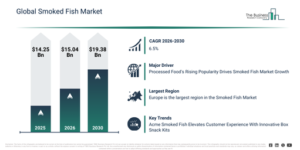
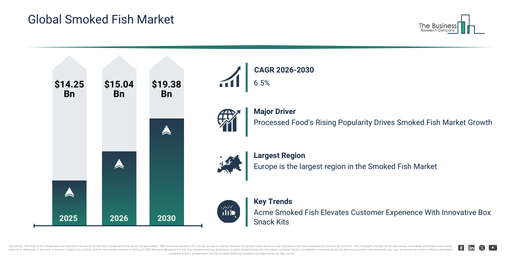
The smoked fish market has experienced significant growth in recent years. It is forecast to increase from $14.25 billion in 2025 to $15.04 billion in 2026, achieving a compound annual growth rate (CAGR) of 5.6%. The historical expansion of this market can be attributed to various elements, including established smoking preservation methods, substantial demand from the food service industry, the broadening of seafood retail channels, consumer inclination towards preserved fish, and the consistent availability of raw fish.
The smoked fish market is anticipated to experience robust expansion in the coming years. It is projected to reach $19.38 billion by 2030, demonstrating a compound annual growth rate (CAGR) of 6.5%. This projected growth during the forecast period is largely due to factors such as the escalating demand for gourmet seafood, an increase in health-aware consumers seeking protein, the proliferation of premium retail seafood options, advancements in smoking and curing methods, and the expansion of online sales for specialized food items. Key trends expected during this period involve the introduction of high-end smoked fish products, a growing appetite for convenient ready-to-eat seafood, the broadening of cold-smoked product ranges, an increasing emphasis on natural smoking processes, and improvements in packaging designed to extend shelf life.
Get A Free Sample Report With In-Depth Market Insights:
Smoked Fish Market Opportunity Drivers: What’s Unlocking New Revenue Potential?
The growing consumer demand for processed food is anticipated to drive the expansion of the smoked fish market. Processed food refers to any food item that has undergone some form of alteration or preparation before being consumed. Smoked fish has become a favored processed food option for consumers who prioritize convenience, health, and a longer shelf life. For example, in 2024, US exports of processed food products amounted to US $39.4 Billion, as reported by the US Foreign Agricultural Service. Consequently, this escalating demand for processed food will fuel the growth of the smoked fish market.
Smoked Fish Market Segment Breakdown: Which Categories Lead On Revenue?
The smoked fish market covered in this report is segmented –
1) By Product Type: Smoked Salmon, Smoked Mackerel, Smoked Herring, Smoked Trout, Other Smoked Fishes
2) By Method: Hot Smoked Fish, Cold Smoked Fish
3) By Application: Food Service Sector, Retail Sector, Institutional Consumption
Subsegments:
1) By Smoked Salmon: Cold-Smoked Salmon, Hot-Smoked Salmon
2) By Smoked Mackerel: Whole Smoked Mackerel, Filleted Smoked Mackerel
3) By Smoked Herring: Whole Smoked Herring, Filleted Smoked Herring, Hot-Smoked Herring, Cold-Smoked Herring
4) By Smoked Trout: Whole Smoked Trout, Filleted Smoked Trout
5) By Other Smoked Fishes: Smoked Cod, Smoked Eel, Smoked Sardines
Smoked Fish Market Strategic Trends: What Defines The Next Growth Phase?
Major companies in the smoked fish market are concentrating on developing novel products, such as box snack kits, to deliver reliable services to customers. A box snack kit comprises a pre-packaged assortment of snacks, typically housed in a cardboard or plastic container. For instance, in December 2023, Acme Smoked Fish, a US-based family-owned entity that produces and distributes smoked and pickled fish products, unveiled Sesame Crusted Smoked Yellowfin Tuna and Lox in a Box Snack Kits. These offerings facilitate the convenient preparation of traditional Jewish holiday-style smoked salmon at home. The significance of these launches underscores Acme’s commitment to innovation, showcasing its capability to integrate tradition with an inventive spirit, positioning the company as a leader in providing diverse and new smoked fish products that cater to the evolving needs of consumers in the smoked fish market.
Smoked Fish Market Leading Players And Competitive Positioning
Major companies operating in the smoked fish market are Acme Smoked Fish Corporation, Ducktrap River of Maine, Santa Barbara Smokehouse, Seabear Smokehouse, Honey Smoked Fish Company, Foppen Group BV, Labeyrie Fine Foods, Leroy Seafood Group, Grieg Seafood ASA, Tassal Group Limited, Multiexport Foods S.A., Empresas AquaChile S.A., Icicle Seafoods, Peter Pan Seafoods, Ocean Beauty Seafoods Inc., Coastal Seafoods, Gottfried Friedrichs KG, Cawoods Smoked Salmon Ltd., Charlie’s Smokehouse, Frank’s Smokehouse, Gerard & Dominique Seafoods, The Great Fish Co., Oregon Seafoods LLC
View The Full Smoked Fish Market Report:
Smoked Fish Market Largest Region: Which Geography Holds The Biggest Share?
Europe was the largest region in the smoked fish market in 2025. The regions covered in the smoked fish market report are Asia-Pacific, South East Asia, Western Europe, Eastern Europe, North America, South America, Middle East and Africa.
Reach Out To Our Team:
The Business Research Company: https://www.thebusinessresearchcompany.com/
Americas: +1 310-496-7795
Asia: +44 7882 955267 & +91 8897263534
Europe: +44 7882 955267
Email us at: marketing@tbrc.info
Follow us on:
LinkedIn: https://in.linkedin.com/company/the-business-research-company
YouTube: https://www.youtube.com/channel/UC24_fI0rV8cR5DxlCpgmyFQ
Global Market Model: https://www.thebusinessresearchcompany.com/global-market-model

Wasay has over a decade of experience in market research, data modelling, and analytics, with prior experience at GlobalData and Decision Tree Consulting Services. At The Business Research Company , he leads research operations across syndicated studies, customized consulting engagements, and the Global Market Model platform. His professional experience includes supporting organizations such as Boston Consulting Group, KPMG, and Ernst & Young. Wasay holds a degree in Electronics and Communications Engineering, postgraduate management qualifications from International Management Institute Belgium and Indian School of Business and Entrepreneurship, and completed the Integrated Program in Business Analytics from Indian Institute of Management Indore.