Enhanced with market attractiveness analysis, total addressable market evaluation, company benchmarking matrices, interactive Excel dashboards, expanded supply chain intelligence, emerging startup coverage, and detailed product insights, The Business Research Company’s 2026 market reports deliver more actionable and strategically valuable research.
Synthetic Food Market Expansion Outlook: What Revenue Opportunities Lie Ahead?
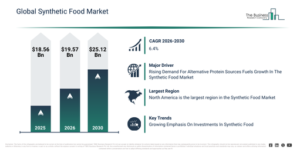
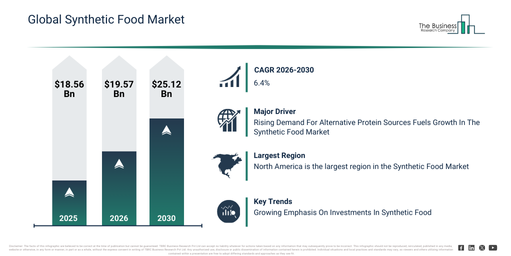
The synthetic food market size has experienced significant growth in recent years. It is projected to expand from $18.56 billion in 2025 to $19.57 billion in 2026, at a compound annual growth rate (CAGR) of 5.5%. The historic period’s growth can be attributed to various factors, including the demand for food preservation solutions, the expansion of processed food consumption, advancements in food chemistry, the availability of synthetic additives, and the growth of industrial food manufacturing.
The synthetic food market is projected to experience substantial expansion over the upcoming years. Its valuation is anticipated to reach $25.12 billion by 2030, progressing at a compound annual growth rate (CAGR) of 6.4%. This projected growth throughout the forecast period stems from factors such as increasing financial commitments to sustainable food technologies, a growing embrace of alternative proteins, the widening application of precision fermentation, an increase in regulatory authorizations, and an escalating need for food systems resilient to climate change. Key developments during this period are expected to involve the escalating creation of lab-grown food ingredients, a rise in the use of synthetic additives during food processing, the broadened utility of alternative protein applications, a heightened emphasis on minimizing environmental impact, and improved accuracy in food formulation.
Download A Free Sample Report For Comprehensive Market Insights:
Synthetic Food Market Growth Momentum: Which Factors Are Influencing Demand?
The escalating demand for alternative protein sources is projected to fuel the expansion of the synthetic food market. These alternative protein sources are derived from plants, animals, or cells produced via fermentation. The heightened desire for protein has prompted rapid innovations within the food industry, encompassing categories like lab-grown meat, plant-based meat, single-cell proteins from yeast or algae, and edible insects. Thus, alternative protein sources and synthetic food are integral to the broader movement towards fostering sustainable and healthy diets. For instance, in 2024, the International Food Information Council, a US-based nonprofit organization, revealed that the proportion of consumers looking to increase their protein intake consistently rose from 59% in 2022 to 67% in 2023 and 71% in 2024. This sustained demand for alternative protein sources is therefore a key driver for the growth of the synthetic food market.
Synthetic Food Market Segment Performance And Strategic Opportunities
The synthetic food market covered in this report is segmented –
1) By Product Type: Cultivated Meat and Poultry, Cultivated Seafood, Synthetic Dairy Products, Microbial or Fermentation-Derived Proteins, Synthetic Fats and Oils
2) By Production Technology: Cellular Agriculture, Precision Fermentation, Microbial Fermentation, Biomass Fermentation
3) By Source Material: Animal Cell-Based, Microbial-Based, Yeast-Based, Fungal-Based
4) By Distribution Channel: Supermarkets and Hypermarkets, Specialty and Alternative Protein Stores, Online Retail, Foodservice Channels
5) By Application: Meat and Poultry Alternatives, Seafood Alternatives, Dairy Alternatives, Processed and Ready-to-Eat Foods, Functional and Nutritional Foods
6) By End User: Food Manufacturers, Foodservice and HoReCa, Retail and Direct-to-Consumer
Subsegments:
1) By Cultivated Meat and Poultry: Cultivated Beef, Cultivated Chicken, Cultivated Pork, Cultivated Lamb
2) By Cultivated Seafood: Cultivated Fish, Cultivated Shrimp, Cultivated Crustaceans and Mollusks
3) By Synthetic Dairy Products: Cultured Milk Proteins, Synthetic Butter and Cream, Synthetic Cheese and Yogurt Bases
4) By Microbial or Fermentation-Derived Proteins: Mycoprotein, Yeast-Derived Proteins, Bacterial-Derived Proteins
5) By Synthetic Fats and Oils: Microbial Fats and Oils, Precision-Fermented Lipids, Cell-Cultured Fats
Synthetic Food Market Trends Reshaping Industry Growth
Major companies operating in the synthetic food market are primarily focused on investing in synthetic food to innovate and scale production methods. Their objectives include enhancing the nutritional profile of food products, meeting the increasing demand for sustainable and alternative protein sources, reducing environmental impact, and addressing food security challenges. Investments in seed funding from prominent investors across the biotech and foodtech sectors are specifically aiming to revolutionize the alternative meat industry with innovative solutions. For instance, in April 2024, Cultimate Foods, a Berlin-based company that manufactures food products, secured USD 2.48 million (€2.3 million) in seed funding. This capital is intended to enhance its production capabilities and expand its operations within the alternative meat industry. The startup underscores that its technology not only improves flavor but also contributes to decreasing reliance on intensive animal farming and mitigating climate change by lowering CO2 emissions.
Synthetic Food Market Key Players: Which Companies Shape Industry Competition?
Major companies operating in the synthetic food market are UPSIDE Foods Inc., Mosa Meat, Aleph Farms Ltd., Believer Meats, GOOD Meat, SuperMeat, Meatable, IntegriCulture Inc., Finless Foods, BlueNalu, Wildtype Foods, Shiok Meats, Orbillion Bio, Future Meat Technologies, New Age Meats, Perfect Day, Remilk, Formo, Change Foods, The EVERY Company
Access The Complete Synthetic Food Market Report:
#Synthetic Food Market Largest Region: Which Geography Holds The Highest Market Share?
North America was the largest region in the synthetic food market in 2025. The regions covered in the synthetic food market report are Asia-Pacific, South East Asia, Western Europe, Eastern Europe, North America, South America, Middle East and Africa.
Get in touch with us:
The Business Research Company: https://www.thebusinessresearchcompany.com/
Americas: +1 310-496-7795
Asia: +44 7882 955267 & +91 8897263534
Europe: +44 7882 955267
Email us at: marketing@tbrc.info
Follow us on:
LinkedIn: https://in.linkedin.com/company/the-business-research-company
YouTube: https://www.youtube.com/channel/UC24_fI0rV8cR5DxlCpgmyFQ
Global Market Model: https://www.thebusinessresearchcompany.com/global-market-model

Wasay has over a decade of experience in market research, data modelling, and analytics, with prior experience at GlobalData and Decision Tree Consulting Services. At The Business Research Company , he leads research operations across syndicated studies, customized consulting engagements, and the Global Market Model platform. His professional experience includes supporting organizations such as Boston Consulting Group, KPMG, and Ernst & Young. Wasay holds a degree in Electronics and Communications Engineering, postgraduate management qualifications from International Management Institute Belgium and Indian School of Business and Entrepreneurship, and completed the Integrated Program in Business Analytics from Indian Institute of Management Indore.