Backed by market attractiveness analysis, total addressable market sizing, company benchmarking matrices, interactive Excel dashboards, wider supply chain intelligence, emerging startup coverage, and detailed product-level insights, The Business Research Company’s 2026 market reports are designed to offer research that is more actionable and strategically valuable than ever.
Tuna Fish Market Expansion Outlook: What Revenue Opportunities Are Ahead?
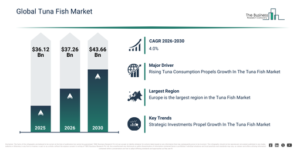
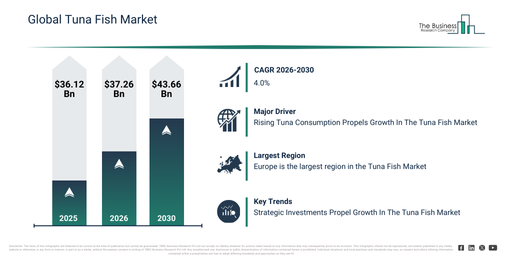
The tuna fish market has shown consistent expansion in recent years. Its size is expected to increase from $36.12 billion in 2025 to $37.26 billion in 2026, achieving a compound annual growth rate (CAGR) of 3.1%. This historical development can be ascribed to several factors, including broader seafood consumption, an increase in canned fish processing capacity, a growing dependence on tuna as a protein source, enhanced cold chain logistics, and a rise in commercial fishing activities.
The tuna fish market is projected to experience consistent expansion over the upcoming years. Its valuation is anticipated to reach $43.66 billion by 2030, exhibiting a compound annual growth rate (CAGR) of 4.0%. This expansion during the projection period stems from factors such as a heightened demand for certified sustainable seafood, increasing capital expenditure in cold storage facilities, an broader array of premium tuna products, a greater emphasis on technologies for seafood traceability, and rising consumption in developing economies. Key developments expected throughout the forecast timeframe include the wider adoption of sustainable fishing methods, a growing need for traceable seafood items, the increasing appeal of convenient ready-to-eat tuna options, the growth of frozen tuna distribution networks, and an improved focus on maintaining quality.
Get A Free Sample Report With In-Depth Market Insights:
Tuna Fish Market Growth Momentum: What Factors Are Shaping Demand?
The escalating consumption of tuna is a significant contributor to the future expansion of the tuna fish market. Tuna refers to any of the seven species of commercially valuable, often large, oceanic fishes belonging to the genus Thunnus, prized as food. Its consumption is driven by its nutritional content, ease of use, and adaptability in cooking, being a rich source of omega-3 fatty acids, protein, and other vital nutrients. For example, according to the Marine Management Organisation (MMO), a UK-based government body, the UK imported 107.0 thousand tonnes of tuna in 2024, an increase of 14.2 thousand tonnes, or 15%, over 2023. This demonstrates how increasing tuna consumption is set to propel the tuna fish market.
Tuna Fish Market Segmentation And Category Overview
The tuna fish market covered in this report is segmented –
1) By Type: Canned, Fresh, Frozen
2) By Species: Skipjack, Yellowfin, Albacore, Bigeye, Bluefin, Other Species
3) By Distribution Channel: Supermarkets And Hypermarkets, Convenience Stores, Online Retails, Other Channels
Subsegments:
1) By Canned: Chunk Light Tuna, Solid White Tuna, Albacore Tuna, Specialty Varieties
2) By Fresh: Yellowfin Tuna, Bluefin Tuna, Albacore Tuna, Other Fresh Varieties
3) By Frozen: Whole Frozen Tuna, Filleted Frozen Tuna, Portion Frozen Tuna
Tuna Fish Market Trends Shaping Long-Term Demand
Companies operating within the tuna fish market are prioritizing strategic investments to bolster their market presence. Strategic investments denote the intentional and systematic allocation of financial resources to attain specific long-term aims or objectives within a business or organizational framework. For instance, in October 2023, BlueNalu, a US-based producer of cell-cultured seafood, successfully completed a $33.5 million Series B funding round and deepened its collaborations with prominent seafood companies in the Asia-Pacific (APAC) region. This initiative aims to launch its cell-cultured bluefin tuna into the market once it secures regulatory approval. The funding received will aid BlueNalu in scaling its growth and delivering sustainable seafood options.
Tuna Fish Market Competitive Analysis Of Leading Industry Participants
Major companies operating in the tuna fish market are Bolton Group, ITOCHU Corporation, Thai Union Group Inc., Dongwon Enterprises Co. Ltd., FCF Co. Ltd., Crown Prince Inc., Mitsubishi Corporation, American Tuna Company, Alliance Select Foods Inc., Wild Planet Foods Inc., Century Pacific Foods Inc., The Jealsa Rianxeira S. AU. Group, Grupo Albacore S.A., IBL Ltd., Sea Delight, Tri Marine Group, StarKist Tuna, Clover Leaf Seafoods Corp., Bumble Bee Foods LLC, Frinsa del Noroeste S.A., A.E.C. Canning Company Limited, Ocean Brands, Balfegó Group, Mareblu SRL, Fish4Ever, John West Foods, Princes Group, Bajamar, Rio Mare
View The Full Tuna Fish Market Report:
Tuna Fish Market Geographic Analysis: Where Is Demand Rising Fastest?
Europe was the largest region in the tuna fish market in 2025.Asia-Pacific is expected to be the fastest-growing region in the tuna fish market report during the forecast period. The regions covered in the tuna fish market report are Asia-Pacific, South East Asia, Western Europe, Eastern Europe, North America, South America, Middle East and Africa.
Reach Out To Our Team:
The Business Research Company: https://www.thebusinessresearchcompany.com/
Americas: +1 310-496-7795
Asia: +44 7882 955267 & +91 8897263534
Europe: +44 7882 955267
Email us at: marketing@tbrc.info
Follow us on:
LinkedIn: https://in.linkedin.com/company/the-business-research-company
YouTube: https://www.youtube.com/channel/UC24_fI0rV8cR5DxlCpgmyFQ
Global Market Model: https://www.thebusinessresearchcompany.com/global-market-model

Wasay has over a decade of experience in market research, data modelling, and analytics, with prior experience at GlobalData and Decision Tree Consulting Services. At The Business Research Company , he leads research operations across syndicated studies, customized consulting engagements, and the Global Market Model platform. His professional experience includes supporting organizations such as Boston Consulting Group, KPMG, and Ernst & Young. Wasay holds a degree in Electronics and Communications Engineering, postgraduate management qualifications from International Management Institute Belgium and Indian School of Business and Entrepreneurship, and completed the Integrated Program in Business Analytics from Indian Institute of Management Indore.