Built to provide research that’s more actionable and strategically valuable, The Business Research Company’s 2026 market reports include market attractiveness analysis, total addressable market sizing, company benchmarking matrices, interactive Excel dashboards, broader supply chain intelligence, emerging startup tracking, and in-depth product insights.
Alternative Proteins Market Size Outlook: How Quickly Will Revenue Expand Through 2030?
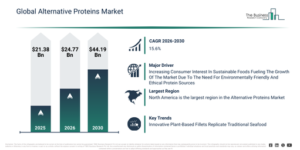
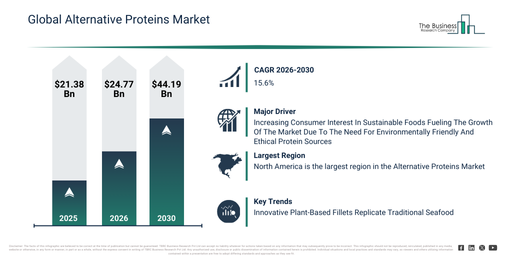
The alternative proteins market has experienced substantial growth in recent years. Its valuation is projected to climb from $21.38 billion in 2025 to $24.77 billion in 2026, reflecting a compound annual growth rate (CAGR) of 15.9%. The market’s past expansion is attributable to factors like increasing consumer awareness, a surge in demand for plant-based proteins, rising health consciousness, the expansion of retail channels, and the embrace of sustainable diets.
The alternative proteins market is projected to experience substantial growth in the coming years. Its value is estimated to reach $44.19 billion by 2030, demonstrating a compound annual growth rate (CAGR) of 15.6%. This expansion during the forecast period can be attributed to heightened investment in cellular agriculture, the increasing adoption of fermentation-derived proteins, the rise of flexitarian and vegan lifestyles, the broadening of product portfolios, and a sharpened focus on environmental sustainability. Key trends anticipated in this period include technological advancements in protein production, novel plant-based formulations, ongoing research and development in cultured meat, the creation of hybrid protein products, and progress in processing and food technology.
Get A Free Sample Report With In-Depth Market Insights:
Alternative Proteins Market Development Factors: What’s Supporting Demand?
Future expansion of the alternative proteins market is anticipated to be driven by consumers’ growing demand for sustainable food options. Sustainable foods are defined as edibles created using methods that lessen environmental harm, preserve natural resources, and encourage responsible and wholesome eating habits. This increasing consumer focus on sustainable food products stems primarily from heightened environmental consciousness and worries about climate change, motivating individuals to lessen the ecological footprint of what they consume. Alternative proteins contribute to sustainable food systems by offering eco-friendly protein sources like plant-derived, microbe-based, or cultivated varieties, thereby decreasing dependence on conventional animal farming. These alternatives enhance food sustainability through reduced greenhouse gas output, preservation of water and land assets, and advocacy for ethical food manufacturing practices. As an illustration, data from April 2025, supplied by the Department for Environment, Food & Rural Affairs, a UK-based government agency, showed that the UK organic food and drink sector achieved sales of approximately £3.7 billion in 2024, marking a 7.3% rise from 2023. Consequently, the heightened consumer demand for sustainable foods is fueling the expansion of the alternative proteins market.
Alternative Proteins Market Segment Analysis And Revenue Potential
The alternative proteins market covered in this report is segmented –
1) By Type: Plant Based Proteins, Cultured Meat, Fermentation Derived Proteins, Insect Based Proteins, Algae Based Proteins
2) By Source: Soy, Pea, Wheat, Microbial, Other Sources
3) By Form: Powder, Liquid, Frozen, Ready To Eat
4) By Distribution Channel: Supermarkets And Hypermarkets, Online Retail, Food Service, Specialty Stores
5) By Application: Food And Beverage, Cattle, Aquaculture, Animal Feed, Pet Food, Equine, Other Applications
Subsegments:
1) By Plant Based Proteins: Soy, Wheat, Pea, Rice, Potato, Canola, Corn, Other Sources
2) By Cultured Meat: Poultry, Beef, Pork, Seafood, Other Meat Types
3) By Fermentation Derived Proteins: Traditional Fermentation, Biomass Fermentation, Precision Fermentation
4) By Insect Based Proteins: Crickets, Black Soldier Flies, Mealworms, Other Insects
5) By Algae Based Proteins: Microalgae, Macroalgae
Alternative Proteins Market Transformation Trends: What Innovations Are Driving Change?
Leading companies within the alternative proteins market are prioritizing the creation of advanced products, including plant-derived seafood alternatives. This focus is driven by the aim to enhance sensory attributes, diversify available options, and offer sustainable substitutes for traditional fish and shellfish. These plant-based seafood analogs leverage botanical proteins and sophisticated formulation methods to replicate the texture, flavor, and nutritional profile of conventional seafood while simultaneously lowering environmental impact. For instance, in August 2025, Slovenia’s Juicy Marbles, a brand specializing in plant-based steak and seafood, collaborated with Austria’s Revo Foods GmbH, an alternative protein expert, to introduce Kinda Salmon. This plant-based salmon fillet is meticulously designed to mirror the texture, color, and taste of conventional salmon, without any animal ingredients. This expansion exemplifies how companies are innovating beyond typical plant-based meats into seafood alternatives to address evolving consumer preferences and sustainability goals. Therefore, the ongoing trend of next-generation plant-based seafood launches is significantly influencing the dynamics of the alternative proteins market.
Alternative Proteins Market Key Players Shaping Industry Direction
Major companies operating in the alternative proteins market are Amy’s Kitchen Inc., Beyond Meat Inc., Impossible Foods Inc., PURIS LLC, Eat Just Inc., UPSIDE Foods Inc., v2food Pty Ltd., Lightlife Foods Inc., Nature’s Fynd Inc., Atlantic Natural Foods LLC, Garden Protein International Inc., Aspire Food Group LLC, GoodDot Enterprises Private Limited, Mosa Meat B.V., Calysta Inc., Entomo Farms Inc., Sophie’s Kitchen Inc., Novameat Tech S.L., Mission Barns Inc., Believer Meats Ltd., Steakholder Foods Ltd., Air Protein Inc., Phycom B.V., Perfect Day Inc.
View The Full Alternative Proteins Market Report:
Alternative Proteins Market Regional Analysis: Which Geography Leads On Revenue?
North America was the largest region in the alternative proteins market in 2025. Asia-Pacific is expected to be the fastest-growing region in the forecast period. The regions covered in the alternative proteins market report are Asia-Pacific, South East Asia, Western Europe, Eastern Europe, North America, South America, Middle East, Africa.
Reach Out To Our Team:
The Business Research Company: https://www.thebusinessresearchcompany.com/
Americas: +1 310-496-7795
Asia: +44 7882 955267 & +91 8897263534
Europe: +44 7882 955267
Email us at: marketing@tbrc.info
Follow us on:
LinkedIn: https://in.linkedin.com/company/the-business-research-company
YouTube: https://www.youtube.com/channel/UC24_fI0rV8cR5DxlCpgmyFQ
Global Market Model: https://www.thebusinessresearchcompany.com/global-market-model

Wasay has over a decade of experience in market research, data modelling, and analytics, with prior experience at GlobalData and Decision Tree Consulting Services. At The Business Research Company , he leads research operations across syndicated studies, customized consulting engagements, and the Global Market Model platform. His professional experience includes supporting organizations such as Boston Consulting Group, KPMG, and Ernst & Young. Wasay holds a degree in Electronics and Communications Engineering, postgraduate management qualifications from International Management Institute Belgium and Indian School of Business and Entrepreneurship, and completed the Integrated Program in Business Analytics from Indian Institute of Management Indore.