Backed by market attractiveness analysis, total addressable market sizing, company benchmarking matrices, interactive Excel dashboards, wider supply chain intelligence, emerging startup coverage, and detailed product-level insights, The Business Research Company’s 2026 market reports are designed to offer research that is more actionable and strategically valuable than ever.
Ambient Food Market Forecast: Value Set To Climb From $93.96 Billion To $118.3 Billion
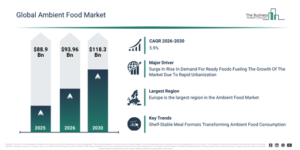
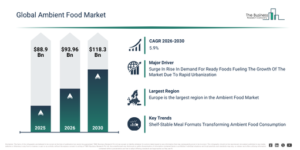
The ambient food market size has shown robust growth over recent years. It is anticipated to expand from $88.9 billion in 2025 to $93.96 billion in 2026, exhibiting a compound annual growth rate (CAGR) of 5.7%. The expansion observed in the past can be ascribed to an increase in canned and preserved food consumption, the proliferation of supermarket and hypermarket distribution, insufficient cold chain infrastructure in developing regions, rising urbanization and busy lifestyles, and the development of packaged food manufacturing capabilities.
The ambient food market is anticipated to show significant expansion over the next few years. It is forecast to grow to $118.3 billion by 2030, achieving a compound annual growth rate (CAGR) of 5.9%. This projected growth can be attributed to factors such as increasing consumer preference for convenience and on-the-go nutrition, the development of sustainable and eco-friendly packaging solutions, the greater adoption of advanced food preservation technologies, the rise of online grocery and quick commerce platforms, and an enhanced focus on food safety and regulatory compliance. Major trends expected during this forecast period include the demand for clean label and preservative-free ambient foods, the diversification of shelf-stable ready-to-eat meal offerings, advancements in aseptic and advanced thermal processing technologies, a rising interest in plant-based ambient packaged foods, and the increasing usage of e-commerce grocery channels for ambient food products.
Get A Free Sample Report With In-Depth Market Insights:
Ambient Food Market Growth Drivers: What’s Behind The Acceleration?
The increasing consumer preference for ready-to-eat foods is anticipated to fuel the expansion of the ambient food market in the coming period. These convenience foods encompass pre-cooked or pre-packaged meals and snacks, intended for instant consumption or rapid reheating, requiring no further preparation. The escalating demand for ready foods stems from factors such as swift urbanization, changing consumer habits, and demanding work schedules, all of which substantially limit the time for conventional cooking and thus foster a preference for easily accessible food choices. Ambient food items cater to this need by providing shelf-stable, convenient nutritional options that do not need refrigeration, thereby improving storage simplicity and availability. For instance, figures released in April 2024 by the National Association of Convenience Stores (NACS), a trade association based in the US, indicated that total industry foodservice sales—including prepared food, commissary goods, and dispensed drinks—represented 26.9% of in-store sales in 2023, a rise from 25.6% in 2022. Additionally, prepared food sales per store each month saw an increase of 12.2%. Consequently, the increased consumption of ready foods is propelling the expansion of the ambient food market.
Ambient Food Market Segments: Where Is Growth Concentrated?
The ambient food market covered in this report is segmented –
1) By Product Type: Ambient Dairy And Dairy Alternatives, Ambient Bakery And Cereal Products, Ambient Snacks And Confectionery, Ambient Meals And Ready-To-Eat Foods, Ambient Sauces, Condiments, And Spreads
2) By Preservation Technique: Thermal Sterilization, Pasteurization, Dehydration, Freeze Drying
3) By Packaging Type: Metal Cans, Glass Jars, Retort Pouches, Plastic Packaging, Other Packaging Types
4) By Distribution Channel: Supermarkets And Hypermarkets, Convenience Stores, Online Retail, Specialty Stores
5) By Application: Household Consumption, Foodservice Industry, Institutional Use
Subsegments:
1) By Ambient Dairy And Dairy Alternatives: Ambient Milk, Ambient Flavored Milk, Ambient Yogurt, Ambient Plant-Based Milk Alternatives, Ambient Dairy Desserts
2) By Ambient Bakery And Cereal Products: Ambient Bread Products, Ambient Cakes And Pastries, Ambient Biscuits And Cookies, Ambient Breakfast Cereals, Ambient Snack Bars
3) By Ambient Snacks And Confectionery: Ambient Savory Snacks, Ambient Sweet Snacks, Ambient Chocolate Confectionery, Ambient Sugar Confectionery, Ambient Nut-Based Snacks
4) By Ambient Meals And Ready-To-Eat Foods: Ambient Pasta Meals, Ambient Rice-Based Meals, Ambient Meat-Based Meals, Ambient Vegetarian Meals, Ambient Ethnic Cuisine Meals
5) By Ambient Sauces, Condiments, And Spreads: Ambient Cooking Sauces, Ambient Table Sauces, Ambient Dressings, Ambient Jams And Preserves, Ambient Nut And Seed Spreads
Ambient Food Market Trends: What’s Defining The Industry’s Next Phase?
Companies primarily engaged in the ambient food market are increasingly directing their efforts toward ready-to-eat, shelf-stable meal solutions presented in innovative pouch formats, aiming to enhance convenience and broaden their plant-based product lines. These ambient pouch meals are specifically designed for storage at room temperature, facilitating quick, microwaveable preparation, thereby offering an extended shelf life combined with ease of use and minimal storage space requirements. This strategy resonates with the escalating consumer demand for convenient, nutritious, and globally inspired meal choices that complement modern lifestyles without needing refrigeration. For example, in February 2025, Leon, a UK-based food brand, expanded its retail offerings by introducing new frozen and ambient microwaveable pouch products, which included plant-based dishes such as Brazilian Black Beans, Keralan Lentil & Chickpea Curry, and katsu-style curries. These particular products are strategically located in the ambient grocery aisle, providing ready-to-heat meal options characterized by extended shelf stability. This progression supports the broader shift towards convenient and plant-based ambient food solutions; however, continuous growth might be contingent on upholding taste quality and positive consumer perception when compared to fresh or chilled food alternatives.
Ambient Food Market Key Participants And Competitive Landscape
Major companies operating in the ambient food market are Nestlé S.A., Unilever PLC, Mars Incorporated, The Kraft Heinz Company, Grupo Bimbo S.A.B. de C.V., General Mills Inc., Conagra Brands Inc., Hormel Foods Corporation, Ajinomoto Co. Inc., The Campbell’s Company, ITC Limited, Dole plc, MTR Foods Private Limited, Orkla ASA, Del Monte Foods Inc., Bonduelle SCA, The Hain Celestial Group Inc., Premier Foods plc, Amy’s Kitchen Inc., Tingyi (Cayman Islands) Holding Corp.
View The Full Ambient Food Market Report:
Ambient Food Market Geographic Analysis: Where Is Demand Rising Fastest?
Europe was the largest region in the ambient food market in 2025. Asia-Pacific is expected to be the fastest-growing region in the forecast period. The regions covered in the ambient food market report are Asia-Pacific, South East Asia, Western Europe, Eastern Europe, North America, South America, Middle East, Africa.
Reach Out To Our Team:
The Business Research Company: https://www.thebusinessresearchcompany.com/
Americas: +1 310-496-7795
Asia: +44 7882 955267 & +91 8897263534
Europe: +44 7882 955267
Email us at: marketing@tbrc.info
Follow us on:
LinkedIn: https://in.linkedin.com/company/the-business-research-company
YouTube: https://www.youtube.com/channel/UC24_fI0rV8cR5DxlCpgmyFQ
Global Market Model: https://www.thebusinessresearchcompany.com/global-market-model

Wasay has over a decade of experience in market research, data modelling, and analytics, with prior experience at GlobalData and Decision Tree Consulting Services. At The Business Research Company , he leads research operations across syndicated studies, customized consulting engagements, and the Global Market Model platform. His professional experience includes supporting organizations such as Boston Consulting Group, KPMG, and Ernst & Young. Wasay holds a degree in Electronics and Communications Engineering, postgraduate management qualifications from International Management Institute Belgium and Indian School of Business and Entrepreneurship, and completed the Integrated Program in Business Analytics from Indian Institute of Management Indore.