Built to provide research that’s more actionable and strategically valuable, The Business Research Company’s 2026 market reports include market attractiveness analysis, total addressable market sizing, company benchmarking matrices, interactive Excel dashboards, broader supply chain intelligence, emerging startup tracking, and in-depth product insights.
Canned Vegetable Market Value Analysis: What Growth Lies Ahead Over The Forecast Period?
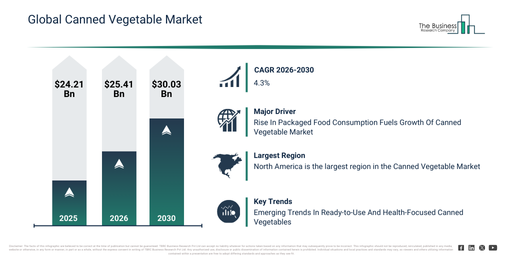
The canned vegetable market has demonstrated consistent expansion in recent times. Its valuation is anticipated to climb from $24.21 billion in 2025 to $25.41 billion in 2026, reflecting a compound annual growth rate (CAGR) of 5.0%. The historical growth of this market can be attributed to various factors, including evolving consumption patterns in growing urban populations, the widening reach of organized retail food distribution, an increased reliance on preserved food products, continuous advancements in food canning technology, and the rising consumer demand for convenient food solutions.
The canned vegetable market size is projected to experience consistent expansion over the upcoming years, reaching $30.03 billion in 2030 at a compound annual growth rate (CAGR) of 4.3%. This anticipated growth during the forecast period is attributable to several factors, including the escalating demand for clean-label canned food products, increased capital expenditure in sophisticated food processing machinery, a growing consumer preference for convenient ready-to-eat vegetables, the widening reach of e-commerce grocery platforms, and a heightened emphasis on packaging solutions that are recyclable. Key trends anticipated during the forecast period encompass a greater uptake of sustainable packaging materials, an escalating need for vegetable products with extended shelf lives, an intensified focus on technologies designed for nutrient retention, the proliferation of automated canning and processing lines, and a reinforced commitment to food safety and traceability.
Get A Free Sample Report With In-Depth Market Insights:
Canned Vegetable Market Demand Drivers Opening New Revenue Streams
The expanding consumption of diverse packaged food items is anticipated to fuel the expansion of the canned vegetable market in the coming years. Packaged food encompasses products that are processed, preserved, and sealed in containers for ease, extended shelf life, and distribution, frequently comprising a variety of pre-prepared or ready-to-eat meals, snacks, and ingredients. The demand for packaged food products is increasing due to evolving lifestyles, a need for convenience, and the globalization of food markets, presenting a wide array of choices to consumers looking for fast and simple meal solutions. Canned vegetables contribute to easier meal preparation and improved taste. For example, a report released by Euromonitor International, a UK-based research and analysis organization, in June 2023, indicated that projected retail sales of packaged foods in Japan are set to reach $235.9 billion by 2026, representing a 9.1% rise or a $19.6 billion increase over 2022 levels. Consequently, the growing intake of various packaged food products is a key driver for the canned vegetable market’s growth.
Canned Vegetable Market Segmentation And Category Overview
The canned vegetable market covered in this report is segmented –
1) By Type: Sliced, Peeled, Other Types
2) By Distribution Channel: Store-Based, Non-Store-Based
3) By Application: Culinary, Salads And Soups, Toppings And Dressings, Other Applications
Subsegments:
1) By Sliced: Sliced Carrots, Sliced Mushrooms, Sliced Potatoes, Sliced Beets, Sliced Tomatoes
2) By Peeled: Peeled Tomatoes, Peeled Potatoes, Peeled Carrots, Peeled Green Beans
3) By Other Types: Whole Vegetables, Diced Vegetables, Chopped Vegetables, Mixed Vegetables, Pureed Vegetables
Canned Vegetable Market Trends Powering Strategic Industry Growth
Leading businesses within the Canned Vegetable Market are prioritizing the creation of a diverse range of convenience-focused and health-conscious canned vegetable and vegetable-blend items. This strategy addresses the growing need for produce that is ready-to-use and shelf-stable among busy city dwellers, developing regions with scarce fresh produce, and foodservice establishments requiring dependable quality and consistent supply. These contemporary canned vegetable options frequently include mixed-vegetable purées, vegetable blends (occasionally enriched with ingredients such as chia or nuts for improved nutrition), and convenient ready-to-eat soup or purée presentations. This marks a departure from conventional plain canned vegetables (single-vegetable cans) which previously necessitated washing, chopping, or further preparation and offered less adaptability. An example of this trend is seen in June 2025, when Countree Food, a China-based canned-food manufacturer, formally introduced new items like a “Veggies Mix Purée with Chia,” “Truffle Cream of Mushroom Soup,” and a ready-to-go “Nut-Mix with Chia” during the 2025 trade-show circuit, which encompassed Europe’s PLMA Amsterdam and Southeast Asia’s THAIFEX–Anuga Asia. The Veggies Mix Purée and soup-format offerings are crafted for ease of use, delivering pre-processed, ready-to-heat or ready-to-use vegetables and blends. These innovations cut down on preparation time, streamline meal creation, and guarantee uniform nutrition and flavor, particularly benefiting households, busy professionals, or areas with restricted access to fresh vegetables. Countree Food’s diversified product formats and its aggressive presence at trade shows highlight a significant change in the wider market: both consumers and foodservice purchasers are increasingly prioritizing convenience, extended shelf life, and diverse options over standard bulk-vegetable cans.
Canned Vegetable Market Competitive Analysis Of Leading Industry Participants
Major companies operating in the canned vegetable market are Nestlé S.A., The Kraft Heinz Company, Dole plc, Del Monte Foods Inc., TreeHouse Foods Inc., Bonduelle SA, Whole Foods Market Inc., B&G Foods Inc., Goya Foods Inc., Seneca Foods Corporation, Hanover Foods Corp., Century Pacific Food Inc., Landec Corporation, CHB Group, Ban Mai company, Planet Green Holdings Corp., Cento Fine Foods Inc., Ayam Brand, Edinborough Products (Pvt) Limited, Libby’s, Farmer’s Market Foods, Mediterranea Belfiore SRL
View The Full Canned Vegetable Market Report:
Canned Vegetable Market Geographic Landscape: Which Region Leads Industry Growth?
North America was the largest region in the canned vegetable market in 2025. Asia-Pacific is expected to be the fastest-growing region in the forecast period. The regions covered in the canned vegetable market report are Asia-Pacific, South East Asia, Western Europe, Eastern Europe, North America, South America, Middle East and Africa.
Reach Out To Our Team:
The Business Research Company: https://www.thebusinessresearchcompany.com/
Americas: +1 310-496-7795
Asia: +44 7882 955267 & +91 8897263534
Europe: +44 7882 955267
Email us at: marketing@tbrc.info
Follow us on:
LinkedIn: https://in.linkedin.com/company/the-business-research-company
YouTube: https://www.youtube.com/channel/UC24_fI0rV8cR5DxlCpgmyFQ
Global Market Model: https://www.thebusinessresearchcompany.com/global-market-model

Wasay has over a decade of experience in market research, data modelling, and analytics, with prior experience at GlobalData and Decision Tree Consulting Services. At The Business Research Company , he leads research operations across syndicated studies, customized consulting engagements, and the Global Market Model platform. His professional experience includes supporting organizations such as Boston Consulting Group, KPMG, and Ernst & Young. Wasay holds a degree in Electronics and Communications Engineering, postgraduate management qualifications from International Management Institute Belgium and Indian School of Business and Entrepreneurship, and completed the Integrated Program in Business Analytics from Indian Institute of Management Indore.