The Business Research Company’s 2026 market reports combine market attractiveness scoring, total addressable market sizing, company benchmarking matrices, interactive Excel dashboards, deeper supply chain intelligence, emerging startup tracking, and granular product-level insights to deliver research that is more actionable and strategically valuable.
Carbonated Beverage Market Size Trajectory: Key Numbers Every Industry Stakeholder Should Know
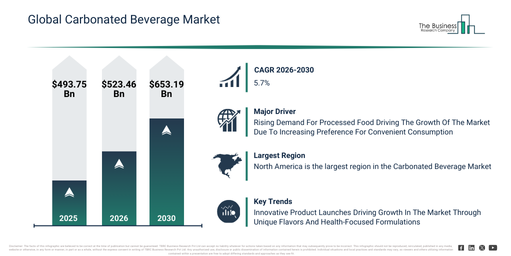
The carbonated beverage market has seen strong growth in recent years. It is forecast to expand from $493.75 billion in 2025 to $523.46 billion in 2026, achieving a compound annual growth rate (CAGR) of 6.0%. This past growth can be ascribed to several factors, including the expansion of mass-market soft drink consumption, robust brand-led beverage marketing, the development of retail beverage distribution networks, widespread adoption of PET bottling, and increasing demand from urban consumers.
The carbonated beverage market size is anticipated to experience robust expansion over the coming years. This market is projected to reach $653.19 billion by 2030, exhibiting a compound annual growth rate (CAGR) of 5.7%. The increase during this forecast period can be attributed to several factors, including consumers’ growing preference for health-conscious beverages, the proliferation of functional and fortified carbonated drinks, increasing capital expenditure in eco-friendly packaging, wider adoption of online beverage purchasing, and a rising desire for high-end and craft carbonated options. Key trends anticipated in the same period involve a heightened demand for carbonated beverages with reduced sugar content, an increase in diverse flavored and functional carbonated options, the growing appeal of upscale sparkling water, a sharpened emphasis on environmentally friendly packaging solutions, and the development of direct-to-consumer sales channels for beverages.
Looking For Reliable Carbonated Beverage Market Data? Request A Free Sample:
What Is Behind The Rising Demand In The Carbonated Beverage Market?
The increasing consumer preference for processed food and beverage items is anticipated to fuel the expansion of the carbonated beverage market moving forward. Processed food and beverages encompass products that have undergone alterations from their original state through physical or chemical processes to enhance their shelf life, flavor, or convenience. The need for these processed items is rising as busy urban lifestyles lead consumers to seek quick and easy meal solutions requiring minimal preparation. Carbonated beverages serve as a suitable accompaniment to processed food and beverage offerings, providing convenient, ready-to-drink options that align with the on-the-go consumption habits prevalent among modern consumers. For instance, in July 2025, data from the Canada-based government body, the Agriculture and Agri-Food Department Canada, indicated that in 2024, the food and beverage processing sector maintained its position as Canada’s largest manufacturing industry by production value, generating $173.4 billion in goods. This sum represented 20.3% of all manufacturing sales and contributed 1.6% to the national GDP. Exports of processed food and beverage products achieved a record value of $59.8 billion, reflecting a 3.8% increase from 2023, and accounted for 34.5% of the industry’s total production value. Therefore, the growing demand for processed food and beverage products is stimulating the growth of the carbonated beverage market.
Carbonated Beverage Market Segment Coverage And Subsegment Analysis
The carbonated beverage market covered in this report is segmented –
1) By Product: Carbonated Soft Drinks, Carbonated Water, Carbonated Sports And Energy Drinks, Other Products
2) By Flavor: Cola, Fruit Based, Other Flavors
3) By Packaging Type: Cans, Bottles, Polyethylene Terephthalate (PET) Bottles
4) By Distribution Channel: Hypermarkets And Supermarkets, Convenience Stores, Food Service Outlets, Transport Terminals, Online Stores And Direct-To-Consumer (D2C)
Subsegments:
1) By Carbonated Soft Drinks: Cola-Based Drinks, Citrus-Based Drinks, Fruit-Flavored Drinks, Root Beer, Ginger Ale
2) By Carbonated Water: Flavored Carbonated Water, Unflavored Carbonated Water, Tonic Water, Club Soda, Seltzer Water
3) By Carbonated Sports And Energy Drinks: Caffeinated Energy Drinks, Non-Caffeinated Energy Drinks, Isotonic Sports Drinks, Hypotonic Sports Drinks, Hypertonic Sports Drinks
4) By Other Products: Carbonated Tea-Based Beverages, Carbonated Coffee-Based Beverages, Alcoholic Carbonated Mixers, Fermented Carbonated Beverages
Carbonated Beverage Market Future Trends: Where Is The Industry Heading?
Leading firms within the carbonated beverage market are concentrating on creating novel and inventive carbonated drinks, including lightly carbonated options, to boost consumer attraction and broaden their range of products. These lightly carbonated drinks contain a subtle amount of effervescence, providing a delicate fizz that feels milder and less strong compared to conventional carbonated sodas. As an example, in October 2024, Asahi Soft Drinks Co., Ltd., a beverage enterprise based in Japan, introduced BE, a fresh lightly carbonated drink, specifically aimed at Generation Z. This product presents three variants aligned with moods: BE SUNNY (grape juice with rosemary oil), BE FOCUSED (grapefruit juice with lemongrass), and BE RELAXED (apple juice with mint), crafted to assist consumers in aligning with various emotional conditions. Developed utilizing direct input from Gen Z via workshops and surveys, BE showcases appealing, convenient packaging and adopts a ‘tuning drink’ philosophy, enabling users to alter their moods and fully appreciate their experiences. This introduction underscores Asahi’s dedication to providing creative, lifestyle-oriented beverages for younger, health-aware demographics.
Carbonated Beverage Market Top Players List For 2026
Major companies operating in the carbonated beverage market are Nestlé S.A, PepsiCo Inc., The Coca-Cola Company, Danone S.A., The Kraft Heinz Company, Suntory Holdings Limited, Asahi Group Holdings Ltd., Keurig Dr Pepper Inc., Red Bull GmbH, Refresco Group, Monster Energy Company, ANADOLU GRUBU A.Ş., Döhler GmbH, Britvic plc, National Beverage Corp., AriZona Beverages USA LLC, Parle Agro Private Limited, A.G. Barr plc, F&N Foods Pte Ltd, Reed’s Inc., Jones Soda Co., Cott Corporation, GreenFizz Beverages Pvt Ltd.
Order Your Copy Of The Carbonated Beverage Market Report 2026:
How Does The Carbonated Beverage Market Vary By Region?
North America was the largest region in the carbonated beverage market in 2025. Asia-Pacific is expected to be the fastest-growing region in the forecast period. The regions covered in the carbonated beverage market report are Asia-Pacific, South East Asia, Western Europe, Eastern Europe, North America, South America, Middle East and Africa.
Reach Out To Our Team:
The Business Research Company: https://www.thebusinessresearchcompany.com/
Americas: +1 310-496-7795
Asia: +44 7882 955267 & +91 8897263534
Europe: +44 7882 955267
Email us at: marketing@tbrc.info
Follow us on:
LinkedIn: https://in.linkedin.com/company/the-business-research-company
YouTube: https://www.youtube.com/channel/UC24_fI0rV8cR5DxlCpgmyFQ
Global Market Model: https://www.thebusinessresearchcompany.com/global-market-model

Wasay has over a decade of experience in market research, data modelling, and analytics, with prior experience at GlobalData and Decision Tree Consulting Services. At The Business Research Company , he leads research operations across syndicated studies, customized consulting engagements, and the Global Market Model platform. His professional experience includes supporting organizations such as Boston Consulting Group, KPMG, and Ernst & Young. Wasay holds a degree in Electronics and Communications Engineering, postgraduate management qualifications from International Management Institute Belgium and Indian School of Business and Entrepreneurship, and completed the Integrated Program in Business Analytics from Indian Institute of Management Indore.