Built to provide research that’s more actionable and strategically valuable, The Business Research Company’s 2026 market reports include market attractiveness analysis, total addressable market sizing, company benchmarking matrices, interactive Excel dashboards, broader supply chain intelligence, emerging startup tracking, and in-depth product insights.
Fiber Ingredients For Sugar Reduction Market Set To Climb From $4.77 Billion In 2026 To $6.91 Billion By 2030
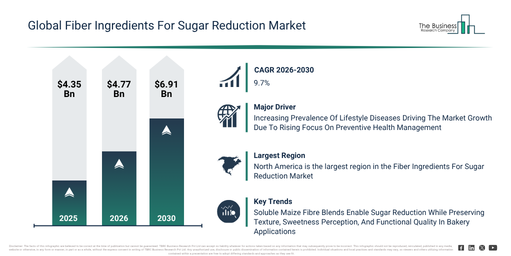
The fiber ingredients for sugar reduction market size has experienced substantial expansion in recent years. Projections indicate that this market will grow from $4.35 billion in 2025 to $4.77 billion in 2026, demonstrating a compound annual growth rate (CAGR) of 9.5%. The historical growth in this sector is attributed to factors such as increasing consumer awareness of sugar-related health concerns, the rising prevalence of obesity and diabetes, a growing demand for low-calorie food products, the expansion of the functional food and beverage industry, and an increase in the enrichment of processed foods with dietary fiber.
The fiber ingredients for sugar reduction market is projected to experience significant expansion over the next few years. It is anticipated to grow to $6.91 billion in 2030 at a compound annual growth rate (CAGR) of 9.7%. This expected growth during the forecast period is driven by factors such as the increasing adoption of plant-based sugar alternatives, the expanding demand for personalized nutrition, continuous innovation in enzymatically modified fibers, the rise in clean label product reformulation, and heightened regulatory pressure regarding added sugar reduction. Prominent trends throughout this period include the increased utilization of resistant dextrin and inulin blends for sugar replacement in beverages, the broadening of fiber-enriched clean label formulations in bakery and confectionery products, a growing consumer interest in low glycemic index food formulations that incorporate soluble fibers, the creation of hybrid fiber systems designed for texture and sweetness optimization in dairy alternatives, and the rising integration of fiber fortification in specialized nutrition and wellness products.
Get A Free Sample Report With In-Depth Market Insights:
Fiber Ingredients For Sugar Reduction Market Growth Backed By Core Demand Fundamentals
The growing incidence of lifestyle-related metabolic illnesses is projected to fuel the expansion of the fiber ingredients for sugar reduction market in the future. These chronic health conditions, encompassing obesity, type 2 diabetes, and cardiovascular disorders, are influenced by various factors such as poor dietary choices, excessive sugar intake, lack of physical activity, and other behavioral and demographic aspects. The rise in lifestyle disease prevalence is attributed to a combination of increased sedentary behavior, evolving dietary patterns, urbanization, and an aging population, all contributing to weight gain, impaired metabolism, and a heightened risk of chronic conditions. Fiber ingredients for sugar reduction help address these issues by partially replacing added sugars with dietary fiber, thereby supporting improved glycemic control, enhancing satiety, and assisting with weight management. These benefits are associated with a reduced risk of obesity and type 2 diabetes, and indirectly contribute to better cardiovascular health. For instance, in June 2024, according to the National Health Service, a UK-based government department, approximately 3.62 million individuals registered with a general practitioner (GP) were diagnosed with non-diabetic hyperglycemia or pre-diabetes in 2023, marking an increase from 3.07 million cases in 2022. Therefore, the expanding occurrence of lifestyle diseases is driving the growth of the fiber ingredients for sugar reduction market.
Fiber Ingredients For Sugar Reduction Market Segment Analysis And Revenue Potential
The fiber ingredients for sugar reduction market covered in this report is segmented –
1) By Fiber Type: Soluble Dietary Fibers, Insoluble Dietary Fibers
2) By Source: Plant Based Fibers, Synthetic Or Modified Fibers, Enzymatically Produced Fibers
3) By Form: Powder Or Granular, Liquid Or Syrup
4) By Application: Bakery And Baked Goods, Beverages, Dairy And Frozen Desserts, Confectionery, Specialized Nutrition, Other Applications
Subsegments:
1) By Soluble Dietary Fibers: Inulin, Fructooligosaccharides, Galactooligosaccharides, Polydextrose, Beta Glucan, Pectin, Resistant Dextrin, Gum Arabic
2) By Insoluble Dietary Fibers: Cellulose, Hemicellulose, Lignin, Wheat Fiber, Corn Fiber, Oat Hull Fiber, Rice Bran Fiber, Pea Fiber
Fiber Ingredients For Sugar Reduction Market Growth Trends Reshaping The Competitive Landscape
Leading companies in the fiber ingredients for sugar reduction market are concentrating on developing innovative products, such as soluble maize fiber blends, to substitute sugar while upholding texture, sweetness perception, and functional attributes in bakery and confectionery items. Soluble maize fiber blends are plant-derived ingredient systems made from processed corn (maize) fibers that dissolve or disperse in food formulations to provide dietary fiber while assisting in sugar replacement and maintaining texture, moisture, and structure in processed foods. For example, in April 2026, Ulrick And Short Limited, a UK-based food ingredient company, unveiled Avanté 25, a soluble fiber ingredient designed to facilitate sugar reduction in sweet bakery applications while preserving texture, structure, and overall product quality. This product delivers excellent water-binding capacity, ensuring freshness and an extended shelf life. It also supports calorie reduction and fiber enrichment without negatively affecting taste or texture. It empowers manufacturers to reformulate products more effectively by sustaining consumer-expected sensory profiles, thus simplifying the achievement of clean-label and reduced-sugar claims.
Fiber Ingredients For Sugar Reduction Market Competitive Analysis Of Leading Industry Participants
Major companies operating in the fiber ingredients for sugar reduction market are Cargill Incorporated, Archer Daniels Midland Company, Ingredion Incorporated, Tereos SCA, Sensus B.V., AGRANA Beteiligungs-Aktiengesellschaft, Roquette Frères S.A., Tate And Lyle Public Limited Company, AGT Food and Ingredients Inc., Emsland-Stärke GmbH, BENEO GmbH, Batory Foods Inc., Nexira SAS, Cosucra Groupe Warcoing SA, Angel Starch & Food Private Limited, Fiberstar Inc., BioNeutra North America Inc., Comet Bio Inc., Herbafood Ingredients GmbH
View The Full Fiber Ingredients For Sugar Reduction Market Report:
Fiber Ingredients For Sugar Reduction Market Geographic Spread And Regional Opportunities
North America was the largest region in the fiber ingredients for sugar reduction market in 2025. Asia-Pacific is expected to be the fastest-growing region in the forecast period. The regions covered in the fiber ingredients for sugar reduction market report are Asia-Pacific, South East Asia, Western Europe, Eastern Europe, North America, South America, Middle East, Africa.
Reach Out To Our Team:
The Business Research Company: https://www.thebusinessresearchcompany.com/
Americas: +1 310-496-7795
Asia: +44 7882 955267 & +91 8897263534
Europe: +44 7882 955267
Email us at: marketing@tbrc.info
Follow us on:
LinkedIn: https://in.linkedin.com/company/the-business-research-company
YouTube: https://www.youtube.com/channel/UC24_fI0rV8cR5DxlCpgmyFQ
Global Market Model: https://www.thebusinessresearchcompany.com/global-market-model

Wasay has over a decade of experience in market research, data modelling, and analytics, with prior experience at GlobalData and Decision Tree Consulting Services. At The Business Research Company , he leads research operations across syndicated studies, customized consulting engagements, and the Global Market Model platform. His professional experience includes supporting organizations such as Boston Consulting Group, KPMG, and Ernst & Young. Wasay holds a degree in Electronics and Communications Engineering, postgraduate management qualifications from International Management Institute Belgium and Indian School of Business and Entrepreneurship, and completed the Integrated Program in Business Analytics from Indian Institute of Management Indore.