The Business Research Company’s 2026 market reports are designed to deliver research that is more actionable and strategically valuable. Key offerings include market attractiveness scoring, total addressable market sizing, company benchmarking matrices, interactive Excel dashboards, deeper supply chain intelligence, emerging startup tracking, and granular product-level insights.
Fish Oil Alternatives Market Revenue Projected To Rise To $4.12 Billion By 2030
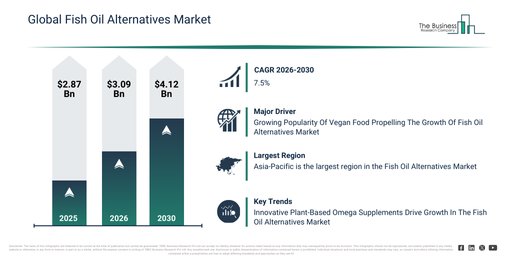
The fish oil alternatives market has experienced robust expansion over the past few years. Projections indicate its expansion from $2.87 billion in 2025 to $3.09 billion in 2026, demonstrating a compound annual growth rate (CAGR) of 7.5%. Historical growth drivers include heightened consumer understanding of omega-3 health advantages, reduced confidence in conventional fish oil sources, the rise of plant-based nutrition patterns, increased consumption of dietary supplements, and advancements in algae cultivation methods.
The fish oil alternatives market anticipates substantial growth in the upcoming years. By 2030, this market is projected to reach $4.12 billion, exhibiting a compound annual growth rate (CAGR) of 7.5%. This anticipated expansion is fueled by several factors, including a growing demand for sustainable nutritional options, increased investments in precision fermentation and algae processing technologies, a rising preference for vegan dietary supplements, broader applications within the nutraceutical sector, and a heightened regulatory emphasis on sustainability declarations. Key trends expected during this period involve a greater embrace of algae-derived omega-3 sources, an uptick in the demand for vegan and plant-derived supplements, a concentrated effort on sustainable omega-3 manufacturing, the proliferation of clean-label nutritional components, and an increased focus on product traceability and certification.
Want Deeper Fish Oil Alternatives Market Insights? Get A Free Sample Report:
Primary Growth Driver Shaping The Fish Oil Alternatives Market Outlook
The increasing adoption of vegan food is projected to boost the expansion of the fish oil alternatives market. Vegan food consists entirely of ingredients derived from plants, excluding any animal products such as meat, dairy, eggs, or honey. The appeal of vegan food is on the rise due to heightened health awareness, ecological concerns, and moral considerations regarding animal welfare. Fish oil substitutes found in vegan diets, such as algae and flaxseed oil, deliver vital omega-3 fatty acids without relying on animal sources. These options contribute to cardiovascular well-being and offer environmentally friendly choices for vegans. For instance, data from the Plant Based Foods Association, a US-based trade organization, indicated that in May 2025, U.S. retail sales of plant-based foods reached $8.1 billion. Furthermore, 59% of U.S. households acquired plant-based foods in 2024, demonstrating a 79% repeat-purchase rate. Consequently, the rising demand for vegan food is accelerating the growth of the fish oil alternatives market. The expanding food and beverage sector is anticipated to fuel the growth of the fish oil alternatives market in the future. This expanding sector encompasses the production, distribution, and consumption of various food and drink items. The increasing food and beverage industry plays a crucial role in advancing sustainable fish oil alternatives by focusing on research, environmental responsibility, nutritional value, economic viability, and evolving consumer preferences. For example, according to the Australian Bureau of Statistics, an Australia-based government statistical agency, in April 2024, 14.8 million tonnes of food and non-alcoholic beverages were sold in 2022-23. Hence, the burgeoning food and beverage industry is a key driver for the fish oil alternatives market.
Fish Oil Alternatives Market Structure: A Detailed Look At Segments And Subsegments
The fish oil alternatives market covered in this report is segmented –
1) By Product Type: Chia Seed Oil, Soybean Oil, Canola Oil, Hemp Seed Oil, Algae Oil, Walnut Oil, Flaxseed Oil, Other Product Types
2) By Application: Food And Beverage Industry, Cosmetics And Personal Care, Animal Feed, Pet Food Additive, Pharmaceuticals, Nutraceuticals, Other Applications
3) By End Use: Human Dietary Supplements, Functional Foods & Beverages, Animal Nutrition & Pet Supplements
Subsegments:
1) By Chia Seed Oil: Organic Chia Seed Oil, Conventional Chia Seed Oil
2) By Soybean Oil: Organic Soybean Oil, Conventional Soybean Oil
3) By Canola Oil: Organic Canola Oil, Conventional Canola Oil
4) By Hemp Seed Oil: Cold-Pressed Hemp Seed Oil, Refined Hemp Seed Oil
5) By Algae Oil: DHA-rich Algae Oil, EPA-rich Algae Oil, DHA & EPA Blend Algae Oil
6) By Walnut Oil: Cold-Pressed Walnut Oil, Refined Walnut Oil
7) By Flaxseed Oil: Cold-Pressed Flaxseed Oil, Refined Flaxseed Oil
8) By Other Product Types: Sacha Inchi Oil, Pumpkin Seed Oil, Poppy Seed Oil
Fish Oil Alternatives Market Innovation And Strategy Trends Among Leading Companies
Leading companies in the fish oil alternatives market are intensifying their efforts to introduce innovative products, such as plant-based supplements, that deliver omega-3 fatty acids without the environmental burden linked to fish oil. A plant-based supplement is a dietary product derived from plants, providing essential nutrients, including plant-sourced omega-3 fatty acids, which are vital for maintaining overall health and well-being. For instance, in June 2024, MegaFood, a US-based dietary supplement company, unveiled the Omega 3-6-9 Supplement. This supplement features sustainable sourcing with farm-traceable ahiflower and fish-free algae oil, offers improved taste, and minimizes burps through careful processing and delayed-release capsules. It also provides a comprehensive nutrient profile, emphasizing omega-3, omega-6, and omega-9 fatty acids. This launch advances fish oil alternatives by offering an omega supplement option that is more environmentally friendly, palatable, and holistic, thereby aligning with the increasing consumer demand for sustainable, plant-based nutrition.
Top Companies Competing In The Fish Oil Alternatives Market
Major companies operating in the fish oil alternatives market are Cargill Inc., Archer Daniels Midland Company (ADM), BASF SE, Wilmar International, CHS Inc., Dupont De Nemours, Koninklijke DSM N.V., Croda International, Corbion, Olvea Group, Connoils LLC, Sonic Biochem, TerraVia Holdings, Bioway Organic Group Limited, Veramaris, AlgiSys BioSciences Inc., Bioriginal Food & Science Corp., Barlean’s Organic Oils LLC, Medix Laboratoires, Qualitas Health (iwi Life)
View The Complete Fish Oil Alternatives Market Study With Segment And Regional Data:
Fish Oil Alternatives Market Regional Outlook Across Major Geographies
Asia-Pacific was the largest region in the fish oil alternatives market in 2025. The regions covered in the fish oil alternatives market report are Asia-Pacific, South East Asia, Western Europe, Eastern Europe, North America, South America, Middle East and Africa.
Reach Out To Our Team:
The Business Research Company: https://www.thebusinessresearchcompany.com/
Americas: +1 310-496-7795
Asia: +44 7882 955267 & +91 8897263534
Europe: +44 7882 955267
Email us at: marketing@tbrc.info
Follow us on:
LinkedIn: https://in.linkedin.com/company/the-business-research-company
YouTube: https://www.youtube.com/channel/UC24_fI0rV8cR5DxlCpgmyFQ
Global Market Model: https://www.thebusinessresearchcompany.com/global-market-model

Wasay has over a decade of experience in market research, data modelling, and analytics, with prior experience at GlobalData and Decision Tree Consulting Services. At The Business Research Company , he leads research operations across syndicated studies, customized consulting engagements, and the Global Market Model platform. His professional experience includes supporting organizations such as Boston Consulting Group, KPMG, and Ernst & Young. Wasay holds a degree in Electronics and Communications Engineering, postgraduate management qualifications from International Management Institute Belgium and Indian School of Business and Entrepreneurship, and completed the Integrated Program in Business Analytics from Indian Institute of Management Indore.