With a focus on actionable insights and strategic value, The Business Research Company’s 2026 market reports include market attractiveness scoring, total addressable market sizing, company benchmarking matrices, interactive Excel dashboards, deeper supply chain intelligence, emerging startup tracking, and granular product-level insights.
Food Colors Market Size Analysis: Historical Growth And Future Revenue Projections
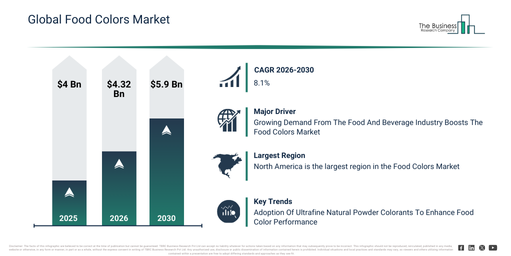
The food colors market size has seen substantial growth in recent years. It is anticipated to expand from $4 billion in 2025 to $4.32 billion in 2026, achieving a compound annual growth rate (CAGR) of 7.9%. This historical expansion can be attributed to factors such as increased processed food consumption, the growing importance of visual appeal in packaged foods, the expansion of beverage manufacturing, the availability of synthetic color additives, and greater standardization in food processing.
The food colors market is projected to experience substantial expansion over the upcoming years. This market is forecast to reach $5.9 billion by 2030, demonstrating a compound annual growth rate (CAGR) of 8.1%. The anticipated growth during this period stems from several factors, including a heightened consumer preference for natural components, increased regulatory examination of synthetic colorants, the proliferation of clean-label food items, growing financial commitments to natural color extraction methods, and expanding demand within high-end food sectors. Key trends foreseen for the forecast horizon encompass a greater uptake of natural and plant-derived food colorings, an escalating need for clean-label coloring alternatives, a surge in the application of colors sourced from microbes and fermentation, the development of more heat-stable and light-stable color compounds, and a concentrated effort on color additives that meet regulatory standards.
Preview The Food Colors Market Report With A Free Sample:
Food Colors Market Drivers: What Is Fueling Demand Through 2030?
The anticipated expansion of the food colors market over the coming years is largely driven by the increasing demand from the food and beverage industry. This sector encompasses all businesses involved in the production, packaging, and distribution of raw food materials, including both fresh and processed foods, as well as alcoholic and non-alcoholic drinks. Food colors are added to these items to preserve their original color and texture, which might otherwise be lost during cooking and preparation due to various chemical and physical processes. For instance, according to the Ministry of Finance and Economy, a Brunei-based government ministry, in terms of volume, food & beverages showed a positive growth of 12.7% year-on-year in Q1 2023, following a 33.3 per cent increase in Q4 2022. Therefore, the escalating demand from the food and beverage industry is a significant catalyst for the growth of the food colors market.
Food Colors Market Segmentation Analysis: Core Categories And Subcategories
The food colors market covered in this report is segmented –
1) By Type: Natural, Synthetic, Nature Identical
2) By Form: Liquid, Powder, Gel
3) By Application: Dairy, Meat Products, Beverages, Bakery And Confectionery, Processed Food And Vegetables, Oils And Fats, Other Applications
Subsegments:
1) By Natural: Plant-Based Colors, Animal-Based Colors, Microbial Colors
2) By Synthetic: Azo Dyes, Non-Azo Dyes
3) By Nature Identical: Synthetic Versions of Natural Colors, Isolated Natural Compounds
Which Trends Will Define The Food Colors Market Through 2030?
Major companies in the food colors market are concentrating on developing innovations such as ultrafine milled natural powder colorant systems. This focus aims to meet the increasing demand for clean label, vibrant, and sustainable food coloration that appeals to health-conscious consumers and addresses food manufacturers’ need for high-performance, easy-to-use color solutions. An ultrafine natural powder colorant system employs milled plant-based pigments with very small particle sizes, which boosts surface area, enhances light reflection, and improves dispersion, leading to more intense, uniform color even at lower dosages compared to traditional natural color powders. For instance, in September 2024, Oterra, a Denmark-based natural-color supplier, launched I-Colors Bold, a range of ten ultrafine, milled powders designed to achieve deeper, richer shades while reducing the required quantity of colorant. These powders are derived from plant-based raw materials like sweet potato, anthocyanin-, or beet-based pigments, and are suitable for applications including powder-based beverages, snack seasonings, coatings, bakery toppings, fat-based fillings, confectionery, and compressed candy. Unlike older natural-color solutions, which frequently produced muted tones, necessitated higher dosages, or had uneven dispersion, I-Colors Bold provides synthetic-level color impact with natural-label ingredients, superior stability, reduced dosage usage, and improved process efficiency.
Food Colors Market Major Companies And Industry Participants
Major companies operating in the food colors market are D.D. Williamson & Co Inc., Kalsec Inc., Döhler GmbH, International Flavors & Fragrances Inc., Koninklijke DSM NV, Sensient Technologies Corporation, Archer-Daniels-Midland Company, LycoRed Ltd., Givaudan SA, Naturex Ltd., GNT Group BV, San-Ei Gen., Roha Dyechem Pvt Ltd., Kolor Jet Chemical Pvt Ltd., Vidhi Specialty Food Ingredients Ltd., Vinayak Ingredients India Pvt Ltd., Neelikon Food Dyes and Chemicals Ltd., Aarkay Food Products Ltd., Natural Food Colors Inc., Ingredion Incorporated
Buy The Full Food Colors Global Market Report 2026:
Food Colors Market Geographic Analysis: Which Region Accounts For The Biggest Share?
North America was the largest region in the food colors market in 2025. The regions covered in the food colors market report are Asia-Pacific, South East Asia, Western Europe, Eastern Europe, North America, South America, Middle East and Africa.
Reach Out To Our Team:
The Business Research Company: https://www.thebusinessresearchcompany.com/
Americas: +1 310-496-7795
Asia: +44 7882 955267 & +91 8897263534
Europe: +44 7882 955267
Email us at: marketing@tbrc.info
Follow us on:
LinkedIn: https://in.linkedin.com/company/the-business-research-company
YouTube: https://www.youtube.com/channel/UC24_fI0rV8cR5DxlCpgmyFQ
Global Market Model: https://www.thebusinessresearchcompany.com/global-market-model

Wasay has over a decade of experience in market research, data modelling, and analytics, with prior experience at GlobalData and Decision Tree Consulting Services. At The Business Research Company , he leads research operations across syndicated studies, customized consulting engagements, and the Global Market Model platform. His professional experience includes supporting organizations such as Boston Consulting Group, KPMG, and Ernst & Young. Wasay holds a degree in Electronics and Communications Engineering, postgraduate management qualifications from International Management Institute Belgium and Indian School of Business and Entrepreneurship, and completed the Integrated Program in Business Analytics from Indian Institute of Management Indore.