With a focus on actionable insights and strategic value, The Business Research Company’s 2026 market reports include market attractiveness scoring, total addressable market sizing, company benchmarking matrices, interactive Excel dashboards, deeper supply chain intelligence, emerging startup tracking, and granular product-level insights.
Food Fortifying Agents Market Size Forecast Points To $240.43 Billion In Revenue By 2030
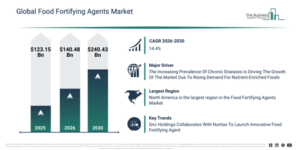
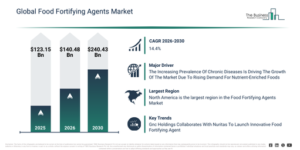
The food fortifying agents market has expanded significantly in recent years. Its size is projected to increase from $123.15 billion in 2025 to $140.48 billion in 2026, demonstrating a compound annual growth rate (CAGR) of 14.1%. The market’s growth during the historic period stems from the increasing prevalence of micronutrient deficiencies, the expansion of government-led fortification programs, the rise in processed food consumption, the growing use of vitamin and mineral premixes, and advancements in fortification processing technologies.
The food fortifying agents market size is projected to experience substantial expansion in the coming years. By 2030, it is forecast to reach $240.43 billion, exhibiting a compound annual growth rate (CAGR) of 14.4%. This projected growth is driven by several factors, including an increased demand for functional and fortified food products, greater investment in preventive healthcare nutrition, the broadening of fortified infant and senior nutrition offerings, the expanding acceptance of personalized nutrition, and an elevated emphasis on clean and natural fortification methods. Key trends anticipated during this period involve a greater utilization of microencapsulated nutrients, an increasing need for tailored fortification blends, the rising preference for clean-label fortifying agents, the broader application of fortification in staple foods, and a heightened emphasis on improving bioavailability and stability.
Get A Free Food Fortifying Agents Market Sample Covering Drivers, Trends And Key Players:
Food Fortifying Agents Market Driver Analysis: Key Factor Supporting Revenue Growth
The increasing prevalence of chronic diseases is expected to propel the food fortifying agents market forward. These conditions, such as heart disease, cancer, asthma, and diabetes, are ongoing illnesses that can be managed with early detection, exercise, an improved diet, and treatment therapy. The growing incidence of chronic diseases is largely influenced by lifestyle changes, including poor diet, physical inactivity, stress, and unhealthy habits like smoking and excessive alcohol consumption. Food fortifying agents help mitigate the risk of chronic diseases by enhancing the nutritional content of foods with essential vitamins and minerals crucial for long-term health. For instance, according to the NHS Confederation, a UK-based national association, in April 2025, it was estimated that by 2035, 17% of the UK population could be living with four or more chronic conditions. Therefore, the expanding prevalence of chronic diseases will significantly promote the food fortifying agents market.
Food Fortifying Agents Market Segmentation Framework: Major Segments At A Glance
The food fortifying agents market covered in this report is segmented –
1) By Type: Minerals, Vitamins, Lipids, Carbohydrates, Proteins And Amino Acids, Prebiotics, Probiotics, Other Types
2) By Process: Powder Enrichment, Premixes And Coatings, Drum Drying, Dusting, Spray Drying Under Microencapsulation Process
3) By Application: Cereals And Cereal-Based Products, Dairy And Dairy-Based Products, Fats And Oils, Bulk Food Items, Beverages, Infant Formula, Dietary Supplements, Other Applications
Subsegments:
1) By Minerals: Calcium, Iron, Zinc, Magnesium, Selenium
2) By Vitamins: Vitamin A, Vitamin B Complex (B1, B2, B3, B6, B12), Vitamin C, Vitamin D, Vitamin E, Vitamin K
3) By Lipids: Omega-3 Fatty Acids, Omega-6 Fatty Acids, Medium-Chain Triglycerides (MCTs)
4) By Carbohydrates: Dietary Fiber, Resistant Starch
5) By Proteins and Amino Acids: Whey Protein, Soy Protein, Casein Protein, Essential Amino Acids, Branched-Chain Amino Acids (BCAAs)
6) By Prebiotics: Inulin, Oligofructose, Galacto-oligosaccharides (GOS)
7) By Probiotics: Lactobacillus, Bifidobacterium, Saccharomyces Boulardii
8) By Other Types: Herbal Extracts, Enzymes, Natural Flavoring Agent
Latest Food Fortifying Agents Market Developments And Emerging Trends
Leading firms within the food fortifying agents market are prioritizing strategic partnerships to secure a competitive advantage. These alliances encompass partnerships between businesses manufacturing food fortifying agents, alongside collaborations with regulatory authorities, healthcare groups, and food producers. For example, in August 2023, GNC Holdings LLC, a US-based manufacturer of health and nutrition items, collaborated with Nuritas, an Ireland-based supplier renowned for AI-driven peptide discovery, to introduce Beyond Raw Dynamic Whey High-Tech Protein. This product is a food fortifying agent enhanced with PeptiStrong, a plant-derived peptide clinically proven to boost muscle protein synthesis, reduce indicators associated with muscle degradation, and diminish exercise-induced inflammation markers. The aim of this innovative formulation is to offer superior benefits compared to traditional whey protein during and after physical activity. The company states that PeptiStrong improves protein metabolism via multiple cell-signaling pathways, leading consumers to expect reduced fatigue in the days post-exercise with consistent use.
Which Companies Are Shaping The Food Fortifying Agents Market?
Major companies operating in the food fortifying agents market are Koninklijke DSM N.V., Chr. Hansen A/S, BASF SE, DuPont de Nemours Inc., Tate & Lyle Plc., Ingredion Incorporated, Archer Daniels Midland Company, Nestle SA, The Kellogg Company, A&B Ingredients Inc., Royal Cosun, Stratum Nutrition, Wenda Ingredients LLC, ABF Ingredients, Cargill Incorporated, FMC Corporation., Glanbia plc., Zhejiang Garden Biochemical High-tech Co. Ltd, Kerry Group plc., Nutralliance Inc., Nutrifusion LLC, Prinova Group LLC, Sensus B.V., SternVitamin GmbH & Co. KG, Roquette Frères, The Wright Group
Dive Deeper Into The Food Fortifying Agents Market With The Full Report:
Food Fortifying Agents Market Regional Distribution: Where Is Revenue Concentrated?
North America was the largest region in the food fortifying agents’ market in 2025. Asia-Pacific is expected to be the fastest-growing region in the forecast period. The regions covered in the food fortifying agents market report are Asia-Pacific, South East Asia, Western Europe, Eastern Europe, North America, South America, Middle East and Africa.
Reach Out To Our Team:
The Business Research Company: https://www.thebusinessresearchcompany.com/
Americas: +1 310-496-7795
Asia: +44 7882 955267 & +91 8897263534
Europe: +44 7882 955267
Email us at: marketing@tbrc.info
Follow us on:
LinkedIn: https://in.linkedin.com/company/the-business-research-company
YouTube: https://www.youtube.com/channel/UC24_fI0rV8cR5DxlCpgmyFQ
Global Market Model: https://www.thebusinessresearchcompany.com/global-market-model

Wasay has over a decade of experience in market research, data modelling, and analytics, with prior experience at GlobalData and Decision Tree Consulting Services. At The Business Research Company , he leads research operations across syndicated studies, customized consulting engagements, and the Global Market Model platform. His professional experience includes supporting organizations such as Boston Consulting Group, KPMG, and Ernst & Young. Wasay holds a degree in Electronics and Communications Engineering, postgraduate management qualifications from International Management Institute Belgium and Indian School of Business and Entrepreneurship, and completed the Integrated Program in Business Analytics from Indian Institute of Management Indore.