Backed by market attractiveness analysis, total addressable market sizing, company benchmarking matrices, interactive Excel dashboards, wider supply chain intelligence, emerging startup coverage, and detailed product-level insights, The Business Research Company’s 2026 market reports are designed to offer research that is more actionable and strategically valuable than ever.
Foodservice Frozen Entrees Market Poised To Hit $47.29 Billion By 2030 With A 7% CAGR
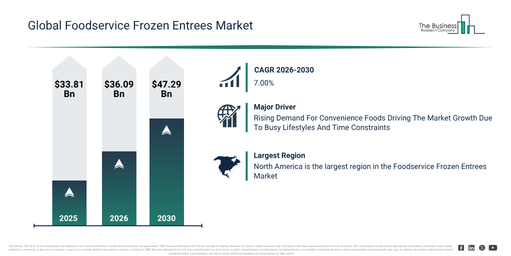
The foodservice frozen entrees market has demonstrated substantial expansion in recent years. It is anticipated to increase from $33. 81 billion in 2025 to $36. 09 billion in 2026, exhibiting a compound annual growth rate (CAGR) of 6. 8%. This growth observed in the past period can be attributed to several factors, including the rising demand for convenience-based commercial food solutions, the proliferation of quick service restaurant chains, the increasing adoption of frozen food within the hospitality sector, the growing requirement for consistent meal quality in large-scale catering operations, and advancements in cold chain logistics infrastructure.
The foodservice frozen entrees market is anticipated to experience substantial growth in the upcoming years, reaching $47.29 billion by 2030, demonstrating a compound annual growth rate (CAGR) of 7.0%. This expansion during the forecast period is primarily driven by factors such as the increasing consumer desire for healthy and functional frozen meal choices, enhanced adoption of automated food processing technologies, a greater move towards sustainable and environmentally friendly packaging, the spread of online B2B foodservice procurement platforms, and rising demand from the institutional and healthcare foodservice sectors. Noteworthy trends predicted for this period include the increased implementation of automated food production and portioning systems in frozen meal creation, a growing call for clean label and preservative-free frozen entrées, an expansion of high-end gourmet frozen meal selections for the hospitality industry, a rising preference for meal solutions that are portion-controlled and reduce waste, and the deepening integration of supply chain digitization within foodservice frozen meal distribution.
Get A Free Sample Report With In-Depth Market Insights:
Foodservice Frozen Entrees Market Demand Drivers: What’s Powering Industry Growth?
The growing consumer demand for convenience foods is anticipated to fuel the expansion of the foodservice frozen entrees market in the coming years. Convenience foods are commercially prepared, ready-to-eat, or easy-to-prepare food items designed to reduce cooking time and effort. The heightened demand for these foods stems from increasingly busy lifestyles, as consumers actively seek quick and effortless meal solutions. Foodservice frozen entrées align with convenience food preferences by offering ready-to-heat, pre-portioned meals that minimize preparation time, ensure consistent quality, and simplify foodservice operations. For instance, in September 2025, data from the National Association of Convenience Stores (NACS), a US-based trade association, revealed that in 2024, foodservice sales—which include prepared food, commissary items, and various dispensed hot, cold, and frozen beverages—accounted for 27.7% of in-store sales and 38.6% of gross margins at convenience stores. Prepared food was a dominant category within this, representing 72.6% of foodservice sales and showing a steady increase in its share over the preceding five years. Consequently, the rising demand for convenience foods is a key driver for the growth of the foodservice frozen entrees market. The increasing disposable incomes of consumers are also projected to propel the growth of the foodservice frozen entrees market. Disposable income refers to the money available to an individual or household for spending or saving after taxes have been deducted. Economic growth is the primary catalyst for rising disposable incomes, as increased employment and higher wages boost individual earnings, leaving more post-tax funds for discretionary spending or saving. Higher disposable incomes support the foodservice frozen entrees sector by enabling people and institutions to more frequently choose convenient, ready-made meals instead of preparing dishes from scratch. For example, in October 2024, Statistics Iceland, an Iceland-based government agency, reported that household disposable income grew by 6.6% in the second quarter of 2024 compared to the same quarter of the previous year. Therefore, the upward trend in disposable incomes is contributing significantly to the expansion of the foodservice frozen entrees market.
Foodservice Frozen Entrees Market Segmentation And Category Overview
The foodservice frozen entrees market covered in this report is segmented –
1) By Product Type: Vegetarian Entrees, Non-Vegetarian Entrees, Vegan Entrees, Gluten-Free Entrees, Other Product Types
2) By Category: Ready To Eat, Ready To Cook
3) By Nature: Conventional, Organic, Clean Label
4) By Distribution Channel: Direct Sales, Distributors Or Wholesalers, Online Sales, Other Distribution Channels
5) By End-User: Hotels And Restaurants, Catering Services, Institutional Foodservice, Quick Service Restaurants, Other End-Users
Subsegments:
1) By Vegetarian Entrees: Vegetable Lasagna, Paneer Based Dishes, Rice Based Meals, Pasta Based Meals, Stuffed Vegetable Dishes
2) By Non-Vegetarian Entrees: Chicken Based Meals, Beef Based Meals, Seafood Based Meals, Lamb Based Meals, Mixed Meat Dishes
3) By Vegan Entrees: Plant Based Protein Meals, Legume Based Dishes, Tofu Based Meals, Dairy Free Pasta, Vegetable Grain Bowls
4) By Gluten-Free Entrees: Rice Based Entrees, Corn Based Meals, Quinoa Based Dishes, Gluten Free Pasta Meals, Potato Based Dishes
5) By Other Product Types: Low Calorie Meals, High Protein Meals, Ketogenic Diet Meals, Allergen Free Meals, Ethnic Specialty Dishes
Foodservice Frozen Entrees Market Industry Leaders And Competitive Landscape
Major companies operating in the foodservice frozen entrees market are Nestlé S. A., Tyson Foods Inc., The Kraft Heinz Company, Grupo Bimbo S. A. B. de C. V., General Mills Inc., Conagra Brands Inc., Hormel Foods Corporation, BRF S. A., Ajinomoto Co. Inc., Kerry Group plc, Dr. August Oetker KG, Lantmännen Unibake International, Lamb Weston Holdings Inc., Nichirei Corporation, Maple Leaf Foods Inc., Nomad Foods Limited, Greencore Group plc, Simmons Foods Inc., Iceland Foods Ltd., Frosta AG, Europastry S. A., McCain Foods Limited, Gorton’s Inc., Saffron Road Food Company, JBS S. A.
View The Full Foodservice Frozen Entrees Market Report:
Foodservice Frozen Entrees Market Regional Analysis And Top Geography
North America was the largest region in the foodservice frozen entrees market in 2025. Asia-Pacific is expected to be the fastest-growing region in the forecast period. The regions covered in the foodservice frozen entrees market report are Asia-Pacific, South East Asia, Western Europe, Eastern Europe, North America, South America, Middle East and Africa.
Reach Out To Our Team:
The Business Research Company: https://www.thebusinessresearchcompany.com/
Americas: +1 310-496-7795
Asia: +44 7882 955267 & +91 8897263534
Europe: +44 7882 955267
Email us at: marketing@tbrc.info
Follow us on:
LinkedIn: https://in.linkedin.com/company/the-business-research-company
YouTube: https://www.youtube.com/channel/UC24_fI0rV8cR5DxlCpgmyFQ
Global Market Model: https://www.thebusinessresearchcompany.com/global-market-model

Wasay has over a decade of experience in market research, data modelling, and analytics, with prior experience at GlobalData and Decision Tree Consulting Services. At The Business Research Company , he leads research operations across syndicated studies, customized consulting engagements, and the Global Market Model platform. His professional experience includes supporting organizations such as Boston Consulting Group, KPMG, and Ernst & Young. Wasay holds a degree in Electronics and Communications Engineering, postgraduate management qualifications from International Management Institute Belgium and Indian School of Business and Entrepreneurship, and completed the Integrated Program in Business Analytics from Indian Institute of Management Indore.