
Backed by market attractiveness analysis, total addressable market sizing, company benchmarking matrices, interactive Excel dashboards, wider supply chain intelligence, emerging startup coverage, and detailed product-level insights, The Business Research Company’s 2026 market reports are designed to offer research that is more actionable and strategically valuable than ever.
Freshness Prediction Artificial Intelligence (AI) Market Forecast: Value Set To Climb From $2.19 Billion To $4.52 Billion
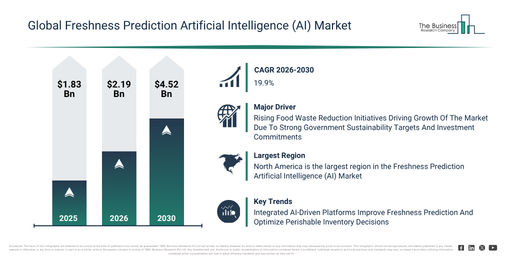
The freshness prediction artificial intelligence (AI) market size has experienced rapid expansion in recent years. It is projected to increase from $1.83 billion in 2025 to $2.19 billion in 2026, achieving a compound annual growth rate (CAGR) of 19.6%. The historical growth of this market can be attributed to rising concerns over food waste reduction, an increase in perishable goods trade, the growing adoption of cold chain logistics, the expansion of retail and grocery chains, and the demand for improved inventory management efficiency.
The freshness prediction artificial intelligence (AI) market is anticipated to experience substantial expansion in the coming years. This market is projected to reach $4.52 billion by 2030, exhibiting a compound annual growth rate (CAGR) of 19.9%. This expansion during the forecast period is driven by factors such as the increasing need for real-time predictive analytics, the development of smart supply chain solutions, a growing emphasis on sustainability within food systems, the incorporation of AI-powered quality assessment tools, and the broadening of automated inventory and logistics systems. Key trends anticipated during this period include the wider adoption of real-time shelf life prediction solutions, an increasing reliance on data-driven strategies for inventory optimization, a heightened demand for technologies aimed at reducing food waste, the widespread implementation of predictive quality monitoring throughout supply chains, and the deeper integration of freshness prediction capabilities into retail operations.
Get A Free Sample Report With In-Depth Market Insights:
Freshness Prediction Artificial Intelligence (AI) Market Growth Backed By Core Demand Fundamentals
The increasing drive for food waste reduction initiatives is anticipated to fuel the expansion of the freshness prediction artificial intelligence (AI) market in the future. Food waste reduction initiatives encompass planned actions and interventions implemented by governments, businesses, and organizations to minimize food wastage, enhance resource efficiency, and boost sustainability throughout the food value chain. The rise in these initiatives stems from growing environmental sustainability concerns, given that decreasing food waste helps to reduce greenhouse gas emissions, preserve resources, and lessen overall environmental impact. Freshness Prediction Artificial Intelligence (AI) aids food waste reduction initiatives by analyzing real-time information, such as temperature, humidity, and product conditions, to accurately estimate shelf life. This capability facilitates optimized inventory management, timely distribution, and decreased spoilage across the supply chain. As an illustration, in January 2026, the United States Environmental Protection Agency, a US-based federal executive agency, reported that the U.S. government has set a goal to reduce food waste in the retail, food service, and residential sectors by 50% by 2030, supported by annual investments of $14 billion in cost-effective solutions projected to eliminate 45 million tons of food waste each year. Therefore, the growth of food waste reduction initiatives is a key driver for the freshness prediction artificial intelligence (AI) market.
Freshness Prediction Artificial Intelligence (AI) Market Segmentation: How Does The Market Break Down By Category?
The freshness prediction artificial intelligence (AI) market covered in this report is segmented –
1) By Component: Solutions, Services
2) By Technology Input: Internet Of Things (IoT) Sensor Data, Visual Data, Historical Sales And Supply Chain Data, Multi-Modal Data Fusion
3) By Deployment Mode: Cloud-Based Or Software As A Service (SaaS), On-Premises Or Edge
4) By Application: Retail And Grocery, Dynamic Pricing And Markdown Optimization, Inventory Rotation And Stock Replenishment, Food Service And Hospitality, Kitchen And Menu Management, Prep Schedule Optimization, Logistics And Supply Chain, Other Applications
5) By End-User: Supermarkets And Grocery Chains, Food And Beverage Manufacturers, Restaurants And Catering Services, Third-Party Logistics Providers, Other End-Users
Subsegments:
1) By Solutions: Predictive Analytics Solutions, Computer Vision Solutions, Data Integration Solutions, Supply Chain Optimization Solutions
2) By Services: Consulting Services, Implementation Services, Support And Maintenance Services, Training And Education Services
Freshness Prediction Artificial Intelligence (AI) Market Growth Trends Reshaping The Competitive Landscape
Major companies engaged in the freshness prediction artificial intelligence (AI) market are concentrating on developing advanced solutions, such as integrated AI-driven fresh operations platforms. These efforts aim to enhance the accuracy of freshness predictions, optimize decisions regarding perishable inventory, and significantly reduce food waste throughout retail supply chains. Integrated AI-driven fresh operations platforms are centralized digital solutions that utilize artificial intelligence to manage fresh food inventory, forecast demand, and oversee shelf-life in real time, thereby reducing waste and boosting supply chain efficiency. For instance, in September 2025, Afresh Technologies, a US-based AI company focused on freshness optimization, launched the Fresh Store Suite. This AI-powered platform unifies inventory management, demand forecasting, ordering, and production planning into a comprehensive system for optimizing freshness across all fresh departments. The platform allows grocers to make quicker, data-driven decisions, minimize food waste, and improve product freshness through predictive replenishment and cross-department AI optimization, all while streamlining fresh operations and boosting profitability.
Freshness Prediction Artificial Intelligence (AI) Market Top Companies Driving Competitive Growth
Major companies operating in the freshness prediction artificial intelligence (AI) market are Google LLC, Microsoft Corporation, Cargill Incorporated, Amazon Web Services Inc., Siemens AG, IBM Corporation, Oracle Corporation, SAP SE, TOMRA Systems ASA, Leanpath Inc., Afresh Technologies Inc., Intello Labs Private Limited, Winnow Solutions Limited, Clarifruit Ltd., OneThird B.V., AgShift Inc., Strella Biotechnology Inc., Wasteless Ltd., OpSense Ltd., Kitro SA.
View The Full Freshness Prediction Artificial Intelligence (AI) Market Report:
Freshness Prediction Artificial Intelligence (AI) Market Global Footprint: Which Region Leads The Market?
North America was the largest region in the freshness prediction artificial intelligence (AI) market in 2025. Asia-Pacific is expected to be the fastest-growing region in the forecast period. The regions covered in the freshness prediction artificial intelligence (AI) market report are Asia-Pacific, South East Asia, Western Europe, Eastern Europe, North America, South America, Middle East, Africa.
Reach Out To Our Team:
The Business Research Company: https://www.thebusinessresearchcompany.com/
Americas: +1 310-496-7795
Asia: +44 7882 955267 & +91 8897263534
Europe: +44 7882 955267
Email us at: marketing@tbrc.info
Follow us on:
LinkedIn: https://in.linkedin.com/company/the-business-research-company
YouTube: https://www.youtube.com/channel/UC24_fI0rV8cR5DxlCpgmyFQ
Global Market Model: https://www.thebusinessresearchcompany.com/global-market-model

Wasay has over a decade of experience in market research, data modelling, and analytics, with prior experience at GlobalData and Decision Tree Consulting Services. At The Business Research Company , he leads research operations across syndicated studies, customized consulting engagements, and the Global Market Model platform. His professional experience includes supporting organizations such as Boston Consulting Group, KPMG, and Ernst & Young. Wasay holds a degree in Electronics and Communications Engineering, postgraduate management qualifications from International Management Institute Belgium and Indian School of Business and Entrepreneurship, and completed the Integrated Program in Business Analytics from Indian Institute of Management Indore.