The Business Research Company’s 2026 market reports are designed to deliver research that is more actionable and strategically valuable. Key offerings include market attractiveness scoring, total addressable market sizing, company benchmarking matrices, interactive Excel dashboards, deeper supply chain intelligence, emerging startup tracking, and granular product-level insights.
Which Factors Will Shape The Genetically Modified Vegetables Market Size Through 2030?
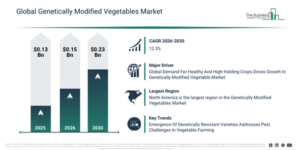
The genetically modified vegetables market has seen rapid expansion in recent years. It is forecast to increase from $0.13 billion in 2025 to $0.15 billion in 2026, exhibiting a compound annual growth rate (CAGR) of 12.9%. This historical growth can be attributed to several factors including escalating vegetable crop losses due to pests, the initial acceptance of transgenic crops, the expansion of commercial vegetable farming operations, a surge in investments within plant biotechnology, and regulatory clearances for GM crops.
The genetically modified vegetables market is anticipated to undergo significant growth in the coming years. It is forecasted to reach $0.23 billion by 2030, displaying a compound annual growth rate (CAGR) of 12.3%. This projected expansion during the forecast period is attributed to several factors, including the increasing demand for robust vegetable varieties, the widening application of precision breeding techniques, an intensified focus on global food security, rising investments in agricultural research, and the growing integration of stacked trait vegetables. Key trends expected in this period encompass the increased adoption of disease-resistant GM vegetables, a rise in the utilization of herbicide-tolerant vegetable varieties, the expansion of gene editing techniques, a stronger emphasis on nutritional enhancement traits, and improved incorporation of multi-trait vegetables.
Request A Free Genetically Modified Vegetables Market Sample To Support Your Strategic Planning:
What Is Propelling The Genetically Modified Vegetables Market Toward $0.23 Billion By 2030?
The increasing preference for healthy and highly productive crops is propelling the genetically modified vegetable market forward. These crops are defined by their vigorous growth, resistance to diseases and pests, and their ability to produce a greater quantity and superior quality of harvest. This heightened demand for nutritious and abundant crops primarily stems from growing health awareness, as consumers increasingly seek out safe and wholesome food choices. Genetically modified vegetables contribute to the cultivation of healthier and more yielding crops by improving nutrient content, bolstering resistance to pests and diseases, and optimizing development even under challenging environmental conditions. For instance, in October 2024, the Food and Agriculture Organization (FAO), an Italy-based United Nations agency, projected global rice production in 2024 to reach a record 539.2 million metric tons, largely due to favorable conditions in India, which highlights the escalating need for productive and resilient crops. Moreover, world wheat production is expected to increase to 792.9 million tons in 2024, with better yield prospects in Australia further contributing to the worldwide focus on healthier and higher-yielding agricultural products. Thus, the requirement for high-yielding and healthy crops is serving as a key driver for the genetically modified vegetable market.
What Are The Key Segments And Subsegments In The Genetically Modified Vegetables Market?
The genetically modified vegetables market covered in this report is segmented –
1) By Type Of Modification: Transgenic, Cis-Genic, Sub-Genic, Multiple Trait Integration
2) By Technique: Gene Guns, Electroporation, Microinjection, Agrobacterium, Other Techniques
3) By Trait: Herbicide Tolerance (HT), Insect Resistance (IR), Stacked Traits, Other Traits
4) By Application: Scientific Research, Agriculture Crops
Subsegments:
1) By Transgenic: Insect-Resistant, Herbicide-Tolerant, Virus-Resistant, Nutritional Enhancement
2) By Cis-Genic: Disease Resistance, Yield Improvement, Stress Tolerance
3) By Sub-Genic: Gene Silencing, Gene Editing
4) By Multiple Trait Integration: Stacked Traits, Enhanced Nutritional Profiles
Genetically Modified Vegetables Market Trends Behind The 12.3% CAGR Forecast
Leading companies operating within the genetically modified vegetables market are developing novel virus-resistant vegetables to maintain their position. Virus-resistant vegetables refer to a class of genetically modified or selectively bred vegetable types that have been engineered or cultivated to possess inherent resistance against specific viruses. For instance, in November 2023, Syngenta AG, a Switzerland-based agrichemical company, launched four new baby plum tomato varieties featuring genetic resistance to Tomato Brown Rugose Fruit Virus (ToBRFV). The Crystelle, Emyelle, Sicybelle, and Adorelle varieties offer substantial yield potential, disease resistance to crucial pathogens, and preserve the quality and taste expected by growers and consumers. These genetically resistant varieties provide defense against key diseases such as tomato mosaic virus, tomato yellow leaf curl, and nematodes.
Major Companies Profiled In The Genetically Modified Vegetables Market Report
Major companies operating in the genetically modified vegetables market are BASF SE, Bayer AG, Syngenta AG, Dupont de Nemours Inc., Groupe Limagrain Holding SA, JR Simplot Company, JKAgri Genetics Ltd., Mahyco Private Limited, Calyxt Inc., Stine Seed Farm Inc., Nuseed Pty Ltd., KWS SAAT SE & Co. KGaA, Sakata Seed Corporation, Okanagan Specialty Fruits Inc., Pairwise Plants LLC, Corteva Inc., Sakata Seed America Inc., Limagrain Holding SA, Arcadia Biosciences Inc., Benson Hill Biosystems Inc.
Explore The Business Research Company’s Complete Genetically Modified Vegetables Market Report:
Where Does The Genetically Modified Vegetables Market Generate The Most Revenue?
North America was the largest region in the genetically modified vegetables market in 2025. The regions covered in the genetically modified vegetables market report are Asia-Pacific, South East Asia, Western Europe, Eastern Europe, North America, South America, Middle East and Africa.
Reach Out To Our Team:
The Business Research Company: https://www.thebusinessresearchcompany.com/
Americas: +1 310-496-7795
Asia: +44 7882 955267 & +91 8897263534
Europe: +44 7882 955267
Email us at: marketing@tbrc.info
Follow us on:
LinkedIn: https://in.linkedin.com/company/the-business-research-company
YouTube: https://www.youtube.com/channel/UC24_fI0rV8cR5DxlCpgmyFQ
Global Market Model: https://www.thebusinessresearchcompany.com/global-market-model

Wasay has over a decade of experience in market research, data modelling, and analytics, with prior experience at GlobalData and Decision Tree Consulting Services. At The Business Research Company , he leads research operations across syndicated studies, customized consulting engagements, and the Global Market Model platform. His professional experience includes supporting organizations such as Boston Consulting Group, KPMG, and Ernst & Young. Wasay holds a degree in Electronics and Communications Engineering, postgraduate management qualifications from International Management Institute Belgium and Indian School of Business and Entrepreneurship, and completed the Integrated Program in Business Analytics from Indian Institute of Management Indore.