
Enhanced with market attractiveness analysis, total addressable market evaluation, company benchmarking matrices, interactive Excel dashboards, expanded supply chain intelligence, emerging startup coverage, and detailed product insights, The Business Research Company’s 2026 market reports deliver more actionable and strategically valuable research.
Honey Food Market Revenue Outlook: What CAGR Is Expected Through 2030?
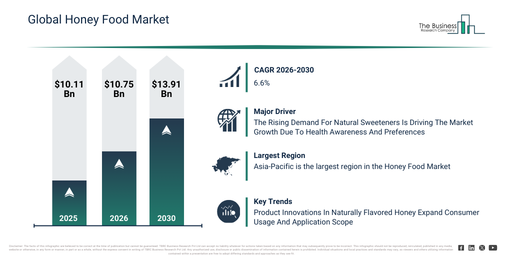
The honey food market size has observed robust growth in recent years. It is anticipated to expand from $10.11 billion in 2025 to $10.75 billion in 2026, demonstrating a compound annual growth rate (CAGR) of 6.4%. The expansion witnessed in the historic period can be attributed to the traditional consumption of honey as a sweetener, increasing awareness of honey’s health benefits, the development of local beekeeping and honey production, the broadening of retail distribution channels, and its rising application in food and beverages.
The honey food market is expected to witness significant expansion over the next few years, with its size projected to reach $13.91 billion by 2030, exhibiting a compound annual growth rate (CAGR) of 6.6%. This growth during the forecast period is primarily driven by an increasing demand for infused and functional honey products, the expansion of online and direct-to-consumer distribution channels, growing applications in pharmaceuticals and cosmetics, the broadening of the premium and monofloral honey market, and the adoption of sustainable and traceable sourcing practices for honey. Major trends anticipated in this period include a rising consumer preference for natural and organic honey, the development of functional and infused honey products, the emergence of premium and specialty honey segments, the prominence of e-commerce and direct-to-consumer sales, and wider applications in health and wellness.
Download A Free Sample Report For Comprehensive Market Insights:
Honey Food Market Industry Drivers: What Is Driving Revenue Growth?
The honey food market is anticipated to expand due to the rising demand for natural sweeteners. Natural sweeteners, including honey, originate from whole or minimally processed ingredients and are prized for offering both sweetness and nutritional advantages over refined sugars. This increasing preference for natural alternatives stems from heightened health awareness and a greater understanding of the adverse health effects linked to overconsumption of refined sugar. Honey-based food products facilitate healthier eating by acting as a widely embraced natural substitute for refined sweeteners in both established and developing markets. As an illustration, in March 2024, the United States Department of Agriculture, a US-based government department, reported that honey production in the United States reached 139 million pounds in 2023, marking an 11% rise from 2022. Consequently, the expanding demand for natural sweeteners is a key driver for the honey food market’s growth.
Honey Food Market Segmentation Trends And Revenue Drivers
The honey food market covered in this report is segmented –
1) By Product Type: Raw Honey, Processed Honey, Flavored Honey, Creamed Honey, Comb Honey, Organic Honey, Industrial-Grade Honey, Honey-Based Spreads, Honey-Infused Products, Specialty Or Monofloral Honey
2) By Packaging Type: Bottles, Jars, Pouches Or Sachets, Tubes, Bulk Packaging
3) By Distribution Channel: Supermarkets And Hypermarkets, Convenience Stores, Specialty Stores, Online Retail, Direct-To-Consumer Channels, Wholesalers And Distributors, Farm Shops And Local Markets, Other Distribution Channels
4) By Application: Food And Beverages, Pharmaceuticals, Cosmetics And Personal Care, Dietary Supplements, Foodservice Or HoReCa, Household Consumption, Industrial Food Processing, Other Applications
Subsegments:
1) By Raw Honey: Wildflower Raw Honey, Multiflora Raw Honey, Monofloral Raw Honey, Unfiltered Raw Honey, Cold Extracted Raw Honey
2) By Processed Honey: Pasteurized Honey, Filtered Honey, Blended Processed Honey, Heat Treated Honey, Ultrafiltered Honey
3) By Flavored Honey: Herb Infused Honey, Fruit Infused Honey, Spice Infused Honey, Vanilla Flavored Honey, Citrus Flavored Honey
4) By Creamed Honey: Spreadable Creamed Honey, Whipped Creamed Honey, Fine Crystal Creamed Honey, Flavored Creamed Honey, Artisanal Creamed Honey
5) By Comb Honey: Cut Comb Honey, Chunk Comb Honey, Whole Comb Honey, Raw Comb Honey, Premium Edible Comb Honey
6) By Organic Honey: Certified Organic Monofloral Honey, Certified Organic Wildflower Honey, Organic Raw Honey, Organic Forest Honey, Organic Mountain Honey
7) By Industrial-Grade Honey: Bulk Industrial Honey, Commercial Blended Honey, Food Processing Grade Honey, Cosmetic Grade Honey, Pharmaceutical Grade Honey
8) By Honey-Based Spreads: Honey Nut Spread, Honey Chocolate Spread, Honey Fruit Spread, Honey Butter Spread, Honey Cinnamon Spread
9) By Honey-Infused Products: Honey Infused Snacks, Honey Infused Beverages, Honey Infused Sauces, Honey Infused Confectionery, Honey Infused Wellness Products
10) By Specialty Or Monofloral Honey: Manuka Honey, Acacia Honey, Lavender Honey, Sidr Honey, Eucalyptus Honey
#Honey Food Market Growth Trends: What Is Influencing The Future Outlook?
Leading companies in the honey food market are concentrating on creating innovative, naturally flavored honey offerings. This strategic focus aims to expand consumption opportunities, improve taste, and appeal to consumers concerned with health. Naturally flavored honey is defined as pure honey infused with natural components like fruits or spices, providing additional flavor without artificial ingredients, all while preserving honey’s inherent nutritional value. An illustrative example is Nate’s Honey, a US-based honey brand, which introduced three new naturally flavored honeys in November 2025. These products were specifically developed to extend honey’s everyday application beyond its conventional role as a sweetener. This new line seeks to attract consumers looking for clean-label, adaptable food choices and is marketed for diverse uses, including drinks, breakfast meals, baking, and cooking, thereby promoting wider household acceptance and increased consumption of value-added honey.
#Honey Food Market Industry Leaders: Which Organizations Are Driving Competition?
Major companies operating in the honey food market are Dabur India Limited, Capilano Honey Limited, GloryBee Foods Inc, Barkman Honey LLC, Dutch Gold Honey Inc, Nature Nates, Manuka Health New Zealand Limited, Dalian Sangdi Honeybee Co. Ltd., Bee Maid Honey Limited, Comvita Limited, Sioux Honey Association Cooperative, Y.S. Organic Bee Farms, New Zealand Honey Co. Ltd, Little Bee Impex Private Limited, Heavenly Organics, Beeyond the Hive, Hi Tech Natural Products India Limited, Pasiina Oy trading as Polar Honey Finland Lappi Hunaja, Golden Acres Honey Products Ltd, Anhui Mizhiyuan Food Group Co. Ltd., and Streamland Biological Technology Limited
Access The Complete Honey Food Market Report:
Honey Food Market Largest Region By Revenue And Market Share
Asia-Pacific was the largest region in the honey food market in 2025. North America is expected to be the fastest-growing region in the forecast period. The regions covered in the honey food market report are Asia-Pacific, South East Asia, Western Europe, Eastern Europe, North America, South America, Middle East, Africa.
Get in touch with us:
The Business Research Company: https://www.thebusinessresearchcompany.com/
Americas: +1 310-496-7795
Asia: +44 7882 955267 & +91 8897263534
Europe: +44 7882 955267
Email us at: marketing@tbrc.info
Follow us on:
LinkedIn: https://in.linkedin.com/company/the-business-research-company
YouTube: https://www.youtube.com/channel/UC24_fI0rV8cR5DxlCpgmyFQ
Global Market Model: https://www.thebusinessresearchcompany.com/global-market-model

Wasay has over a decade of experience in market research, data modelling, and analytics, with prior experience at GlobalData and Decision Tree Consulting Services. At The Business Research Company , he leads research operations across syndicated studies, customized consulting engagements, and the Global Market Model platform. His professional experience includes supporting organizations such as Boston Consulting Group, KPMG, and Ernst & Young. Wasay holds a degree in Electronics and Communications Engineering, postgraduate management qualifications from International Management Institute Belgium and Indian School of Business and Entrepreneurship, and completed the Integrated Program in Business Analytics from Indian Institute of Management Indore.