Designed to make market research more actionable and strategically valuable, The Business Research Company’s 2026 market reports feature market attractiveness scoring, total addressable market sizing, company benchmarking matrices, interactive Excel dashboards, deeper supply chain intelligence, emerging startup tracking, and granular product-level insights.
Natural Oil Polyols Market Revenue Expansion Outlook For The 2026–2030 Forecast Period
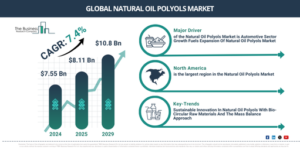
The natural oil polyols market has shown robust expansion over recent years. It is anticipated to increase from $8.11 billion in 2025 to $8.74 billion in 2026, demonstrating a compound annual growth rate (CAGR) of 7.8%. The historical growth in this market stems from factors such as the development of vegetable oil-based polyols, heightened environmental regulations impacting petrochemical polyols, the broadening scope of polyurethane foam applications, the availability of agricultural oil feedstocks, and the rise of green chemistry initiatives.
The natural oil polyols market size is projected for substantial growth in the coming years, with an expectation to reach $11.47 billion by 2030, demonstrating a compound annual growth rate (CAGR) of 7.0%. This expansion during the forecast period is primarily driven by increasing demand for circular economy materials, the broader adoption of bio-based plastics, growing investments in sustainable polymers, the escalating needs of automotive electrification, and a heightened focus on reducing carbon footprints. Furthermore, key trends throughout this period include the rising uptake of bio-based polyurethanes, their increasing application in sustainable construction materials, a growing demand for low-VOC coatings, the broadening of automotive lightweight applications, and an enhanced emphasis on renewable feedstocks.
Download A Free Sample For In-Depth Natural Oil Polyols Market Intelligence:
Natural Oil Polyols Market Demand Driver: How It Is Shaping Industry Growth
The Natural Oil Polyols market is projected to expand due to increasing demand within the automotive industry. This sector encompasses the creation, production, promotion, and distribution of motor vehicles, including both passenger and commercial types. The surge in automotive demand primarily stems from urbanization and economic prosperity, as growing urban populations and higher disposable incomes in developing economies boost vehicle acquisition and manufacturing to fulfill transport requirements. Natural oil polyols are crucial for the automotive sector because these bio-derived substances are vital for making lightweight polyurethane foams utilized in car seats, interior components, and insulation, thereby assisting manufacturers in lowering vehicle mass and adhering to environmental standards. For example, the European Automobile Manufacturers’ Association (ACEA), a Belgium-based automobile association, reported in March 2025 that global car sales reached 74.6 million units in 2024, representing a 2.5% increase compared to 2023. Consequently, the rising demand in the automotive sector is a key factor driving the expansion of the natural oil polyols market. Growth in the Natural Oil Polyols market is also anticipated to be propelled by the rising demand from the construction industry. This sector encompasses activities associated with developing, refurbishing, and maintaining infrastructure, alongside residential, commercial, and industrial structures. As urbanization intensifies due to individuals migrating for better employment, education, and living conditions, the need for new infrastructure fuels expansion in construction. Natural oil polyols are crucial in construction, enhancing the sustainability and efficacy of various materials like coatings, adhesives, and foams. They provide environmentally friendly substitutes for petrochemical-derived polyols, fostering more sustainable construction methods. For instance, the United States Census Bureau, a US-based government administration, reported in July 2024 that in June 2023, building permits were issued for 1,493,000 privately owned housing units at a seasonally adjusted annual rate, which was 3.1 percent higher than the May rate of 1,399,000. Additionally, privately owned home starts in June 2023 reached a seasonally adjusted annual rate of 1,415,000, an increase of 4.4 percent compared to the May 2023 rate of 1,314,000. Thus, the escalating demand within the construction sector is a significant driver for the natural oil polyols market’s expansion.
Natural Oil Polyols Market Segmentation Overview: Detailed Category Analysis
The natural oil polyols market covered in this report is segmented –
1) By Type: Polyester Oil, Polyether Oil
2) By Application: Polyurethane Foams, Cushioning, Other Applications
3) By End-User: Construction, Automobile
Subsegments:
1) By Polyester Oil: Vegetable Oil-Based Polyester Polyols, Animal Fat-Based Polyester Polyols
2) By Polyether Oil: Propylene Oxide-Based Polyether Polyols, Ethylene Oxide-Based Polyether Polyols
Top Natural Oil Polyols Market Trends And Recent Industry Developments
Leading companies in the natural oil polyols market are concentrating on developing technological advancements, such as 100% bio-based polyester polyols, to satisfy the growing demand for sustainable, low-carbon polyurethane materials in coatings, adhesives, sealants, elastomers (CASE), and foam applications. A bio-based polyester polyol is derived from renewable vegetable oils (like soybean or castor oil) and functions similarly to traditional petrochemical polyols in polyurethane synthesis. It reacts with isocyanates to produce foams, coatings, or adhesives, offering benefits like a reduced carbon footprint, renewable content, and improved environmental compliance. For instance, in September 2024, Cargill, Incorporated, a US-based agribusiness and industrial chemicals company, unveiled three 100% bio-based polyols at FEICA 2024. These products include a fully bio-based polyester polyol suitable for PU foams and coatings, an rPET-derived polyol that promotes circular-economy use, and a next-generation polyol designed to eliminate isocyanates, collectively enabling formulators to maintain performance while increasing renewable content and sustainability claims.
Natural Oil Polyols Market Company Landscape: Key Players To Watch
Major companies operating in the natural oil polyols market are Cargill Incorporated, Mitsui Chemicals Inc., BASF SE, Repsol S.A, The Dow Chemical Company, Wanhua Chemical Group, Covestro AG, Evonik Industries AG, Arkema, Huntsman International LLC., Stepan Company, Croda International Plc, Perstorp Holding AB, Sanyo Chemical Industries Ltd., Kukdo Chemical Co. Ltd., Jayant Agro Organics Ltd., Oleon NV, Emery Oleochemicals, Elevance Renewable Sciences Inc., Novomer Inc
Explore The Natural Oil Polyols Global Market Report For Full Insights:
Natural Oil Polyols Market Region-Wise Analysis: Largest Regional Market Identified
North America was the largest region in the natural oil polyols market in 2025. The regions covered in the natural oil polyols market report are Asia-Pacific, South East Asia, Western Europe, Eastern Europe, North America, South America, Middle East and Africa.
Reach Out To Our Team:
The Business Research Company: https://www.thebusinessresearchcompany.com/
Americas: +1 310-496-7795
Asia: +44 7882 955267 & +91 8897263534
Europe: +44 7882 955267
Email us at: marketing@tbrc.info
Follow us on:
LinkedIn: https://in.linkedin.com/company/the-business-research-company
YouTube: https://www.youtube.com/channel/UC24_fI0rV8cR5DxlCpgmyFQ
Global Market Model: https://www.thebusinessresearchcompany.com/global-market-model

Wasay has over a decade of experience in market research, data modelling, and analytics, with prior experience at GlobalData and Decision Tree Consulting Services. At The Business Research Company , he leads research operations across syndicated studies, customized consulting engagements, and the Global Market Model platform. His professional experience includes supporting organizations such as Boston Consulting Group, KPMG, and Ernst & Young. Wasay holds a degree in Electronics and Communications Engineering, postgraduate management qualifications from International Management Institute Belgium and Indian School of Business and Entrepreneurship, and completed the Integrated Program in Business Analytics from Indian Institute of Management Indore.