Backed by market attractiveness analysis, total addressable market sizing, company benchmarking matrices, interactive Excel dashboards, wider supply chain intelligence, emerging startup coverage, and detailed product-level insights, The Business Research Company’s 2026 market reports are designed to offer research that is more actionable and strategically valuable than ever.
Organic Wine Market CAGR Outlook And Future Development
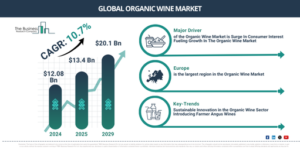
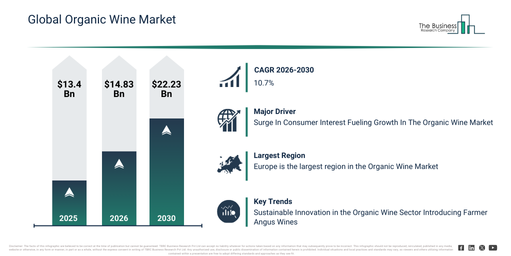
The organic wine market has observed substantial growth in recent years. It is projected to expand from $13.4 billion in 2025 to $14.83 billion in 2026, exhibiting a compound annual growth rate (CAGR) of 10.7%. Historically, this expansion can be ascribed to the broader adoption of organic farming practices in viticulture, growing consumer consciousness regarding organic alcohol, the proliferation of boutique wineries, enhanced certification of organic vineyards, and an increase in premium wine consumption.
The organic wine market size is set for significant expansion over the next few years. It is expected to reach $22.23 billion in 2030, demonstrating a compound annual growth rate (CAGR) of 10.7%. This projected increase is largely due to a rising consumer demand for sustainable alcoholic beverages, greater accessibility through online wine retail, an increase in organic wine exports, increased investments in eco-friendly packaging, and consumers’ growing preference for transparency in wine sourcing. Prominent trends anticipated in this period encompass a stronger inclination towards chemical-free wine production, an escalating demand for premium organic wines, the widespread adoption of sustainable vineyard practices, enhanced traceability in wine production processes, and a heightened focus on authentic regional varietals.
Get A Free Sample Report With In-Depth Market Insights:
Organic Wine Market Growth Momentum: What Factors Are Shaping Demand?
Consumer enthusiasm for organic wines is projected to boost the organic wine market. Organic wine is a completely natural and genuine beverage produced without synthetic chemical agents throughout its making. Such organic products have recently surged in demand due to their many advantages, including the absence of chemicals and shifts in dietary and lifestyle choices. For example, in September 2023, Wine Australia, an Australian government corporation, reported that in 2022–23, Australia exported 180,000 cases of organic wine, valued at $10 million FOB. This quantity accounted for 0.3% of the total wine export volume and 0.5% of the total export value for the year. Consequently, consumers’ rising interest in organic wines is fueling the expansion of the organic wine market.
Organic Wine Market Segments: Where Is Growth Concentrated?
The organic wine market covered in this report is segmented –
1) By Product Type: Red Organic Wine, White Organic Wine
2) By Packaging: Bottles, Cans
3) By Distribution Channel: Business-tTo-Business (B2B), Business-To-Consumer (B2C), Online Retailing
Subsegments:
1) By Red Organic Wine: Organic Cabernet Sauvignon, Organic Merlot, Organic Pinot Noir, Organic Syrah Or Shiraz
2) By White Organic Wine: Organic Chardonnay, Organic Sauvignon Blanc, Organic Riesling, Organic Pinot Grigio
Organic Wine Market Trends Redefining Industry Growth
Leading companies in the organic wine market are prioritizing the development of innovative products, such as Farmer Angus Wines, to cater to consumer preferences for healthier, environmentally conscious alternatives. Farmer Angus Wines are produced using biodynamic farming techniques, with an emphasis on sustainability and natural processes. These wines underscore the unique characteristics of the land, involving minimal intervention throughout their production. For instance, in July 2024, Spier Wine Farm, a South Africa-based company, introduced Farmer Angus Wines, delivering notable benefits through its commitment to organic and regenerative farming methods. The wines are created without synthetic chemicals, thereby encouraging soil vitality and biodiversity, which ultimately improves the quality of the grapes and supports a more robust ecosystem.
Organic Wine Market Key Participants And Competitive Landscape
Major companies operating in the organic wine market are Avondale Wine Estate, Elgin Ridge Wine Estate, The Organic Wine Company, King Estate Winery, Grgich Hills Estate, Viña Emiliana S.A., Società Agricola Querciabella S.p.A., Frey Vineyards, Xinjiang Tiansai Winery Co. Ltd., La Cantina Pizzolato S.r.l., Tamburlaine Organic Wines Pty. Ltd., Bonterra Organic Vineyards, Dry Farm Wines, Vintage Roots, Mount Avoca Vineyard, Domaine de la Coulée de Serrant, Kendall-Jackson Wine Estate and Gardens, Bronco Wine Company, Caviro Cooperativa Vitivinicola, Trinchero Family Estates, Marchesi Antinori S.p.A., Castel Group, Cantina Tramin
View The Full Organic Wine Market Report:
Organic Wine Market Regional Breakdown: Where Is Demand Concentrated?
Europe was the largest region in the organic wines market in 2025. The regions covered in the organic wine market report are Asia-Pacific, South East Asia, Western Europe, Eastern Europe, North America, South America, Middle East and Africa.
Reach Out To Our Team:
The Business Research Company: https://www.thebusinessresearchcompany.com/
Americas: +1 310-496-7795
Asia: +44 7882 955267 & +91 8897263534
Europe: +44 7882 955267
Email us at: marketing@tbrc.info
Follow us on:
LinkedIn: https://in.linkedin.com/company/the-business-research-company
YouTube: https://www.youtube.com/channel/UC24_fI0rV8cR5DxlCpgmyFQ
Global Market Model: https://www.thebusinessresearchcompany.com/global-market-model

Wasay has over a decade of experience in market research, data modelling, and analytics, with prior experience at GlobalData and Decision Tree Consulting Services. At The Business Research Company , he leads research operations across syndicated studies, customized consulting engagements, and the Global Market Model platform. His professional experience includes supporting organizations such as Boston Consulting Group, KPMG, and Ernst & Young. Wasay holds a degree in Electronics and Communications Engineering, postgraduate management qualifications from International Management Institute Belgium and Indian School of Business and Entrepreneurship, and completed the Integrated Program in Business Analytics from Indian Institute of Management Indore.