The Business Research Company’s 2026 market reports are designed to deliver research that is more actionable and strategically valuable. Key offerings include market attractiveness scoring, total addressable market sizing, company benchmarking matrices, interactive Excel dashboards, deeper supply chain intelligence, emerging startup tracking, and granular product-level insights.
Pork Market Size Insights: Annual Growth Rate, Revenue Outlook And Forecast Drivers
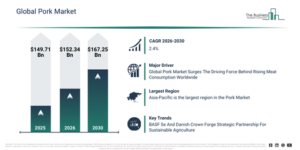
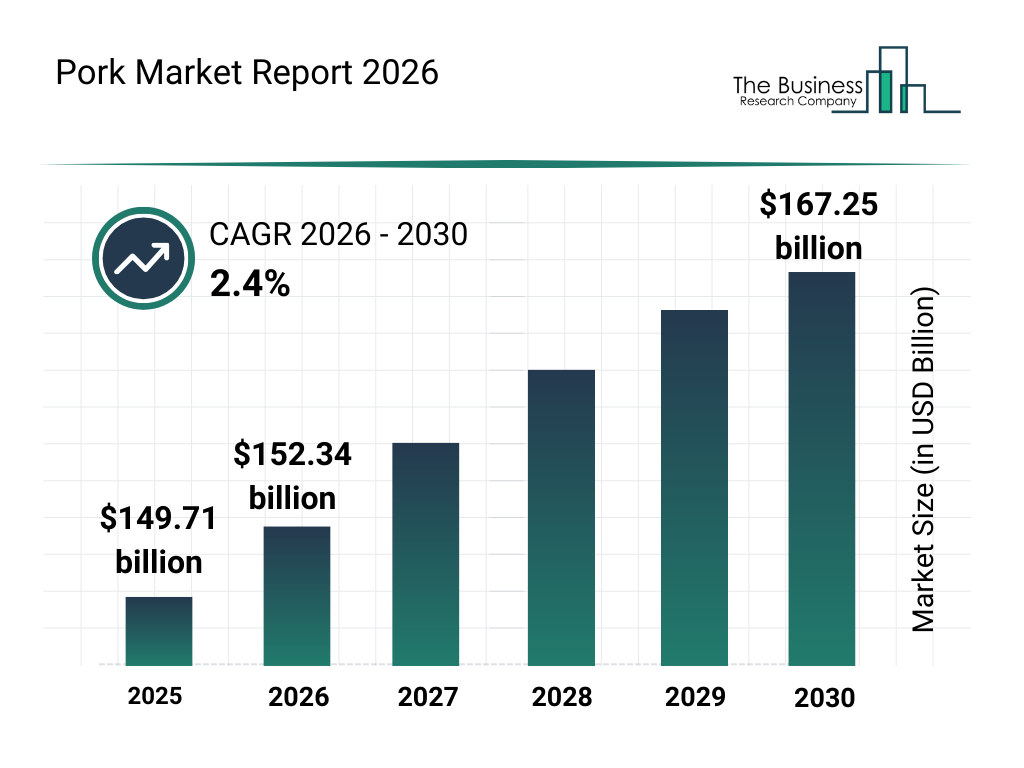
The pork market has seen marginal growth over recent years. It is anticipated to expand from $149.71 billion in 2025 to $152.34 billion in 2026, at a compound annual growth rate (CAGR) of 1.8%. This historic growth can be attributed to several factors including the expansion of commercial pig farming operations, rising pork consumption among urban populations, enhancements in meat processing infrastructure, increased availability of chilled and frozen pork products, and the growing retail penetration of packaged meat.
The pork market size is anticipated to undergo steady expansion in the coming years, with projections indicating it will reach $167.25 billion by 2030, exhibiting a compound annual growth rate (CAGR) of 2.4%. This growth over the forecast period is attributed to a rising demand for protein-rich diets, increased attention to animal welfare standards, the broadening consumption of processed meats, greater adoption of advanced packaging technologies, and enhanced regulatory oversight on meat quality. Major trends expected during this period include a growing embrace of sustainable livestock farming practices, an escalating demand for traceable and quality-certified pork, wider use of advanced cold chain packaging, an expansion in value-added pork products, and a stronger emphasis on food safety compliance.
Request A Free Excerpt Of The Pork Global Market Report 2026:
What Will Drive Pork Market Growth Through 2030?
The increasing global consumption of meat is propelling the pork market forward. Meat refers to the edible components of animals, typically domesticated cattle, swine, and sheep, utilized as food, which can include tendons, ligaments, and muscle tissue. Pork stands out as an excellent option for meals and consumption because it is cost-effective to produce, boasts a high protein content, and offers great adaptability. For instance, in October 2025, as reported by Meat And Livestock Australia Limited, an Australia-based non-profit organization founded in 2024, Australia’s red meat and livestock exports saw a 3.2% year-on-year increase, achieving a value of $19.5 billion. Consequently, the rising worldwide intake of meat is a primary driver for the pork market.
Pork Market Segment Analysis Covering All Major Categories
The pork market covered in this report is segmented –
1) By Type: Chilled, Frozen
2) By Packaging: Store Wrap, Modified Atmosphere Packaging, Vacuum Packaging, Shrink Bags
3) By Application: Household, Commercial
Subsegments:
1) By Chilled: Fresh Chilled Pork Cuts, Fresh Chilled Pork Primal Cuts, Fresh Chilled Pork Offal
2) By Frozen: Frozen Pork Cuts, Frozen Pork Primal Cuts, Frozen Pork Offal
Major Trends Shaping The Future Of The Pork Market
Leading companies in the pork market are implementing a strategic partnership strategy to decrease the carbon footprint associated with pork production. These partnerships involve businesses utilizing each other’s strengths and resources to attain shared advantages and successful outcomes. For example, in May 2023, BASF SE, a German energy management firm, revealed a collaboration with Danish Crown, a Danish pork manufacturing enterprise. This partnership aims to demonstrate that nitrification inhibitors can reduce nitrous oxide emissions by as much as 50% when fertilizers are applied to grow feed crops. The initiative also receives funding from DLG Group, an association comprising 25,000 Danish farmers, and SEGES Innovation, an independent, non-profit Danish agricultural research and development company that is privately held. BASF and Danish Crown are working together to provide extensive field documentation of the improved climate impact of BASF’s nitrification inhibitors. These substances can be easily incorporated into manure during field application. Their active components are capable of halving nitrous oxide emissions by slowing down the process where specific soil bacteria convert ammonium into nitrate.
Pork Market Competitive Environment And Key Companies
Major companies operating in the pork market are JBS SA, Tyson Foods Inc., Danish Crown A S, Vion Food Group Ltd., WH Group Limited, Hormel Foods Corporation, Muyuan Foods Co. Ltd., China Yurun Food Group Co. Ltd., Craig Mostyn Group, Tonnies Group, Cargill Inc., Seaboard Foods LLC, Triumph Foods LLC, Prestage Farms Inc., The Maschhoffs LLC, Clemens Food Group LLC, Indiana Packers Corporation, Maple Leaf Foods Inc., BRF S A, Marfrig Global Foods S A
Access Expert Pork Market Analysis In The Full Report:
Which Regions Are Covered In The Pork Market Report?
Asia-Pacific was the largest region in the pork market in 2025. The regions covered in the pork market report are Asia-Pacific, South East Asia, Western Europe, Eastern Europe, North America, South America, Middle East and Africa.
Reach Out To Our Team:
The Business Research Company: https://www.thebusinessresearchcompany.com/
Americas: +1 310-496-7795
Asia: +44 7882 955267 & +91 8897263534
Europe: +44 7882 955267
Email us at: marketing@tbrc.info
Follow us on:
LinkedIn: https://in.linkedin.com/company/the-business-research-company
YouTube: https://www.youtube.com/channel/UC24_fI0rV8cR5DxlCpgmyFQ
Global Market Model: https://www.thebusinessresearchcompany.com/global-market-model

Wasay has over a decade of experience in market research, data modelling, and analytics, with prior experience at GlobalData and Decision Tree Consulting Services. At The Business Research Company , he leads research operations across syndicated studies, customized consulting engagements, and the Global Market Model platform. His professional experience includes supporting organizations such as Boston Consulting Group, KPMG, and Ernst & Young. Wasay holds a degree in Electronics and Communications Engineering, postgraduate management qualifications from International Management Institute Belgium and Indian School of Business and Entrepreneurship, and completed the Integrated Program in Business Analytics from Indian Institute of Management Indore.