Featuring market attractiveness scoring, total addressable market sizing, company benchmarking matrices, interactive Excel dashboards, deeper supply chain intelligence, emerging startup tracking, and granular product-level insights, The Business Research Company’s 2026 market reports are built to deliver research that is both more actionable and more strategically valuable.
Reduced Caffeine Beverages Market Set To Climb From $4.8 Billion In 2026 To $6.41 Billion By 2030
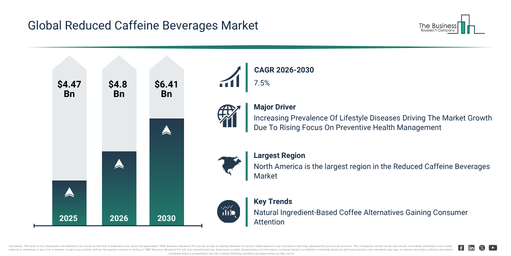
The market size for reduced caffeine beverages has experienced substantial growth in recent years. This market is anticipated to increase from $4.47 billion in 2025 to $4.8 billion in 2026, achieving a compound annual growth rate (CAGR) of 7.3%. Over the historic period, this growth can be ascribed to a strong global coffee and tea consumption culture, increasing demand for energy drinks among the younger population, heightened awareness of health issues associated with caffeine, the expansion of the packaged beverage industry, and improved availability of retail beverages in urban environments.
The reduced caffeine beverages market size is forecasted to undergo significant expansion in the coming years. It is projected to reach a valuation of $6.41 billion in 2030, demonstrating a compound annual growth rate (CAGR) of 7.5%. This growth during the forecast period is attributable to increasing health awareness and sleep wellness trends, a rising demand for functional and adaptive beverages, the advancement of personalized nutrition and dietary customization, the expansion of natural ingredient-based beverage innovation, and stricter regulations concerning labeling and caffeine content transparency. Prominent trends expected in this period include a growing demand for functional beverages with controlled stimulant intake catering to health-conscious consumers, an increase in decaffeinated and half-caffeine hybrid beverage formulations across coffee and tea sectors, enhanced product innovation in low-caffeine energy drinks incorporating natural stimulants, the broadening of clean label and plant-based reduced-caffeine beverage options, and a rising preference for personalized nutrition-based beverage consumption patterns.
Get A Free Sample Report With In-Depth Market Insights:
Reduced Caffeine Beverages Market Growth Catalysts And Demand Drivers
The increasing prevalence of lifestyle diseases is projected to drive the growth of the reduced caffeine beverages market going forward. Lifestyle diseases are chronic health conditions such as obesity, diabetes, and cardiovascular disorders, primarily caused by unhealthy diet, physical inactivity, and other behavioral factors. The rise in these conditions is attributed to increasing sedentary behavior, as reduced physical activity slows metabolism, contributes to weight gain, and elevates the risk of chronic conditions including obesity, diabetes, and cardiovascular diseases. Reduced caffeine beverages assist in managing lifestyle diseases by lowering excessive caffeine intake, which can support better sleep quality, reduce stress levels, and contribute to improved cardiovascular and metabolic health over time. For instance, in June 2024, the National Health Service, a UK-based government department, reported that around 3.62 million individuals registered with a general practitioner (GP) were diagnosed with non-diabetic hyperglycemia or pre-diabetes in 2023, marking an increase from 3.07 million cases in 2022. Therefore, the increasing prevalence of lifestyle diseases is driving the growth of the reduced caffeine beverages market.
Reduced Caffeine Beverages Market Segment Landscape And Growth Outlook
The reduced caffeine beverages market covered in this report is segmented –
1) By Product Type: Reduced Caffeine Coffee, Reduced Caffeine Tea, Reduced Caffeine Soft Drinks, Reduced Caffeine Energy Drinks, Other Product Types
2) By Distribution Channel: Supermarkets Or Hypermarkets, Convenience Stores, Online Retail, Specialty Stores, Other Distribution Channels
3) By End User: Adults, Teenagers, Elderly, Other End Users
Subsegments:
1) By Reduced Caffeine Coffee: Decaffeinated Roasted Coffee Beans, Half Caff Ground Coffee, Instant Decaf Coffee, Low Caffeine Espresso Blends, Cold Brew Reduced Caffeine Coffee, Coffee Pods
2) By Reduced Caffeine Tea: Decaffeinated Black Tea, Decaffeinated Green Tea, Low Caffeine White Tea, Herbal Tea Blends With Trace Caffeine, Half Caffeine Chai Blends, Cold Brew Decaf Tea
3) By Reduced Caffeine Soft Drinks: Caffeine Free Cola Variants, Low Caffeine Citrus Sodas, Reduced Caffeine Flavored Carbonated Drinks, Diet Soft Drinks With Reduced Caffeine, Energy Soda Hybrids, Functional Sparkling Beverages
4) By Reduced Caffeine Energy Drinks: Low Caffeine Energy Shots, Hybrid Energy Drinks, Electrolyte Based Low Caffeine Energy Drinks, Natural Stimulant Based Drinks, Sugar Free Low Caffeine Energy Drinks, Sports Energy Crossover Drinks
5) By Other Product Types: Reduced Caffeine Chocolate Beverages, Low Caffeine Plant Based Drinks, Functional Wellness Drinks, Reduced Caffeine Flavored Waters, Caffeine Controlled Protein Drinks, Specialty Ayurvedic Beverages
Reduced Caffeine Beverages Market Trends Shaping Long-Term Demand
Companies operating within the reduced caffeine beverages market are increasingly focused on developing innovative products, specifically plant-based caffeine-free coffee alternatives, to cater to consumers seeking to lower their stimulant intake without sacrificing taste or functional benefits. These plant-based options are crafted from natural ingredients such as roasted grains, nuts, seeds, legumes, or botanicals, designed to replicate coffee’s flavor and aroma without caffeine. This helps consumers avoid common side effects like jitteriness, sleep disruption, and increased heart rate while still enjoying a coffee-like experience. For example, in January 2024, Kamana, a US-based beverage brand, introduced a mesquite-based caffeine-free coffee alternative. This product was specifically formulated to emulate the taste and aroma of traditional coffee while removing caffeine, thereby assisting consumers in avoiding issues such as jitteriness, sleep interruption, and an elevated heart rate, and instead promoting a smoother, more balanced beverage experience. The drink is created using roasted mesquite pods, which naturally contribute a subtly sweet, earthy flavor profile, alongside mild cocoa-like and caramel undertones, delivering a coffee-esque sensory experience without needing coffee beans. It is positioned as a functional and wellness-oriented drink, suitable for individuals aiming to reduce caffeine intake while still maintaining familiar coffee rituals like brewing and hot consumption.
Reduced Caffeine Beverages Market Industry Leaders And Competitive Landscape
Major companies operating in the reduced caffeine beverages market are Nestlé S.A., PepsiCo Inc., Starbucks Corporation, Tata Consumer Products Limited, R. C. Bigelow Inc., Dilmah Ceylon Tea Company PLC, Luigi Lavazza S.p.A., Verve Coffee Roasters LLC, Traditional Medicinals Inc., Harney & Sons Fine Teas Inc., Counter Culture Coffee Inc., Republic of Tea Inc., Tchibo GmbH, Four Sigmatic Inc., MUD\WTR Inc., Teeccino Caffé Inc., Crio Bru LLC, Rasa LLC, Dandy Blend LLC, Arbor Teas Inc.
View The Full Reduced Caffeine Beverages Market Report:
Reduced Caffeine Beverages Market Regional Analysis And Leading Geography
North America was the largest region in the reduced caffeine beverages market in 2025. Asia-Pacific is expected to be the fastest-growing region in the forecast period. The regions covered in the reduced caffeine beverages market report are Asia-Pacific, South East Asia, Western Europe, Eastern Europe, North America, South America, Middle East, Africa.
Reach Out To Our Team:
The Business Research Company: https://www.thebusinessresearchcompany.com/
Americas: +1 310-496-7795
Asia: +44 7882 955267 & +91 8897263534
Europe: +44 7882 955267
Email us at: marketing@tbrc.info
Follow us on:
LinkedIn: https://in.linkedin.com/company/the-business-research-company
YouTube: https://www.youtube.com/channel/UC24_fI0rV8cR5DxlCpgmyFQ
Global Market Model: https://www.thebusinessresearchcompany.com/global-market-model

Wasay has over a decade of experience in market research, data modelling, and analytics, with prior experience at GlobalData and Decision Tree Consulting Services. At The Business Research Company , he leads research operations across syndicated studies, customized consulting engagements, and the Global Market Model platform. His professional experience includes supporting organizations such as Boston Consulting Group, KPMG, and Ernst & Young. Wasay holds a degree in Electronics and Communications Engineering, postgraduate management qualifications from International Management Institute Belgium and Indian School of Business and Entrepreneurship, and completed the Integrated Program in Business Analytics from Indian Institute of Management Indore.