Market attractiveness scoring, total addressable market sizing, company benchmarking matrices, interactive Excel dashboards, deeper supply chain intelligence, emerging startup tracking, and granular product-level insights are among the key offerings featured in The Business Research Company’s 2026 market reports, designed to deliver more actionable and strategically valuable research.
What Is The Sparkling Wine Market Size In 2026, And Where Is It Heading By 2030?
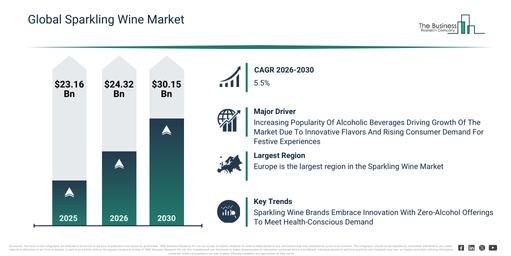
The sparkling wine market has experienced consistent expansion over recent years. It is projected to expand from $23.16 billion in 2025 to $24.32 billion in 2026, demonstrating a compound annual growth rate (CAGR) of 5.0%. Historically, this growth can be attributed to several factors, including increased global wine consumption, the proliferation of on-trade hospitality establishments, the growing appeal of celebratory drinks, enhanced production of Prosecco and Champagne, and the broadening of international wine commerce.
The sparkling wine market is projected to experience substantial growth in the upcoming years. Its value is expected to reach $30.15 billion by 2030, growing at a compound annual growth rate (CAGR) of 5.5%. This expansion during the forecast period is primarily attributed to a heightened demand for premium alcoholic beverages, an increasing emphasis on sustainable wine production practices, the growth of e-commerce channels for alcohol sales, consumers’ evolving preference for authentic wine experiences, and continuous innovation in sparkling wine manufacturing techniques. Significant trends during this period include a rising demand for premium and artisanal sparkling wines, the growing popularity of low-alcohol and organic variants, increased adoption of sustainable packaging solutions, the expansion of direct-to-consumer sales channels, and an enhanced focus on brand differentiation and overall consumer experience.
Request Your Free Sparkling Wine Market Sample With Segment And Regional Data:
Sparkling Wine Market Growth Drivers And Their Impact On Future Demand
The expanding appeal of alcoholic drinks is projected to drive the future growth of the sparkling wine market. Alcoholic drinks are defined as those containing ethanol, which is created through the fermentation of sugars by yeast or via distillation. This growing popularity stems primarily from the introduction of novel flavors and a diverse range of products, including ready-to-drink cocktails and flavored spirits, captivating younger, health-aware consumers who desire fresh and engaging drinking experiences. Sparkling wine stands out as a favored alcoholic drink due to its effervescent and crisp nature, making it ideal for festivities and social events. Its vibrant bubbles and celebratory charm draw in consumers seeking a high-quality, enjoyable drinking experience. For example, reports from the Canada-based government entity, the Agriculture and Agri-Food Department Canada, in July 2025 indicated that in 2024, Canada’s food and beverage processing sector maintained its position as the largest manufacturing industry by production value, producing $173.4 billion in goods. This accounted for 20.3% of all manufacturing sales and contributed 1.6% to the national GDP. Exports of processed food and beverage items achieved a record $59.8 billion, marking a 3.8% rise from 2023, and constituted 34.5% of the industry’s overall production value. Consequently, the widespread occurrence of hazardous alcohol consumption fuels the expansion of the alcoholic beverages market.
What Categories Define The Sparkling Wine Market?
The sparkling wine market covered in this report is segmented –
1) By Wine Color: Red Sparkling Wine, White Sparkling Wine, Rosé Sparkling Wine
2) By Product Type: Cava, Champagne, Crémant, Prosecco, Other Products
3) By Production Method: Traditional Method, Tank Method, Caribbean Method, Carbonic Maceration, Other Production Methods
4) By Distribution Channel: Supermarket Or Hypermarket, Specialty Stores, On Trade, Other Distribution Channels
5) By End User: Residential, Commercial
Subsegments:
1) By Red Sparkling Wine: Dry Red Sparkling Wine, Sweet Red Sparkling Wine, Semi-Dry Red Sparkling Wine
2) By White Sparkling Wine: Brut (Dry) White Sparkling Wine, Extra Dry White Sparkling Wine, Demi-Sec (Semi-Sweet) White Sparkling Wine, Sweet White Sparkling Wine
3) By Rosé Sparkling Wine: Brut Rosé Sparkling Wine, Extra Dry Rosé Sparkling Wine, Demi-Sec Rosé Sparkling Wine
What New Developments Are Emerging In The Sparkling Wine Market?
Leading companies within the sparkling wine sector are increasingly concentrating on novel offerings, such as non-alcoholic or zero-alcohol sparkling wines. This strategic shift addresses the growing consumer preference for healthier and more inclusive drink choices. Zero-alcohol sparkling wines are defined as drinks that emulate the flavor and effervescence of conventional sparkling wines but contain less than 0.5% alcohol by volume, appealing to consumers who prioritize health or are exploring sobriety. For instance, in December 2024, the Chilean wine label Casillero del Diablo introduced Casillero del Diablo Zero, marking its debut alcohol-free sparkling wine. This product is crafted from 100% early-harvested Chardonnay grapes sourced from Chile’s Central Valley and is carefully dealcoholized to maintain its quality, offering just 22 calories per 125 ml glass. The introduction of this product is a direct response to the increasing demand for alcohol-free and low-alcohol alternatives, particularly among younger demographics, with the goal of integrating alcohol-free wine into the mainstream market by capitalizing on Casillero del Diablo’s robust brand recognition as the UK’s third-largest wine brand.
Major Players Driving Competition In The Sparkling Wine Market
Major companies operating in the sparkling wine market are Henkell & Co. Sektkellerei KG, Moët & Chandon S.A., Laurent-Perrier S.A., Champagne Nicolas Feuillatte S.A., Valdo Spumanti S.p.A., Grupo Codorníu Raventós S.A., Schramsberg Vineyards Inc., The Wine Group LLC, Moët Hennessy Louis Vuitton SE, Domaine Carneros LLC, Roederer Estate LLC, Freixenet S.A., Veuve Clicquot Ponsardin S.A., E. & J. Gallo Winery LP, Argyle Winery LLC, Mionetto S.p.A., G.H. Mumm & Cie, Champagne Taittinger S.A., Piper-Heidsieck S.A., Martini & Rossi S.p.A., Santa Margherita S.p.A., Segura Viudas S.A., Bollinger S.A.
View The Comprehensive Sparkling Wine Market Analysis:
Sparkling Wine Market Regional Leaders: Insights From The 2026 Report
Europe was the largest region in the sparkling wine market in 2025. Asia-Pacific is expected to be the fastest-growing region in the forecast period. The regions covered in the sparkling wine market report are Asia-Pacific, South East Asia, Western Europe, Eastern Europe, North America, South America, Middle East and Africa.
Reach Out To Our Team:
The Business Research Company: https://www.thebusinessresearchcompany.com/
Americas: +1 310-496-7795
Asia: +44 7882 955267 & +91 8897263534
Europe: +44 7882 955267
Email us at: marketing@tbrc.info
Follow us on:
LinkedIn: https://in.linkedin.com/company/the-business-research-company
YouTube: https://www.youtube.com/channel/UC24_fI0rV8cR5DxlCpgmyFQ
Global Market Model: https://www.thebusinessresearchcompany.com/global-market-model

Wasay has over a decade of experience in market research, data modelling, and analytics, with prior experience at GlobalData and Decision Tree Consulting Services. At The Business Research Company , he leads research operations across syndicated studies, customized consulting engagements, and the Global Market Model platform. His professional experience includes supporting organizations such as Boston Consulting Group, KPMG, and Ernst & Young. Wasay holds a degree in Electronics and Communications Engineering, postgraduate management qualifications from International Management Institute Belgium and Indian School of Business and Entrepreneurship, and completed the Integrated Program in Business Analytics from Indian Institute of Management Indore.