
Delivering more actionable and strategically valuable research, The Business Research Company’s 2026 market reports feature market attractiveness analysis, total addressable market evaluation, company benchmarking matrices, interactive Excel dashboards, expanded supply chain intelligence, emerging startup coverage, and detailed product insights.
Emergency Medical Services Software Market Size Forecast: How Large Could The Market Become By 2030?
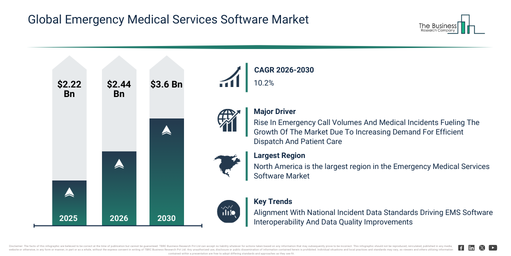
The emergency medical services software market has seen substantial growth in recent years. Its value is expected to increase from $2.22 billion in 2025 to $2.44 billion in 2026, indicating a compound annual growth rate (CAGR) of 10.0%. This past growth can be attributed to factors such as a heightened demand for efficient pre-hospital care, the increasing adoption of digital health solutions, the expansion of emergency medical services infrastructure, a rising requirement for patient data management, and the integration of communication tools within EMS operations.
The emergency medical services software market size is expected to undergo rapid expansion in the next few years. It is projected to grow to $3.6 billion in 2030, demonstrating a compound annual growth rate (CAGR) of 10.2%. This growth during the forecast period can be attributed to advancements in AI-driven dispatch systems, the emergence of cloud-based emergency services solutions, increased adoption of interoperable health record sharing, the expansion of telehealth integration in EMS, and a heightened focus on predictive analytics for resource allocation. Key trends anticipated in the forecast period encompass real-time emergency response coordination, patient data interoperability, optimization of fleet and resources, regulatory compliance and reporting, and the automation of clinical documentation.
Download A Free Sample Report For Comprehensive Market Insights:
Emergency Medical Services Software Market Demand Drivers: What Is Fueling Industry Growth?
The expansion of the emergency medical services software market is anticipated to be driven by an increase in emergency call volumes and medical incidents. These terms define the collective count of emergency service requests handled by dispatch centers and the associated patient care situations managed by EMS staff. The upward trend in emergency calls and medical events stems from factors such as increasing population density, an aging demographic, and the growing incidence of chronic health conditions. Emergency medical services software assists in managing elevated call volumes by facilitating quicker incident prioritization and streamlining dispatch operations, thereby enhancing response times during periods of high demand. As an illustration, the Midland Fire Department, a US fire protection and emergency medical services provider, reported in December 2025 that EMS calls climbed from 14,895 between January and November 2024 to 15,592 for the equivalent period in 2025, marking an approximate 4.08% year-over-year growth. Consequently, the increasing frequency of emergency calls and medical incidents is a key driver for the expansion of the emergency medical services software market.
Emergency Medical Services Software Market Segment Breakdown: Which Categories Generate The Most Revenue?
The emergency medical services software market covered in this report is segmented –
1) By Product Type: Computer-Aided Dispatch, Electronic Patient Care Reporting, Emergency Medical Services (EMS) Billing, Scheduling And Workforce Management, Fleet Management, Other Product Types
2) By Deployment Mode: Cloud-Based, On-Premises
3) By Functionality: Incident Reporting, Resource Allocation, Communication And Coordination, Reporting And Analytics, Compliance Management
4) By Application: Hospitals And Clinics, Emergency Service Providers, Other Applications
5) By End User: Public Ambulance Services, Private Ambulance Services, Healthcare Organizations, Fire Departments, Other Emergency Services
Subsegments:
1) By Computer-Aided Dispatch: Priority Based Dispatch, Real Time Unit Tracking, Call Taking And Triage, Location Based Dispatching, Inter Agency Dispatch Coordination
2) By Electronic Patient Care Reporting: Clinical Documentation Management, Patient Data Capture, Treatment And Outcome Recording, Interoperable Health Record Sharing, Quality Assurance And Audit Support
3) By Emergency Medical Services (EMS) Billing: Insurance Claim Processing, Automated Invoice Generation, Reimbursement Management, Revenue Cycle Optimization, Payment Tracking And Reporting
4) By Scheduling And Workforce Management: Shift Scheduling, Staff Availability Management, Credential And Certification Tracking, Overtime And Leave Management, Workforce Performance Monitoring
5) By Fleet Management: Vehicle Location Tracking, Maintenance And Service Scheduling, Fuel And Cost Monitoring, Asset And Equipment Tracking, Fleet Utilization Analysis
6) By Other Product Types: Inventory And Supply Management, Compliance And Regulatory Reporting, Training And Simulation Management, Analytics And Performance Dashboards, Telehealth And Remote Support Integration
Emergency Medical Services Software Market Innovation Trends: Which Developments Are Transforming The Industry?
Major companies operating in the emergency medical services software market are primarily focused on making their platforms compatible with developing national incident data standards like NEMSIS and the National Emergency Response Information System (NERIS) to enhance the quality and utility of data. NEMSIS-compliant and NERIS-aligned data architectures are standardized digital structures created to organize, validate, and exchange emergency medical and fire incident data in line with federal and state reporting obligations. For example, in April 2024, ImageTrend, a US-based public safety and healthcare software firm, released a policy position statement outlining its strategy for NERIS data flow within its EMS and fire data platform. The company highlighted its commitment to NERIS modernization while advocating for a state-centric data submission model, where incident data continues to move from local agencies to state systems before being transmitted to NERIS. This action demonstrates ImageTrend’s integration of NERIS-aligned data frameworks and transition resources within its software to assist EMS and fire agencies in adapting to the National Emergency Response Information System, concurrently ensuring data governance, interoperability, and compliance with updated federal reporting mandates.
Emergency Medical Services Software Market Key Players And Strategic Industry Positioning
Major companies operating in the emergency medical services software market are Motorola Solutions Incorporation, Hexagon AB, Tyler Technologies Inc., Eso Solutions Inc., ZOLL Medical Corporation, ImageTrend Inc., Forte Holdings Inc., Sansio, Emergency Reporting, Digitech Computer Inc., Ortivus AB, Traumasoft Inc., AngelTrack LLC, MP Cloud Technologies Inc., AIM System, EPIC EMS, Documed Systems International Inc., Healthware Corp., Macrologic Inc., Emergidata.
Access The Complete Emergency Medical Services Software Market Report:
Emergency Medical Services Software Market Regional Outlook: Where Are The Largest Opportunities Located?
North America was the largest region in the emergency medical services software market in 2025. Asia-Pacific is expected to be the fastest-growing region in the forecast period. The regions covered in the emergency medical services software market report are Asia-Pacific, South East Asia, Western Europe, Eastern Europe, North America, South America, Middle East, Africa.
Get in touch with us:
The Business Research Company: https://www.thebusinessresearchcompany.com/
Americas: +1 310-496-7795
Asia: +44 7882 955267 & +91 8897263534
Europe: +44 7882 955267
Email us at: marketing@tbrc.info
Follow us on:
LinkedIn: https://in.linkedin.com/company/the-business-research-company
YouTube: https://www.youtube.com/channel/UC24_fI0rV8cR5DxlCpgmyFQ
Global Market Model: https://www.thebusinessresearchcompany.com/global-market-model

Wasay has over a decade of experience in market research, data modelling, and analytics, with prior experience at GlobalData and Decision Tree Consulting Services. At The Business Research Company , he leads research operations across syndicated studies, customized consulting engagements, and the Global Market Model platform. His professional experience includes supporting organizations such as Boston Consulting Group, KPMG, and Ernst & Young. Wasay holds a degree in Electronics and Communications Engineering, postgraduate management qualifications from International Management Institute Belgium and Indian School of Business and Entrepreneurship, and completed the Integrated Program in Business Analytics from Indian Institute of Management Indore.