The Business Research Company’s 2026 market reports are designed to deliver research that is more actionable and strategically valuable. Key offerings include market attractiveness scoring, total addressable market sizing, company benchmarking matrices, interactive Excel dashboards, deeper supply chain intelligence, emerging startup tracking, and granular product-level insights.
Which Factors Will Shape The Fast Food and Quick Service Restaurant Market Size Through 2030?
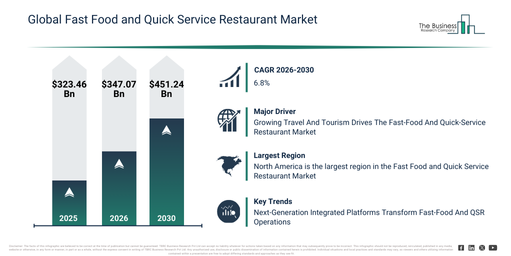
The fast food and quick service restaurant market has experienced significant expansion in recent years. This market is projected to grow from $323.46 billion in 2025 to $347.07 billion in 2026, at a compound annual growth rate (CAGR) of 7.3%. The historical growth of this market can be attributed to several factors, including urbanization trends, busy consumer lifestyles, the rise of franchise models, the affordability of fast food, and the expansion of various food chains.
The fast food and quick service restaurant market is projected to experience substantial expansion in the coming years. This market is anticipated to reach $451.24 billion by 2030, exhibiting a compound annual growth rate (CAGR) of 6.8%. This anticipated growth during the forecast period is primarily driven by factors such as the rise of food delivery platforms, increased adoption of digital payments, expansion into new emerging markets, a consistent demand for rapid meal options, and the integration of automation in kitchen operations. Key trends expected during this period involve the increasing popularity of online and mobile ordering, the broadening of delivery and drive-through services, greater standardization of menus and operational procedures, a growing consumer preference for affordable convenience foods, and a strong emphasis on enhancing speed and operational efficiency.
Request A Free Fast Food and Quick Service Restaurant Market Sample To Support Your Strategic Planning:
What Is Propelling The Fast Food and Quick Service Restaurant Market Toward $451.24 Billion By 2030?
The fast-food and quick-service restaurant market is projected to grow, driven by the increasing need for travel and tourism. This trend encompasses the expansion of the tourism industry and a greater number of individuals undertaking trips for leisure, business, or other purposes. For example, a report released in May 2023 by the United Nations World Tourism Organization, a Spain-based specialized agency, revealed a rebound in international tourist arrivals during the first quarter of 2023, reaching 80% of pre-pandemic volumes with roughly 235 million travelers, signifying more than a twofold increase compared to the same period in 2022. The tourism sector demonstrated remarkable resilience, as updated figures for 2022 indicated that over 960 million international tourists journeyed abroad last year. This accomplishment signifies a recovery of two-thirds (66%) of pre-pandemic levels, showcasing the industry’s capacity for resurgence and regaining momentum. Consequently, the rising demand for travel and tourism is fueling the expansion of the fast-food and quick-service restaurant market.
What Are The Key Segments And Subsegments In The Fast Food and Quick Service Restaurant Market?
The fast food and quick service restaurant market covered in this report is segmented –
1) By Ownership Type: Chain, Independent
2) By Product Type: Burger And Sandwiches, Pizzas And Pastas, Drinks And Desserts, Chicken And Seafood, Other Product Types
3) By Service: Eat-In, Takeaway, Drive-Through, Home Delivery
4) By Cuisine: American, Chinese, Italian, Mexican, Japanese, Turkish And Lebanese, Other Cuisines
Subsegments:
1) By Chain: National Chains, Regional Chains, International Chains
2) By Independent: Local Independents, Specialty Independents, Food Trucks Or Pop-Ups
Fast Food and Quick Service Restaurant Market Trends Behind The 6.8% CAGR Forecast
Leading companies in the fast-food and quick-service restaurant sector are concentrating on developing innovative solutions, such as comprehensive restaurant management platforms. This push responds to the increasing need for streamlined processes, improved customer experiences, and efficient order handling. An integrated restaurant management platform functions as a digital system that centralizes critical restaurant tasks, including point-of-sale activities, inventory control, kitchen procedures, and customer analytics, all within a single interface. This approach provides real-time data insights and boosts operational efficiency compared to older, separate systems. For example, in June 2025, PAR Technology, a US-based restaurant technology firm, introduced its integrated platform specifically for restaurants. This advanced solution aims to modernize QSR operations following 2022. The platform incorporates a cloud-based architecture, enabling management across multiple locations, and offers customizable dashboards for tracking sales and inventory. It also includes automated workflow tools to minimize manual errors and provides analytics-driven insights for optimizing staffing and menu performance. Its distinct ability to combine front-of-house and back-of-house operations leads to quicker service, greater order accuracy, and enhanced customer satisfaction. Furthermore, this technology supports the integration of mobile and online ordering, thereby facilitating a cohesive omnichannel engagement for both dine-in and delivery services.
Major Companies Profiled In The Fast Food and Quick Service Restaurant Market Report
Major companies operating in the fast food and quick service restaurant market are McDonalds Corporation, Burger King Corporation, Carrols Restaurant Group Inc., Chipotle Mexican Grill Inc., Del Taco Restaurants Inc., Jack In The Box Inc., Kotipizza Oyj, Restaurant Brands International Inc., Subway IP LLC, The Wendys Company, Yum Brands Inc., Starbucks Corporation, Dominos Pizza Inc., Coffee Day Global Limited, Dunkin Brands Group Inc., Hunt Brothers Pizza, Jollibee Foods Corporation, Little Caesar Enterprises Inc., Papa Johns International Inc., Arbys Restaurant Group Inc., Bojangles OpCo LLC, Boston Market Corporation, Cafe De Coral Holdings Limited, Captain Ds LLC, CKE Restaurants Holdings Inc., Checkers Drive In Restaurants Inc., Churchs Texas Chicken, Culver Franchising System LLC, International Dairy Queen Inc., El Pollo Loco Holdings Inc., Five Guys Enterprises LLC, Greggs plc, Hardees Food Systems Inc., Jersey Mikes Franchise Systems Inc.
Explore The Business Research Company’s Complete Fast Food and Quick Service Restaurant Market Report:
Where Does The Fast Food and Quick Service Restaurant Market Generate The Most Revenue?
North America was the largest region in the fast food and quick service restaurant market in 2025. Asia-Pacific is expected to be the fastest-growing region in the fast food and quick service restaurant market report during the forecast period. The regions covered in the fast food and quick service restaurant market report are Asia-Pacific, South East Asia, Western Europe, Eastern Europe, North America, South America, Middle East, Africa.
Reach Out To Our Team:
The Business Research Company: https://www.thebusinessresearchcompany.com/
Americas: +1 310-496-7795
Asia: +44 7882 955267 & +91 8897263534
Europe: +44 7882 955267
Email us at: marketing@tbrc.info
Follow us on:
LinkedIn: https://in.linkedin.com/company/the-business-research-company
YouTube: https://www.youtube.com/channel/UC24_fI0rV8cR5DxlCpgmyFQ
Global Market Model: https://www.thebusinessresearchcompany.com/global-market-model

Wasay has over a decade of experience in market research, data modelling, and analytics, with prior experience at GlobalData and Decision Tree Consulting Services. At The Business Research Company , he leads research operations across syndicated studies, customized consulting engagements, and the Global Market Model platform. His professional experience includes supporting organizations such as Boston Consulting Group, KPMG, and Ernst & Young. Wasay holds a degree in Electronics and Communications Engineering, postgraduate management qualifications from International Management Institute Belgium and Indian School of Business and Entrepreneurship, and completed the Integrated Program in Business Analytics from Indian Institute of Management Indore.