Market attractiveness scoring, total addressable market sizing, company benchmarking matrices, interactive Excel dashboards, deeper supply chain intelligence, emerging startup tracking, and granular product-level insights are among the key offerings featured in The Business Research Company’s 2026 market reports, designed to deliver more actionable and strategically valuable research.
3D Holographic Market Valued At $1 Billion In 2026, Projected To Reach $2.03 Billion By 2030
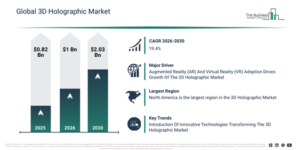
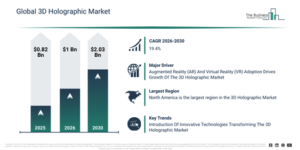
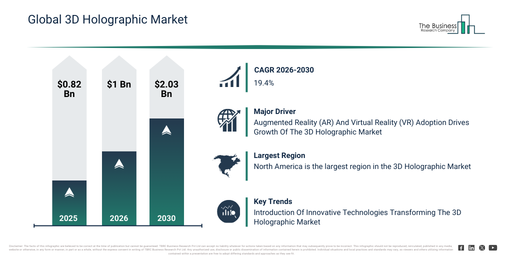
The 3D holographic market size has seen substantial growth in recent years. It is anticipated to expand from $0.82 billion in 2025 to $1 billion in 2026, registering a compound annual growth rate (CAGR) of 21.7%. The historical increase in this market can be attributed to developments in display technologies, a heightened demand for engaging visual experiences, the expansion of digital advertising uses, the adoption of 3D visualization in educational settings, and the rising volume of media and entertainment content production.
The 3D holographic market is projected to experience substantial expansion over the coming years. This market is predicted to reach $2.03 billion by 2030, demonstrating a compound annual growth rate (CAGR) of 19.4%. This anticipated expansion during the forecast period is driven by factors such as increased funding for immersive technology platforms, a surge in the uptake of holographic communication instruments, broadening applications for enterprise and industrial visualization, a rising need for lifelike virtual experiences, and ongoing advancements in display resolution and optical technologies. Key trends expected over the forecast horizon encompass a greater embrace of interactive 3D display systems, an expanding application of holography within entertainment and media sectors, increasing implementation of holographic visualization solutions in healthcare, the proliferation of real-time 3D communication platforms, and a heightened emphasis on high-resolution holographic displays.
Request A Complimentary 3D Holographic Market Research Sample:
Key Factor Propelling The 3D Holographic Market Forward
The expanding need for augmented reality (AR) and virtual reality (VR) is poised to fuel the advancement of the 3D holographic market. These immersive technologies transform how individuals perceive their surroundings, either by integrating digital content into the physical world (AR) or by constructing entirely simulated environments (VR). Their growing popularity stems from several factors, including broader industrial applications, a heightened desire for immersive encounters, increased financial backing and investment, wider adoption in professional settings, enhanced accessibility, and evolving consumer expectations and behaviors. 3D holographic technology significantly enhances AR and VR experiences through features such as realistic holographic overlays, capabilities for spatial interaction, virtual try-on options, dynamic interactive displays, fully immersive environments, precise spatial manipulation, realistic holographic avatars, and intuitive holographic user interface elements. As an illustration, data from the Department for Business and Trade, a UK-based government department, indicates that by 2024, UK spending on AR and VR is projected to increase by 78.3% compared to previous years. Furthermore, this expenditure is anticipated to reach £62.5 billion ($79.9 billion) by 2030. Consequently, the escalating demand for augmented reality (AR) and virtual reality (VR) serves as a key driver for the expansion of the 3D holographic market.
3D Holographic Market Segments And Subsegments Explained
The 3D holographic market covered in this report is segmented –
1) By Component: Light Modulator, Scanner, Lens, Digital Micrometer, Monitor
2) By Technology Type: Touchable Holographic, Semi-Transparent Or Electro Holographic, Pistons Holographic, Laser Or Plasma Holographic
3) By Industry Vertical: Consumer Electronics, Media And Entertainment, Healthcare And Medical, Education, Aerospace And Defense, Other Industry Verticals
Subsegments:
1) By Light Modulator: Liquid Crystal Light Modulator (LCLM), Digital Micromirror Device (DMD), Acousto-Optic Light Modulator
2) By Scanner: Galvanometer Scanner, Polygonal Mirror Scanner, MEMS Scanner
3) By Lens: Refractive Lenses, Diffractive Lenses, Hybrid Lenses
4) By Digital Micrometer: Micro-Optical Measuring Devices, Laser Interferometers
5) By Monitor: LCD Monitors, OLED Monitors, 3D-Enabled Displays
Emerging Trends Transforming The 3D Holographic Market
Leading firms in the 3D holographic market are concentrating on creating cutting-edge technologies, including mixed reality and AI-driven platforms, to maintain their competitive standing. Mixed reality enables users to view and engage with 3D holograms within their physical surroundings, thereby enhancing the concreteness and immersive quality of digital content. AI algorithms are capable of analyzing user information and preferences to tailor the holographic experience, guaranteeing content relevance and personalization. An example of this is HoloCare AS, a Norway-based health tech startup, which introduced software in January 2024 to generate interactive 3D holograms of a patient’s specific organ, empowering surgeons to meticulously plan and customize operations according to the patient’s distinct anatomical structure. The immersive quality of holographic technology offers healthcare teams an unmatched experience, improving surgical planning, communication, and teamwork. Furthermore, the remote access feature of these holograms allows medical professionals to participate in interactive discussions and make decisions irrespective of their physical presence.
3D Holographic Market Key Players: Major Companies In The 2026 Report
Major companies operating in the 3D holographic market are Digital Domain, EON Reality, Holoxica Ltd., Looking Glass Factory Inc., Envisics Ltd., AV Concepts, Hypervsn Company, Light Field Lab, VividQ, Futurotec Solutions LLP, Rivox Technologies, Zebra Imaging, Nanjing DSeeLab Digital Technology Co. Ltd., SeeReal Technologies GmbH, Virtual Group, Wicked Laser, Holografika Kft., Musion 3D Ltd., Realfiction Holding AB, Hypervision Technologies, Liminal Space Inc., Digital Video Enterprises, IKIN Inc., Shenzhen SMX Display Technology Co. Ltd., Voxon Photonics, MDH Hologram Ltd.
Explore The Full 3D Holographic Market Report With Forecasts To 2030:
3D Holographic Market By Region: Where Is Demand Strongest?
North America was the largest region in the 3D holographic market in 2025. Asia-Pacific is expected to be the fastest-growing region in the forecast period. The regions covered in the 3D holographic market report are Asia-Pacific, South East Asia, Western Europe, Eastern Europe, North America, South America, Middle East, Africa.
Reach Out To Our Team:
The Business Research Company: https://www.thebusinessresearchcompany.com/
Americas: +1 310-496-7795
Asia: +44 7882 955267 & +91 8897263534
Europe: +44 7882 955267
Email us at: marketing@tbrc.info
Follow us on:
LinkedIn: https://in.linkedin.com/company/the-business-research-company
YouTube: https://www.youtube.com/channel/UC24_fI0rV8cR5DxlCpgmyFQ
Global Market Model: https://www.thebusinessresearchcompany.com/global-market-model

Wasay has over a decade of experience in market research, data modelling, and analytics, with prior experience at GlobalData and Decision Tree Consulting Services. At The Business Research Company , he leads research operations across syndicated studies, customized consulting engagements, and the Global Market Model platform. His professional experience includes supporting organizations such as Boston Consulting Group, KPMG, and Ernst & Young. Wasay holds a degree in Electronics and Communications Engineering, postgraduate management qualifications from International Management Institute Belgium and Indian School of Business and Entrepreneurship, and completed the Integrated Program in Business Analytics from Indian Institute of Management Indore.