The Business Research Company’s 2026 market reports combine market attractiveness scoring, total addressable market sizing, company benchmarking matrices, interactive Excel dashboards, deeper supply chain intelligence, emerging startup tracking, and granular product-level insights to deliver research that is more actionable and strategically valuable.
3D Virtual Fence Market Revenue Forecast: $7.34 Billion In 2026 Rising To $15.93 Billion In 2030
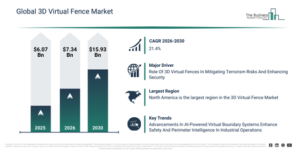
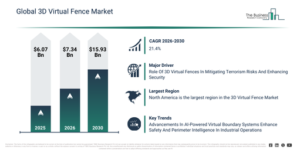
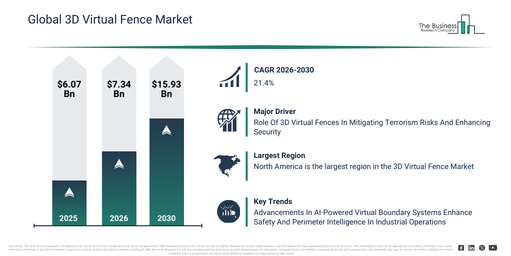
The 3D virtual fence market has experienced substantial expansion in recent times. This market is projected to expand from $6.07 billion in 2025 to $7.34 billion by 2026, demonstrating a compound annual growth rate (CAGR) of 20.9%. Historically, this growth has been driven by factors such as heightened security concerns within logistics, the expanded use of remote monitoring in agriculture, a surge in demand for smart city surveillance, stricter construction site safety regulations, and a greater requirement for perimeter control in the banking sector.
The 3D virtual fence market is expected to experience substantial growth in the coming years. Its valuation is projected to reach $15.93 billion in 2030, growing at a compound annual growth rate (CAGR) of 21.4%. This anticipated growth is attributed to factors like the increasing integration with AI-enabled analytics, wider adoption in autonomous transport, expanded use in smart infrastructure projects, a rise in demand for hybrid deployment solutions, and enhanced regulatory compliance for digital security. Prominent trends for the forecast period include real-time boundary monitoring, virtual access control, predictive security alerts, remote surveillance integration, and event-triggered notifications.
Free Sample Report: 3D Virtual Fence Market Size, Trends And Forecast To 2030:
3D Virtual Fence Market Growth Catalyst: What Is Creating New Demand?
The escalating threat of terrorism is anticipated to fuel the expansion of the 3D virtual fence market in the future. Terrorism is defined as violent acts carried out by individuals, groups, or states designated as foreign terrorist entities or nations. A 3D virtual fence system identifies potential incursions and questionable behaviors, helping to prevent terrorist attacks by establishing a digital perimeter around a designated location, like a structure or boundary. This technology employs cameras, sensors, and other equipment to survey the area for any unusual occurrences. For instance, a report from June 2023 by the United Nations High Commissioner for Refugees (a Switzerland-based UN agency dedicated to aiding and safeguarding refugees) indicated that around 110 million individuals globally had been forcibly displaced owing to factors such as persecution, terrorism, conflict, violence, and human rights abuses. This figure included 36.4 million refugees worldwide (with 30.5 million under UNHCR’s purview and 5.94 million Palestine refugees under UNRWA’s mandate), alongside 62.1 million internally displaced persons, 6.08 million asylum seekers, and 5.6 million Venezuelan refugees or others requiring international protection. Approximately 90% of these newly displaced people originated from major crises in seven nations, namely Afghanistan, the Democratic Republic of the Congo, Myanmar, Somalia, Sudan, Ukraine, and several Latin American countries. Consequently, the heightened danger of terrorism is propelling the expansion of the 3D virtual fence market.
3D Virtual Fence Market Segment Overview: Categories Covered In The 2026 Report
The 3D virtual fence market covered in this report is segmented –
1) By Type: 3D Virtual Cameras, 3D Video Motion Detection System
2) By Deployment: On-Premises, Cloud Based, Hybrid
3) By End-User: Logistics, Agriculture, Banking, Construction, Security
Subsegments:
1) By 3D Virtual Cameras: Fixed 3D Cameras, Pan-Tilt-Zoom (PTZ) 3D Cameras
2) By 3D Video Motion Detection System: Standalone Detection Systems, Integrated Detection Systems
How Are Leading Companies Shaping 3D Virtual Fence Market Trends?
Major companies within the 3D virtual fence market are prioritizing the development of innovative solutions, such as artificial intelligence (AI)-powered virtual safety fence systems, to enhance workplace safety and streamline automated processes. These AI-driven virtual safety fences leverage advanced 3D digital twin modeling, edge AI, and vision analytics to establish dynamic safety zones around machinery and robots, offering a flexible alternative to traditional physical barriers that struggle to adapt to evolving workflows. For instance, in October 2025, Accenture plc, a U.S.-headquartered global professional services company, launched Physical AI Orchestrator. This cloud-based solution empowers manufacturers to construct live digital twins of physical facilities and implement virtual safety fences. The system captures real-time video of human, vehicle, and robot movements with centimeter-level precision, simulates potential safety scenarios, and automatically stops or reroutes machinery when humans enter designated areas. Its distinct features include AI agents for simulation and instruction generation, reality capture for creating accurate 3D models, and integration with existing equipment for seamless deployment. The applications of this system encompass improving pedestrian safety in warehouses, reducing workplace accidents, and optimizing operational efficiency without requiring physical infrastructure changes.
3D Virtual Fence Market Players: Key Companies Shaping Competition
Major companies operating in the 3D virtual fence market are Avigilon Corporation; Genetec Inc.; Bosch Security Systems Inc.; March Networks Corporation; IndigoVision Group plc; Controp Precision Technologies Ltd.; Senstar Corporation; Magal Security Systems Ltd.; D-Fend Solutions; Optex Co. Ltd.; SpotterRF; Robin Radar Systems; LIPS Corporation; Fiber SenSys Inc.; Sensofusion Oy; PureTech Systems; Rbtec Perimeter Security Systems; ACSE GmbH; FLIR Systems; Hikvision Digital Technology
Access Complete 3D Virtual Fence Market Data, Forecasts And Competitive Insights:
3D Virtual Fence Market Regional Performance And Geographic Coverage
North America was the largest region in the 3D virtual fence market in 2025. Asia-Pacific is expected to be the fastest-growing region in the forecast period. The regions covered in the 3D virtual fence market report are Asia-Pacific, South East Asia, Western Europe, Eastern Europe, North America, South America, Middle East, Africa.
Reach Out To Our Team:
The Business Research Company: https://www.thebusinessresearchcompany.com/
Americas: +1 310-496-7795
Asia: +44 7882 955267 & +91 8897263534
Europe: +44 7882 955267
Email us at: marketing@tbrc.info
Follow us on:
LinkedIn: https://in.linkedin.com/company/the-business-research-company
YouTube: https://www.youtube.com/channel/UC24_fI0rV8cR5DxlCpgmyFQ
Global Market Model: https://www.thebusinessresearchcompany.com/global-market-model

Wasay has over a decade of experience in market research, data modelling, and analytics, with prior experience at GlobalData and Decision Tree Consulting Services. At The Business Research Company , he leads research operations across syndicated studies, customized consulting engagements, and the Global Market Model platform. His professional experience includes supporting organizations such as Boston Consulting Group, KPMG, and Ernst & Young. Wasay holds a degree in Electronics and Communications Engineering, postgraduate management qualifications from International Management Institute Belgium and Indian School of Business and Entrepreneurship, and completed the Integrated Program in Business Analytics from Indian Institute of Management Indore.