The Business Research Company’s 2026 market reports combine market attractiveness scoring, total addressable market sizing, company benchmarking matrices, interactive Excel dashboards, deeper supply chain intelligence, emerging startup tracking, and granular product-level insights to deliver research that is more actionable and strategically valuable.
Affective Computing Market Size Trajectory: Key Numbers Every Industry Stakeholder Should Know
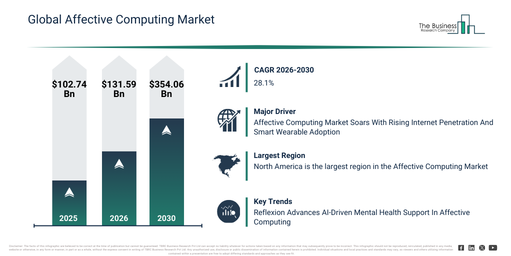
The affective computing market has experienced substantial expansion in recent years. Its size is expected to rise from $102.74 billion in 2025 to $131.59 billion in 2026, demonstrating a compound annual growth rate (CAGR) of 28.1%. This historical increase can be attributed to factors such as initial studies in human-computer interaction, the expanded deployment of biometric sensors, advancements in facial and voice recognition technologies, a heightened interest in emotional AI within media and entertainment, and the adoption of touch-based interfaces in healthcare settings.
The affective computing market is projected to experience rapid expansion over the coming years, reaching $354.06 billion by 2030, demonstrating a compound annual growth rate (CAGR) of 28.1%. This anticipated growth is driven by several factors, including the integration of artificial intelligence with immersive technologies for detecting emotions, the increasing adoption of touchless affective computing in smart devices, the application of affective analytics across the BFSI and healthcare sectors, real-time emotion detection to enhance personalized user experiences, and the broadening use of affective computing in government and defense. Key developments expected during this period involve advanced emotion recognition algorithms, sophisticated sentiment analysis tools, improvements in human-computer interaction, multimodal emotion detection capabilities, and real-time affective feedback systems.
Looking For Reliable Affective Computing Market Data? Request A Free Sample:
What Is Behind The Rising Demand In The Affective Computing Market?
The increasing integration of Internet of Things (IoT) devices is anticipated to stimulate the expansion of the affective computing market. IoT devices are defined as physical objects fitted with sensors, software, and network capabilities that enable them to gather and exchange data over the internet. The proliferation of IoT devices is driven by the development of interconnected ecosystems and a growing demand for intelligent technologies that enhance automation and real-time data analytics. This growth is supported by the affective computing market, which utilizes IoT-enabled sensors and systems to interpret human emotions via physiological signals, gestures, and facial expressions, thereby improving personalized user interactions across various devices and applications. For instance, in May 2023, DataProt, a cybersecurity information organization from the Republic of Serbia, reported roughly 15.1 billion IoT devices connected globally in 2023, with this number expected to climb steadily in subsequent years. Thus, the rising adoption of Internet of Things (IoT) devices is propelling the growth of the affective computing market.
Affective Computing Market Segment Coverage And Subsegment Analysis
The affective computing market covered in this report is segmented –
1) By Technology: Touch-Based, Touchless
2) By Component: Hardware, Analytics Software, Cameras, Other Components
3) By Vertical: Media And Entertainment, Healthcare And Life Sciences, Government And Defense, Banking, Financial Services And Insurance (BFSI), Other Verticals
Subsegments:
1) By Touch-Based: Gesture Recognition, Facial Recognition, Biometric Sensors
2) By Touchless: Voice Recognition, Emotion Detection via Video Analysis, Environmental Sensors
Affective Computing Market Future Trends: Where Is The Industry Heading?
Leading companies within the affective computing market are prioritizing the enhancement of emotional intelligence in AI systems, including AI-driven mental health support platforms, to achieve a competitive advantage. These AI-powered mental health support platforms employ machine learning and natural language processing to identify, interpret, and respond to human emotions, enabling customized and context-sensitive interventions. For example, in May 2025, Reflexion, a US-based digital health company, launched its AI platform with the goal of broadening access to mental health support for underserved communities, offering features such as real-time emotion recognition, individualized coping strategies, and interaction models that are culturally adaptable.
Affective Computing Market Top Players List For 2026
Major companies operating in the affective computing market are Amazon.com Inc.; Apple Inc.; Alphabet Inc.; Microsoft Corporation; Sony Group Corporation; Panasonic Corporation; Intel Corporation ; International Business Machines Corporation; Qualcomm Technologies Inc.; NEC Corporation; Tobii Technology AB; Gorilla Technology Group; Noldus Information Technology; Entropic Technologies; Affectiva Inc.; Beyond Verbal Communication Ltd.; iMotions A/S; Sentiance NV; audEERING GmbH; Gesturetek Inc.; NuraLogix Corporation; NVISO Inc.; Numenta Inc.; Kairos AR Inc.; Cipia Vision Ltd.
Order Your Copy Of The Affective Computing Market Report 2026:
How Does The Affective Computing Market Vary By Region?
North America was the largest region in the affective computing market in 2025. Asia-Pacific is expected to be the fastest-growing region in the forecast period. The regions covered in the affective computing market report are Asia-Pacific, South East Asia, Western Europe, Eastern Europe, North America, South America, Middle East, Africa.
Reach Out To Our Team:
The Business Research Company: https://www.thebusinessresearchcompany.com/
Americas: +1 310-496-7795
Asia: +44 7882 955267 & +91 8897263534
Europe: +44 7882 955267
Email us at: marketing@tbrc.info
Follow us on:
LinkedIn: https://in.linkedin.com/company/the-business-research-company
YouTube: https://www.youtube.com/channel/UC24_fI0rV8cR5DxlCpgmyFQ
Global Market Model: https://www.thebusinessresearchcompany.com/global-market-model

Wasay has over a decade of experience in market research, data modelling, and analytics, with prior experience at GlobalData and Decision Tree Consulting Services. At The Business Research Company , he leads research operations across syndicated studies, customized consulting engagements, and the Global Market Model platform. His professional experience includes supporting organizations such as Boston Consulting Group, KPMG, and Ernst & Young. Wasay holds a degree in Electronics and Communications Engineering, postgraduate management qualifications from International Management Institute Belgium and Indian School of Business and Entrepreneurship, and completed the Integrated Program in Business Analytics from Indian Institute of Management Indore.