With a focus on actionable insights and strategic value, The Business Research Company’s 2026 market reports include market attractiveness scoring, total addressable market sizing, company benchmarking matrices, interactive Excel dashboards, deeper supply chain intelligence, emerging startup tracking, and granular product-level insights.
How Much Will The Artificial Intelligence (AI) For Earth Monitoring Market Be Worth By 2030?
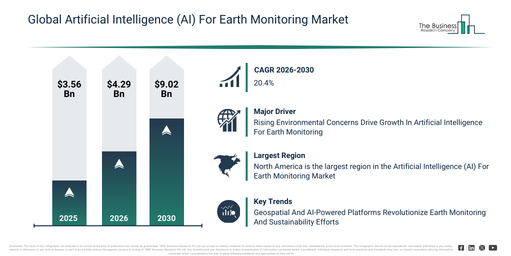
The artificial intelligence (AI) for earth monitoring market size has experienced significant expansion in recent years. This market is projected to grow from $3.56 billion in 2025 to $4.29 billion in 2026, at a compound annual growth rate (CAGR) of 20.7%. The growth observed in the past can be ascribed to an increase in satellite data availability, the expansion of climate research programs, the adoption of digital environmental monitoring tools, the rising frequency of extreme weather events, and an increase in government-funded earth observation projects.
The artificial intelligence (AI) for earth monitoring market is projected to experience substantial growth over the coming years. It is anticipated to reach a valuation of $9.02 billion by 2030, demonstrating a compound annual growth rate (CAGR) of 20.4%. This expansion during the forecast period is driven by factors such as the integration of AI with intelligent sensor networks, the growth of climate resilience initiatives, an increase in predictive environmental analytics, the growing need for disaster early warning systems, and heightened private sector investment in earth intelligence platforms. Key developments expected during this period involve the automation of satellite image analytics, real-time environmental data processing, AI-driven climate pattern prediction, platforms for integrating remote sensing, and the broadening of geospatial intelligence.
Get Access To A Free Artificial Intelligence (AI) For Earth Monitoring Market Report Sample:
The Key Driver Behind The Artificial Intelligence (AI) For Earth Monitoring Market’s 20.4% CAGR
Growing apprehension about climate change, deforestation, and pollution is anticipated to drive the expansion of artificial intelligence (AI) in the earth monitoring market. These issues represent environmental challenges that compromise the health and stability of the natural world, and concerns have intensified recently due to greater public awareness of their impacts, scientific validation, and observable ecological shifts. Artificial intelligence (AI) for earth monitoring plays a crucial role by aiding in the analysis of environmental data, tracking changes, and implementing measures to mitigate climate impacts. For instance, in April 2024, the World Resources Institute, a US-based organization dedicated to addressing environmental and sustainability challenges, reported a 24% rise in global tree cover loss in 2023, increasing from 22.8 million hectares in 2022 to 28.3 million hectares. Furthermore, in February 2024, the International Energy Agency (IEA), a France-based autonomous intergovernmental organization, indicated that global energy-related carbon dioxide (CO2) emissions climbed by 1.1%, equivalent to 410 million metric tons (Mt CO2) in 2023. These escalating environmental worries thus serve as a key driver for artificial intelligence (AI) in the earth monitoring market.
Artificial Intelligence (AI) For Earth Monitoring Market Classification: Main Segments And Detailed Subsegments
The artificial intelligence (AI) for earth monitoring market covered in this report is segmented –
1) By Technology: Machine Learning, Natural Language Processing, Computer Vision, Other Technologies
2) By Application: Atmosphere Monitoring, Land Monitoring, Marine Monitoring, Climate Monitoring, Other Applications
3) By End User: Government And Public Sector, Private Sector, Research And Academia
Subsegments:
1) By Machine Learning: Supervised Learning, Unsupervised Learning, Reinforcement Learning, Deep Learning, Neural Networks, Predictive Analytics For Climate And Environmental Changes
2) By Natural Language Processing (NLP): Text Analysis and Mining, Speech Recognition For Earth Monitoring Systems, Sentiment Analysis For Environmental Feedback, Chatbots For Real-time Monitoring and Alerts
3) By Computer Vision: Satellite Image Analysis, Object Detection And Classification, Remote Sensing, Land Use And Land Cover Mapping, Change Detection In Environmental Features
4) By Other Technologies: Robotic Process Automation (RPA) For Environmental Data Collection, Edge Computing For Real-Time Data Processing, AI-Driven Geospatial Data Analytics, IoT Integration For Earth Monitoring (AI-powered sensors and devices).
Artificial Intelligence (AI) For Earth Monitoring Market Strategic Shifts: What Leading Players Are Prioritizing
Major companies operating in the artificial intelligence (AI) for Earth monitoring market are advancing their initiatives toward generative artificial (AI) solutions to bolster the accuracy and efficiency of environmental monitoring, enhance sustainability decision-making, forecast and analyze changes in climate and land use, and aid effective disaster response and infrastructure planning. Generative AI solutions involve AI in creating new content or models by learning from existing data, thereby enabling the generation of realistic and inventive outputs based on patterns found in the input data. For instance, in January 2024, Deloitte Touche Tohmatsu Limited, a UK-based professional services company, introduced a new geospatial and AI platform for scenario planning and monitoring, powered by Google Earth Engine and Vertex AI. This platform integrates advanced geospatial data and artificial intelligence technologies to assist clients in improving their sustainability efforts and climate action strategies. It provides tools for enhanced urban planning, disaster response, and infrastructure development by utilizing AI to analyze and visualize data related to land use and environmental impacts. The platform also offers insights for optimizing sustainable outcomes and supports financial modeling for sustainable investments.
Artificial Intelligence (AI) For Earth Monitoring Market Company Analysis: Major Industry Participants
Major companies operating in the artificial intelligence (AI) for earth monitoring market are Google LLC, Microsoft Corporation, Airbus SE, International Business Machines Corporation (IBM), L3Harris Technologies Inc., EagleView Technologies Inc, Planet Labs Inc, Satellite Applications Catapult Ltd, Spire Global Inc, BlackSky Global Inc, Orbital Insight Inc, Tomorrow.io Inc., SatSure AG, Synspective Inc., Kayrros SAS, Orbital Sidekick Inc., Ursa Space Systems Inc, Satellogic Inc, Earth-I Ltd., Climavision Analytics LLC, Sentinel Hub Ltd
Get Full Access To The Artificial Intelligence (AI) For Earth Monitoring Market Report 2026:
Artificial Intelligence (AI) For Earth Monitoring Market Global Regional Breakdown: Key Regions Analyzed
North America was the largest region in the artificial intelligence (AI) for earth monitoring market in 2025. Asia-Pacific is expected to be the fastest-growing region in the forecast period. The regions covered in the artificial intelligence (AI) for earth monitoring market report are Asia-Pacific, South East Asia, Western Europe, Eastern Europe, North America, South America, Middle East, Africa.
Reach Out To Our Team:
The Business Research Company: https://www.thebusinessresearchcompany.com/
Americas: +1 310-496-7795
Asia: +44 7882 955267 & +91 8897263534
Europe: +44 7882 955267
Email us at: marketing@tbrc.info
Follow us on:
LinkedIn: https://in.linkedin.com/company/the-business-research-company
YouTube: https://www.youtube.com/channel/UC24_fI0rV8cR5DxlCpgmyFQ
Global Market Model: https://www.thebusinessresearchcompany.com/global-market-model

Wasay has over a decade of experience in market research, data modelling, and analytics, with prior experience at GlobalData and Decision Tree Consulting Services. At The Business Research Company , he leads research operations across syndicated studies, customized consulting engagements, and the Global Market Model platform. His professional experience includes supporting organizations such as Boston Consulting Group, KPMG, and Ernst & Young. Wasay holds a degree in Electronics and Communications Engineering, postgraduate management qualifications from International Management Institute Belgium and Indian School of Business and Entrepreneurship, and completed the Integrated Program in Business Analytics from Indian Institute of Management Indore.