
Through market attractiveness analysis, total addressable market evaluation, company benchmarking matrices, interactive Excel dashboards, expanded supply chain intelligence, emerging startup coverage, and detailed product insights, The Business Research Company’s 2026 market reports provide more actionable and strategically valuable research.
Artificial Intelligence (AI) For Spectrum Management Market Size Outlook: How Fast Will Revenue Grow Through 2030?
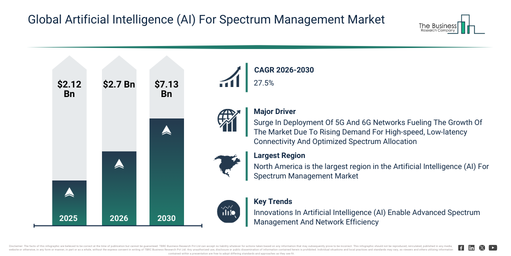
The artificial intelligence (AI) for spectrum management market has experienced substantial expansion in recent years. This market is forecast to increase from $2.12 billion in 2025 to $2.7 billion in 2026, exhibiting a compound annual growth rate (CAGR) of 27.3%. Historically, this growth can be linked to the rise of wireless networks, heightened spectrum congestion, the early adoption of cognitive radio, ongoing telecom modernization, and the push for greater efficiency.
The artificial intelligence (AI) for spectrum management market is projected to experience rapid expansion over the upcoming years. This market is anticipated to reach $7.13 billion by 2030, exhibiting a compound annual growth rate (CAGR) of 27.5%. Key factors contributing to this growth during the forecast period include the broadening of 5G and 6G technologies, the implementation of private networks, demands for defense communication, the expansion of smart cities, and AI-powered network automation. Significant trends expected during this period involve dynamic spectrum allocation, AI-driven interference detection, predictive spectrum analytics, automated frequency planning, and cognitive radio optimization.
Download A Free Sample Report For Comprehensive Market Insights:
Artificial Intelligence (AI) For Spectrum Management Market Expansion Drivers: What Is Shaping Future Growth?
The expanding deployment of 5G and 6G networks is anticipated to significantly boost the artificial intelligence for the spectrum management market moving forward. This deployment involves the initiation and setup of advanced wireless technologies aimed at delivering quicker, more dependable, and minimal-latency mobile connectivity. The increased demand for rapid, low-latency connectivity fuels the expanding rollout of 5G and 6G networks, compelling telecommunication companies to enhance their infrastructure for quicker data transmission and real-time application support. Within 5G and 6G network deployment, artificial intelligence for spectrum management proves beneficial by optimizing radio frequency allocation and utilization, thus guaranteeing efficient, interference-free, and high-capacity network performance amidst increasing connectivity demands. For example, data from March 2024, provided by 5G Americas, a US-based wireless industry trade association, indicated that global 5G connections reached 1.76 billion by the close of 2023, representing an increase of 700 million connections over the year, which signified a 66% rise compared to 2022. Furthermore, worldwide 5G connections are forecast to hit 7.9 billion by 2028. Consequently, the expanding implementation of 5G and 6G networks is a key factor propelling the expansion of the artificial intelligence for the spectrum management market.
Artificial Intelligence (AI) For Spectrum Management Market Segment Landscape: Which Areas Lead Market Development?
The artificial intelligence (AI) for spectrum management market covered in this report is segmented –
1) By Component: Software, Hardware, Services
2) By Deployment Mode: On-Premises, Cloud
3) By Organization Size: Small And Medium Enterprises, Large Enterprises
4) By Application: Telecommunications, Defense, Broadcasting, Transportation, Public Safety, Other Applications
5) By End-User Industry: Telecommunications And Communication Service Providers (CSPs), Government And Defense, Enterprises, Space And Satellite Operators, Broadcasting
Subsegments:
1) By Software: Spectrum Monitoring Software, Interference Detection Software, Spectrum Analytics Software, Frequency Planning Software, Compliance And Reporting Software
2) By Hardware: Spectrum Sensors, Signal Monitoring Devices, Network Analyzers, Edge Processing Units, Communication Infrastructure Equipment
3) By Services: Consulting And Advisory Services, System Integration Services, Managed Spectrum Monitoring Services, Maintenance And Support Services, Training And Optimization Services
Artificial Intelligence (AI) For Spectrum Management Market Strategic Trends: What Is Defining The Next Phase Of Growth?
Companies leading in the artificial intelligence for spectrum management market are dedicated to developing inventive solutions, such as an artificial intelligence-native wireless stack for 6G, to improve spectrum efficiency and autonomous decision-making within increasingly complex and dynamic radio environments. An artificial intelligence-native wireless stack for 6G signifies a future communications protocol and software architecture where artificial intelligence (AI) and machine learning (ML) functionalities are fundamentally embedded at every level of the wireless stack, rather than being applied as distinct optimization tools. For example, in October 2025, Nvidia Corporation, a technology company from the US, revealed the All-American Artificial Intelligence-RAN Stack, which is an innovative AI-native 6G wireless stack built upon its NVIDIA artificial intelligence. This solution, an aerial platform, incorporates artificial intelligence-driven spectrum agility and sensing abilities to manage wireless spectrum allocation in real time, pinpoint and alleviate interference without deactivating entire frequency bands, and provide substantial improvements in spectral efficiency and network performance compared to traditional techniques. Additionally, it supports multimodal integrated sensing and communications, boosting spatial awareness and network adaptability, thereby making it highly relevant for telecom operators anticipating 6G deployments.
Artificial Intelligence (AI) For Spectrum Management Market Industry Leaders And Market Competition
Major companies operating in the artificial intelligence (AI) for spectrum management market are Microsoft Corporation, Samsung Electronics Co Ltd, Huawei Technologies Co Ltd, International Business Machines Corporation, Cisco Systems Inc, Intel Corporation, Qualcomm Technologies Inc, Hewlett Packard Enterprise Company, NVIDIA Corporation, Telefonaktiebolaget LM Ericsson, NEC Corporation, Motorola Solutions Inc, Arista Networks Inc, Keysight Technologies Inc, Rohde & Schwarz GmbH & Co KG, VIAVI Solutions Inc, Anritsu Corporation, Federated Wireless Inc, Cohere Technologies Inc, and Xtremis AI SL
Access The Complete Artificial Intelligence (AI) For Spectrum Management Market Report:
Artificial Intelligence (AI) For Spectrum Management Market Global Footprint: Which Region Holds Market Leadership?
North America was the largest region in the artificial intelligence for spectrum management market in 2025. Asia-Pacific is expected to be the fastest-growing region in the forecast period. The regions covered in the artificial intelligence (AI) for spectrum management market report are Asia-Pacific, South East Asia, Western Europe, Eastern Europe, North America, South America, Middle East, Africa.
Get in touch with us:
The Business Research Company: https://www.thebusinessresearchcompany.com/
Americas: +1 310-496-7795
Asia: +44 7882 955267 & +91 8897263534
Europe: +44 7882 955267
Email us at: marketing@tbrc.info
Follow us on:
LinkedIn: https://in.linkedin.com/company/the-business-research-company
YouTube: https://www.youtube.com/channel/UC24_fI0rV8cR5DxlCpgmyFQ
Global Market Model: https://www.thebusinessresearchcompany.com/global-market-model

Wasay has over a decade of experience in market research, data modelling, and analytics, with prior experience at GlobalData and Decision Tree Consulting Services. At The Business Research Company , he leads research operations across syndicated studies, customized consulting engagements, and the Global Market Model platform. His professional experience includes supporting organizations such as Boston Consulting Group, KPMG, and Ernst & Young. Wasay holds a degree in Electronics and Communications Engineering, postgraduate management qualifications from International Management Institute Belgium and Indian School of Business and Entrepreneurship, and completed the Integrated Program in Business Analytics from Indian Institute of Management Indore.