Enhanced with market attractiveness analysis, total addressable market evaluation, company benchmarking matrices, interactive Excel dashboards, expanded supply chain intelligence, emerging startup coverage, and detailed product insights, The Business Research Company’s 2026 market reports deliver more actionable and strategically valuable research.
AI In Cybersecurity Market Growth Potential: How Will Market Size Change Through 2030?
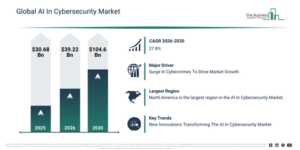
The AI in cybersecurity market has experienced substantial growth recently. It is projected to increase from $30.68 billion in 2025 to $39.22 billion in 2026, achieving a compound annual growth rate (CAGR) of 27.8%. This historical expansion can be attributed to factors such as an increase in cyberattack frequency, the growth of enterprise data volumes, early adoption of machine learning security tools, the expansion of cloud computing, and rising regulatory compliance needs.
The AI in cybersecurity market is projected to experience substantial expansion over the upcoming years, with its valuation anticipated to reach $104.6 billion by 2030, exhibiting a compound annual growth rate (CAGR) of 27.8%. This expected growth during the forecast period is attributable to several factors, including the increasing sophistication of cyber threats, the rising demand for real-time threat intelligence, the adoption of AI-based zero trust security, the proliferation of cloud and hybrid environments, and the automation of security operations. Key trends for this period encompass the widespread integration of AI-driven threat detection, the advancement of predictive security analytics, the expansion of automated incident response systems, the increased utilization of behavioral analytics, and the growing implementation of AI-based fraud detection solutions.
Download A Free Sample Report For Comprehensive Market Insights:
AI In Cybersecurity Market Expansion Supported By Key Demand Factors
The increasing occurrence of cybercrimes is projected to boost the expansion of the AI in cybersecurity market in the future. Cybercrime encompasses illicit activities utilizing computers, networks, or other digital tools, perpetrated by individuals or groups with harmful intentions, including acts like data theft, system disruption, or fraud. Artificial intelligence addresses the escalating cybercrime threat through sophisticated security solutions capable of real-time detection, analysis, and response to cyber threats, while also minimizing false positives by distinguishing non-threatening activities. As an illustration, in November 2024, the Australian Cyber Security Centre, an Australia-based government agency, reported that during the financial year 2023–24, the Australian Cybersecurity Hotline, managed by ASD, recorded over 36,700 calls, representing a 12% rise from the prior year, and ASD managed more than 1,100 cybersecurity incidents within the identical timeframe. Consequently, the increased frequency of cybercrimes is propelling the growth of the AI in cybersecurity market.
AI In Cybersecurity Market Segment Outlook: Which Categories Are Expanding The Fastest?
The AI in cybersecurity market covered in this report is segmented –
1) By Offering: Hardware, Software, Services
2) By Technology: Machine learning, Natural Language Processing (NLP), Context-Aware Computing
3) By Security Type: Network Security, Endpoint Security, Application Security, Cloud Security
4) By Application: Identity And Access Management, Risk and Compliance Management, Data Loss Prevention, Unified Threat Management, Security And Vulnerability Management, Antivirus Or Antimalware, Fraud Detection Or Anti-Fraud, Intrusion Detection Or Prevention System, Threat Intelligence, Other Applications
5) By End Users: Banking, Financial Services, And Insurance (BFSI), Retail, Manufacturing, Infrastructure, Enterprise, Healthcare, Automotive And Transportation, Government And Defense, Other End-Users
Subsegments:
1) By Hardware: Secure Servers and Data Processing Units, AI-Enabled Security Appliances, Network Security Hardware with Embedded AI, Endpoint Security Hardware with AI Capabilities, Hardware Security Modules (HSMs) With AI Integration
2) By Software: Artificial Intelligence (AI)-Based Threat Detection and Prevention Software, Machine Learning-Based Intrusion Detection And Prevention Systems, Behavioral Analytics and User Entity Behavior Analytics (UEBA) Software, Security Information and Event Management (SIEM) With Artificial Intelligence (AI), Artificial Intelligence (AI)-Driven Network Traffic Analysis Software
3) By Services: Managed Artificial Intelligence (AI) Cybersecurity Services, Threat Intelligence and Predictive Analytics Services, Cybersecurity Consulting And Artificial Intelligence (AI) Integration Services, Training And Support Services
AI In Cybersecurity Market Strategic Trends: What Is Defining The Next Phase Of Growth?
Key players in the AI cybersecurity market are innovating new solutions for business protection to gain a competitive advantage. Enterprise security denotes the extensive array of tactics and procedures organizations employ to guard their data, possessions, technologies, and operations from various hazards and dangers. For example, in April 2023, SentinelOne, Inc., a US-based cybersecurity enterprise, unveiled a threat detection platform that uses generative artificial intelligence and reinforcement learning. This platform integrates real-time neural networks with a language model-driven natural language interface, allowing users to manage and oversee security data with AI, obtain immediate insights, and execute actions smoothly. The system collects data from diverse sources, suggesting and performing response actions without requiring coding abilities. SentinelOne intends to enable organizations to expand their cybersecurity operations, anticipate developing threats, and build a sturdy defense infrastructure for the future.
AI In Cybersecurity Market Key Companies And Competitive Benchmarking
Major companies operating in the AI in cybersecurity market are Nvidia Corporation; Intel Corporation; International Business Machines Corporation; Amazon Web Services Inc.; Microsoft Corporation; Palo Alto Networks Inc.; CrowdStrike Holdings Inc.; NortonLifeLock Inc.; Cylance Inc.; FireEye Inc.; Check Point Software Technologies Ltd.; Darktrace Plc; McAfee LLC; Symantec Corporation; Fortinet Inc.; Cisco Systems Inc.; Splunk Inc.; Varonis Systems Inc.; Trend Micro Incorporated; Sophos Group plc; Carbon Black Inc.; Dragos Inc.; Zscaler Inc.; CyberArk Software Ltd.; Lookout Inc.; XM Cyber Ltd.; Axonius Inc.
Access The Complete AI In Cybersecurity Market Report:
AI In Cybersecurity Market Geographic Landscape: Which Region Dominates Industry Growth?
North America was the largest region in the AI in cybersecurity market in 2025. Asia-Pacific is expected to be the fastest-growing region in the global AI in cybersecurity market report during the forecast period. The regions covered in the AI in cybersecurity market report are Asia-Pacific, South East Asia, Western Europe, Eastern Europe, North America, South America, Middle East, Africa.
Get in touch with us:
The Business Research Company: https://www.thebusinessresearchcompany.com/
Americas: +1 310-496-7795
Asia: +44 7882 955267 & +91 8897263534
Europe: +44 7882 955267
Email us at: marketing@tbrc.info
Follow us on:
LinkedIn: https://in.linkedin.com/company/the-business-research-company
YouTube: https://www.youtube.com/channel/UC24_fI0rV8cR5DxlCpgmyFQ
Global Market Model: https://www.thebusinessresearchcompany.com/global-market-model

Wasay has over a decade of experience in market research, data modelling, and analytics, with prior experience at GlobalData and Decision Tree Consulting Services. At The Business Research Company , he leads research operations across syndicated studies, customized consulting engagements, and the Global Market Model platform. His professional experience includes supporting organizations such as Boston Consulting Group, KPMG, and Ernst & Young. Wasay holds a degree in Electronics and Communications Engineering, postgraduate management qualifications from International Management Institute Belgium and Indian School of Business and Entrepreneurship, and completed the Integrated Program in Business Analytics from Indian Institute of Management Indore.