
Enhanced with market attractiveness analysis, total addressable market evaluation, company benchmarking matrices, interactive Excel dashboards, expanded supply chain intelligence, emerging startup coverage, and detailed product insights, The Business Research Company’s 2026 market reports deliver more actionable and strategically valuable research.
AI In Hospitality And Tourism Market Value Analysis: What Growth Is Expected Over The Forecast Period?
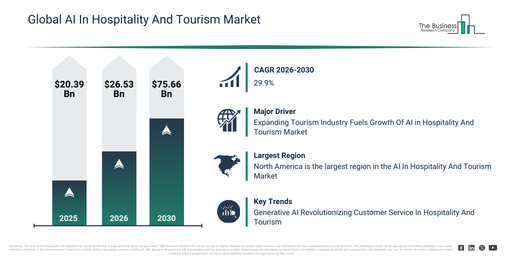
The AI in hospitality and tourism market has seen considerable growth in recent years. It is anticipated to increase from $20.39 billion in 2025 to $26.53 billion in 2026, showing a compound annual growth rate (CAGR) of 30.1%. During the historical period, this expansion was driven by the recovery of global tourism, the rise of online booking platforms, increasing digital engagement with travelers, the adoption of CRM systems in hospitality, and a heightened focus on personalized guest experiences.
The AI in hospitality and tourism market is projected to experience substantial expansion over the coming years, reaching $75.66 billion by 2030, demonstrating a robust compound annual growth rate (CAGR) of 29.9%. This anticipated growth is largely fueled by escalating investments in AI-powered personalization tools, a burgeoning demand for contactless hospitality options, the ongoing development of smart hotel infrastructure, an increased application of sentiment analysis for brand reputation management, and a greater dependence on real-time travel analytics. Noteworthy trends identified for this forecast period encompass the wider embrace of AI-driven customer service chatbots, a heightened utilization of predictive analytics for anticipating demand, the expanding implementation of personalized recommendation systems, advancements in smart guest room automation, and a stronger emphasis on data-informed revenue management strategies.
Download A Free Sample Report For Comprehensive Market Insights:
#AI In Hospitality And Tourism Market Growth Factors: Which Forces Are Supporting Market Expansion?
The expanding tourism sector is projected to boost the AI in hospitality and tourism market in the foreseeable future. This industry encompasses various activities and services related to individuals traveling to destinations beyond their usual environment for leisure, business, or other objectives. The tourism industry’s growth is fueled by increased global mobility, rising disposable incomes, and an increasing demand for distinctive travel experiences. AI in tourism enhances customer service, optimizes operational processes, and personalizes travel experiences through sophisticated technologies like chatbots, predictive analytics, and recommendation systems. For instance, in April 2024, according to Statistics Canada, a Canada-based government agency, tourism spending by international visitors in Canada increased by 1.8% in the first quarter, following a 4.0% increase in the previous quarter. This surge was primarily attributed to outlays on accommodation and food and beverage services, both of which saw a 2.0% rise. Furthermore, the volume of non-resident travelers entering Canada grew by 1.7%. Therefore, the expanding tourism industry is a key factor propelling the development of the AI in hospitality and tourism market.
AI In Hospitality And Tourism Market Segment Analysis: What Are The Major Market Categories?
The AI in hospitality and tourism market covered in this report is segmented –
1) By Type: Natural Language Processing (NLP) Applications, Machine Learning Algorithms, Computer Vision And Image Recognition, Chatbots And Virtual Assistants, Recommendation Systems, Sentiment Analysis
2) By Application: Customer Service And Support, Personalized Marketing And Advertising, Hotel And Room Booking Systems, Virtual Concierge Services, Smart Guest Room Automation, Data Analytics And Business Intelligence, Revenue Management And Pricing Optimization
3) By End-User: Hotels And Resorts, Airlines And Airports, Travel Agencies And Tour Operators, Restaurants And Food Service Providers, Cruise Lines And Maritime Tourism, Online Travel Platforms And Booking Websites
Subsegments:
1) By Natural Language Processing (NLP) Applications: Language Translation, Voice Recognition, Text Analysis, Speech-To-Text Conversion
2) By Machine Learning Algorithms: Predictive Analytics, Demand Forecasting, Dynamic Pricing Models, Customer Segmentation
3) By Computer Vision And Image Recognition: Facial Recognition For Check-In, Visual Quality Inspection, Object Detection In Security, Automated Identification For Guest Preferences
4) By Chatbots And Virtual Assistants: Customer Service Chatbots, Booking And Reservation Assistants, Travel Information Assistants, In-Room Virtual Assistants
5) By Recommendation Systems: Personalized Destination Recommendations, Activity And Event Suggestions, Dining And Cuisine Recommendations, Hotel Room And Amenity Recommendations
6) By Sentiment Analysis: Customer Feedback Analysis, Review Monitoring And Analysis, Brand Reputation Management, Social Media Sentiment Tracking
AI In Hospitality And Tourism Market Growth Trends Influencing Competitive Dynamics
Leading companies active in the AI in hospitality and tourism market are increasingly focusing on developing sophisticated solutions, such as generative AI functionalities, to enhance customer service within the hospitality sector. Generative AI describes artificial intelligence systems designed to create new content, including text, images, music, or even code, that emulates human-like creativity and intelligence. For instance, in June 2024, Sabre Hospitality, a US-based technology company, introduced SynXis Concierge.AI, marking its initial entry into generative AI to improve customer service in the hospitality sector. This pioneering solution seeks to revolutionize how hoteliers engage with customers by delivering immediate, comprehensive, and accurate responses to inquiries, leveraging Sabre’s extensive data resources. Initially, Sabre’s Customer Care and Delivery team will utilize the tool for various customer interactions, encompassing questions and issue resolution.
AI In Hospitality And Tourism Market Leading Companies Driving Competitive Growth
Major companies operating in the AI in hospitality and tourism market are Google LLC, Microsoft Corporation, Accenture PLC, International Business Machines Corporation, Oracle Corporation, Salesforce com Inc., Tata Consultancy Services Limited (TCS), Capgemini SE, Infosys Limited, Adobe Inc., Booking Holdings Inc., HCL Technologies Limited, Expedia Group Inc., Wipro Limited, Amadeus IT Group, Sabre Corporation, Concur Technologies (SAP Concur), Travelport Worldwide Limited, Cvent Inc., Trivago N.V., Skyscanner Ltd., Mews Systems, Hopper Inc., Kayak Software Corporation, RateGain Technologies, Revinate Inc., Hotelogix
Access The Complete AI In Hospitality And Tourism Market Report:
AI In Hospitality And Tourism Market Geographic Landscape: Which Region Dominates Industry Growth?
North America was the largest region in the AI in hospitality and tourism market in 2025. The regions covered in the AI in hospitality and tourism market report are Asia-Pacific, South East Asia, Western Europe, Eastern Europe, North America, South America, Middle East, Africa.
Get in touch with us:
The Business Research Company: https://www.thebusinessresearchcompany.com/
Americas: +1 310-496-7795
Asia: +44 7882 955267 & +91 8897263534
Europe: +44 7882 955267
Email us at: marketing@tbrc.info
Follow us on:
LinkedIn: https://in.linkedin.com/company/the-business-research-company
YouTube: https://www.youtube.com/channel/UC24_fI0rV8cR5DxlCpgmyFQ
Global Market Model: https://www.thebusinessresearchcompany.com/global-market-model

Wasay has over a decade of experience in market research, data modelling, and analytics, with prior experience at GlobalData and Decision Tree Consulting Services. At The Business Research Company , he leads research operations across syndicated studies, customized consulting engagements, and the Global Market Model platform. His professional experience includes supporting organizations such as Boston Consulting Group, KPMG, and Ernst & Young. Wasay holds a degree in Electronics and Communications Engineering, postgraduate management qualifications from International Management Institute Belgium and Indian School of Business and Entrepreneurship, and completed the Integrated Program in Business Analytics from Indian Institute of Management Indore.