
Delivering more actionable and strategically valuable research, The Business Research Company’s 2026 market reports feature market attractiveness analysis, total addressable market evaluation, company benchmarking matrices, interactive Excel dashboards, expanded supply chain intelligence, emerging startup coverage, and detailed product insights.
AI In Smart Buildings And Infrastructure Market Value Analysis: What Growth Is Expected Over The Forecast Period?
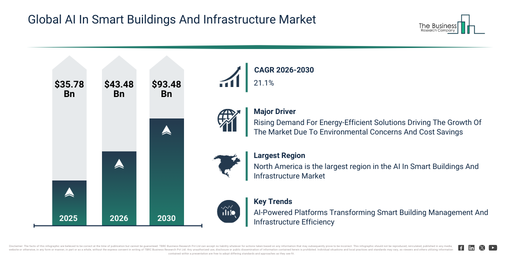
The market for AI in smart buildings and infrastructure has seen significant expansion in recent years. This sector is expected to expand from $35.78 billion in 2025 to $43.48 billion in 2026, achieving a compound annual growth rate (CAGR) of 21.5%. Historically, this growth has been driven by several factors, including the increasing prevalence of building management systems, tighter energy efficiency regulations, the widespread adoption of IoT sensors, efforts in urban infrastructure modernization, and the continuous demand for reducing operational expenditures.
The AI in smart buildings and infrastructure market is projected to experience substantial expansion over the upcoming years. Its valuation is expected to reach $93.48 billion by 2030, advancing at a compound annual growth rate (CAGR) of 21.1%. This anticipated growth throughout the forecast period stems from the increasing development of smart city programs, more stringent sustainability requirements, breakthroughs in edge AI devices, a heightened need for automated facility management, and the merging of AI with digital twin technologies. Significant developments during this period are predicted to include AI-powered building automation, proactive infrastructure maintenance, AI-assisted energy optimization, sophisticated security and surveillance solutions, and smart building systems designed around occupant well-being.
Download A Free Sample Report For Comprehensive Market Insights:
AI In Smart Buildings And Infrastructure Market Growth Momentum: Which Factors Are Influencing Demand?
The rising need for eco-friendly and energy-saving building approaches is projected to accelerate the expansion of the AI in smart buildings and infrastructure market in the future. Such solutions encompass the creation and deployment of systems aimed at lowering energy use, lessening environmental footprints, and fostering enduring sustainability within structures. Growing worries about the environment and climate change are fueling the heightened call for these energy-efficient and sustainable building solutions. They contribute to diminishing carbon emissions, cutting down on energy expenses, and adhering to more stringent governmental sustainability mandates. Artificial intelligence optimizes energy usage in smart buildings by automating functions like climate control, lighting, and predictive maintenance, thereby boosting efficiency and sustainability. To illustrate, data from March 2024, provided by the Department for Energy Security and Net Zero, a UK-based government agency, indicated that 318,600 energy efficiency measures were implemented in 2023 in properties throughout Great Britain via diverse government support programs, representing a 49% surge over 2022. Consequently, the escalating requirement for energy-efficient and sustainable building solutions is propelling the expansion of the AI in smart buildings and infrastructure market.
AI In Smart Buildings And Infrastructure Market Segmentation And Category Breakdown
The AI in smart buildings and infrastructure market covered in this report is segmented –
1) By Type: Software, Hardware, Services
2) By Technology: Machine Learning, Natural Language Processing, Computer Vision, Robotic Process Automation, Other Technologies
3) By Application: Building Automation, Energy Management, Security And Surveillance, Predictive Maintenance, Smart Parking, Other Applications
4) By End-User Industry: Commercial Buildings, Residential Buildings, Industrial Buildings, Government Buildings, Healthcare Facilities, Educational Institutions, Retail Spaces, Other End User Industries
Subsegments:
1) By Software: AI-Powered Building Management Systems (BMS), Energy Management Software, Predictive Maintenance Solutions, Security And Surveillance Analytics, Space Optimization And Utilization Software, HVAC Optimization Software, Smart Lighting Control Software
2) By Hardware: Sensors, Edge AI Devices, IoT Gateways, AI-Powered Cameras And Surveillance Equipment, Smart Meters And Smart Grids, Robotics For Facility Management
3) By Services: AI Consulting And Implementation Services, System Integration Services, Managed AI Services, Predictive Maintenance Services, AI Training And Support Services, Cloud-Based AI Services For Smart Buildings
AI In Smart Buildings And Infrastructure Market Trends: What Is Shaping Future Industry Growth?
Major companies engaged in the AI in smart buildings and infrastructure market are concentrating on developing advanced technologies, such as intelligent autonomous building control platforms, with the aim of optimizing energy efficiency, improving occupant comfort, and enhancing operational performance. Intelligent autonomous building control platforms are sophisticated, self-regulating systems that harness AI and sensor data to automatically manage and refine building performance across energy, environmental, and security functions. For example, in June 2025, Honeywell International Inc., a US-based multinational technology and industrial company, launched an AI-powered building management solution designed to streamline facility operations, reduce energy consumption, and boost predictive maintenance. This solution integrates AI-driven analytics with connected sensors to offer real-time insights, automate system adjustments, and pinpoint inefficiencies before they become critical. By enabling more informed decision-making and decreasing operational expenditures, Honeywell’s AI-enabled platform supports the shift towards more sustainable, resilient, and high-performance smart buildings and infrastructure.
AI In Smart Buildings And Infrastructure Market Competitive Analysis Of Major Industry Participants
Major companies operating in the AI in smart buildings and infrastructure market are Google LLC, Microsoft Corporation, Amazon Web Services Inc., Robert Bosch GmbH, Hitachi Ltd., Siemens AG, Intel Corporation, Panasonic Corporation, International Business Machines Corporation (IBM), Cisco Systems Inc., Oracle Corporation, Schneider Electric SE, Honeywell International Inc., ABB Ltd, NEC Corporation, Johnson Controls International plc, Samsung SDS, Autodesk Inc., Terminus Group, GridPoint Inc., Verdigris Technologies, BuildingIQ Inc., Built Robotics
Access The Complete AI In Smart Buildings And Infrastructure Market Report:
AI In Smart Buildings And Infrastructure Market Global Footprint: Which Region Holds Market Leadership?
North America was the largest region in the AI in smart buildings and infrastructure market in 2025. The regions covered in the AI in smart buildings and infrastructure market report are Asia-Pacific, South East Asia, Western Europe, Eastern Europe, North America, South America, Middle East, Africa.
Get in touch with us:
The Business Research Company: https://www.thebusinessresearchcompany.com/
Americas: +1 310-496-7795
Asia: +44 7882 955267 & +91 8897263534
Europe: +44 7882 955267
Email us at: marketing@tbrc.info
Follow us on:
LinkedIn: https://in.linkedin.com/company/the-business-research-company
YouTube: https://www.youtube.com/channel/UC24_fI0rV8cR5DxlCpgmyFQ
Global Market Model: https://www.thebusinessresearchcompany.com/global-market-model

Wasay has over a decade of experience in market research, data modelling, and analytics, with prior experience at GlobalData and Decision Tree Consulting Services. At The Business Research Company , he leads research operations across syndicated studies, customized consulting engagements, and the Global Market Model platform. His professional experience includes supporting organizations such as Boston Consulting Group, KPMG, and Ernst & Young. Wasay holds a degree in Electronics and Communications Engineering, postgraduate management qualifications from International Management Institute Belgium and Indian School of Business and Entrepreneurship, and completed the Integrated Program in Business Analytics from Indian Institute of Management Indore.