Built to provide research that’s more actionable and strategically valuable, The Business Research Company’s 2026 market reports include market attractiveness analysis, total addressable market sizing, company benchmarking matrices, interactive Excel dashboards, broader supply chain intelligence, emerging startup tracking, and in-depth product insights.
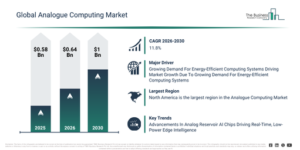
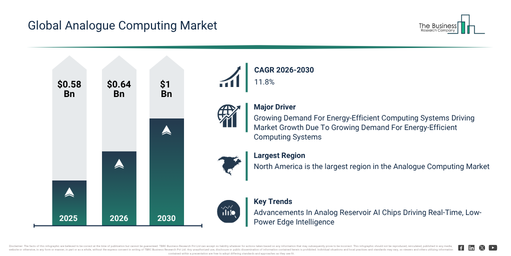
Analogue Computing Market Set To Climb From $0.64 Billion In 2026 To $1 Billion By 2030
The market size for analogue computing has experienced substantial expansion recently. This market is projected to expand from $0.58 billion in 2025 to reach $0.64 billion in 2026, showing a compound annual growth rate (CAGR) of 11.5%. The historical growth can be linked to the early uptake of electronic circuit-based computation models, the necessity for real time control systems within aerospace and defense, the evolution of operational amplifier technologies, the expansion of analog signal processing in telecommunications, and an escalating demand for simulation in industrial engineering.
The analogue computing market is projected to experience swift expansion over the coming years, reaching $1 billion by 2030, driven by an 11.8% compound annual growth rate (CAGR). This anticipated growth during the forecast period stems from factors such as increasing requirements for ultra-low power computing architectures, the escalating need for AI-driven hardware acceleration, the proliferation of edge computing demanding real-time processing, the growing complexity of simulations in autonomous systems, and the uptake of hybrid analog-digital computing models. Key trends expected in this timeframe encompass neuromorphic and brain-inspired analog computing systems, hybrid analog-digital computing architectures, real-time analog signal processing at the edge, energy-efficient high-speed simulation computing, and analog hardware acceleration tailored for AI workloads.
Get A Free Sample Report With In-Depth Market Insights:
Analogue Computing Market Demand Drivers: What’s Powering Industry Growth?
The increasing need for energy-efficient computing systems is anticipated to drive the expansion of the analogue computing market in the future. These systems involve computer hardware and software designs focused on reducing energy usage while preserving essential performance, speed, and reliability. The emergence of such systems stems from the necessity to decrease energy consumption alongside enhancing computational performance. Analogue computing supports energy-efficient systems by enabling calculations through continuous physical signals rather than discrete digital binary steps. For example, the International Energy Agency (IEA), a France-based intergovernmental organization, reported that in July 2025, data center facilities consumed approximately 485 terawatt hours (TWh) of electricity, accounting for 1.7% of global demand. This figure is predicted to climb to nearly 945 TWh by 2030, underscoring the swift growth of worldwide digital infrastructure, propelled by cloud computing and artificial intelligence workloads. Consequently, the escalating demand for energy-efficient computing systems is fueling the expansion of the analogue computing market.
Analogue Computing Market Segment Landscape: Which Areas Lead Development?
The analogue computing market covered in this report is segmented –
1) By Component: Hardware, Services
2) By Technology: Analog Signal Processing And Computation, Hybrid Analog-Digital Computing Systems, Neuromorphic And Brain-Inspired Computing, Analog Hardware Design And Consulting
3) By Deployment: On-Premises And Embedded Systems, Edge Computing Solutions, Cloud-Based Simulation Services, Custom Hardware Deployments
4) By Application: Simulation And Modeling, Real-Time Signal Processing, Artificial Intelligence Training And Inference, Control Systems
5) By End-User: Aerospace And Defense, Healthcare, Automotive, Telecommunications, Industrial Manufacturing, Energy And Utilities
Subsegments:
1) By Hardware: Analog Computing Systems, Analog Signal Processing Units, Operational Amplifier Based Systems, Electronic Circuit Simulation Hardware, Control And Instrumentation Units
2) By Services: Design Services, Consulting Services, Integration Services, Maintenance And Support Services, Training And Education Services
Analogue Computing Market Innovation Trends: What Developments Are Reshaping The Industry?
Leading companies in the analog computing market are increasingly directing their efforts towards developing advanced analog signal processing units, including prototype analog reservoir AI chips. This focus aims to facilitate real-time learning, minimize power consumption, and improve on-device intelligence for emerging edge applications. Prototype analog reservoir AI chips are experimental AI hardware that utilize analog circuits and reservoir computing, allowing for real-time, energy-efficient learning and the direct processing of time-based data on a device. For example, in October 2025, TDK Corporation, a Japan-based electronics and materials technology company, is set to introduce a prototype analog reservoir artificial intelligence (AI) chip. This compact neuromorphic computing system is engineered for real-time analog adaptive sensing, processing live sensor data through physical circuit dynamics, and enabling continuous on-device learning and adaptive responses without traditional model retraining. Moreover, it delivers ultra-low power operation and strong performance for time-series and motion-based sensing tasks, such as gesture recognition and real-time prediction on edge devices.
Analogue Computing Market Industry Leaders And Competitive Landscape
Major companies operating in the analogue computing market are Texas Instruments Incorporated; Infineon Technologies AG; STMicroelectronics N.V.; NXP Semiconductors N.V.; Renesas Electronics Corporation; Microchip Technology Incorporated; Keysight Technologies Inc.; Synopsys Inc.; Cadence Design Systems Inc.; SynSense AG; Innatera Nanosystems B.V.; Mythic Inc.; Aspinity Inc.; GrAI Matter Labs SAS; Rain Neuromorphics Inc.; anabrid GmbH; Blumind Inc.; Extropic Inc.; Vivum Computing Inc.; Aspirare Semiconductor Pvt. Ltd.
View The Full Analogue Computing Market Report:
Analogue Computing Market Regional Analysis And Top Geography
North America was the largest region in the analogue computing market in 2025. Asia-Pacific is expected to be the fastest-growing region in the forecast period. The regions covered in the analogue computing market report are Asia-Pacific, South East Asia, Western Europe, Eastern Europe, North America, South America, Middle East, Africa.
Reach Out To Our Team:
The Business Research Company: https://www.thebusinessresearchcompany.com/
Americas: +1 310-496-7795
Asia: +44 7882 955267 & +91 8897263534
Europe: +44 7882 955267
Email us at: marketing@tbrc.info
Follow us on:
LinkedIn: https://in.linkedin.com/company/the-business-research-company
YouTube: https://www.youtube.com/channel/UC24_fI0rV8cR5DxlCpgmyFQ
Global Market Model: https://www.thebusinessresearchcompany.com/global-market-model

Wasay has over a decade of experience in market research, data modelling, and analytics, with prior experience at GlobalData and Decision Tree Consulting Services. At The Business Research Company , he leads research operations across syndicated studies, customized consulting engagements, and the Global Market Model platform. His professional experience includes supporting organizations such as Boston Consulting Group, KPMG, and Ernst & Young. Wasay holds a degree in Electronics and Communications Engineering, postgraduate management qualifications from International Management Institute Belgium and Indian School of Business and Entrepreneurship, and completed the Integrated Program in Business Analytics from Indian Institute of Management Indore.