
Built to provide research that’s more actionable and strategically valuable, The Business Research Company’s 2026 market reports include market attractiveness analysis, total addressable market sizing, company benchmarking matrices, interactive Excel dashboards, broader supply chain intelligence, emerging startup tracking, and in-depth product insights.
Antifuse Field Programmable Gate Array Market Size, Value And Growth Trajectory Through 2030
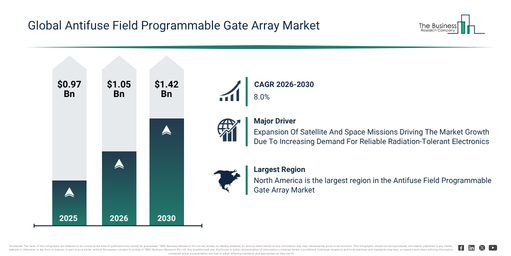
The antifuse field programmable gate array market has seen substantial growth over recent years. It is projected to increase from $0.97 billion in 2025 to $1.05 billion in 2026, exhibiting a compound annual growth rate (CAGR) of 8.4%. This past growth can be attributed to several factors, including the increasing demand for reliable programmable logic, the rising adoption of secure semiconductor devices, the growing use of customized hardware architectures, the increasing demand for permanent circuit configurations, and a rising need for hardware security.
The antifuse field programmable gate array market is projected to experience robust expansion over the coming years. This market is forecast to reach $1.42 billion by 2030, exhibiting a compound annual growth rate (CAGR) of 8.0%. This anticipated growth during the projection period stems from factors such as increasing demand for radiation-tolerant programmable devices, the rising adoption of high-reliability FPGAs, a growing need for secure hardware in critical applications, the increasing requirement for long-term hardware stability, and the rising demand for application-specific programmable logic. Key trends identified for the forecast timeframe encompass an increasing demand for permanent hardware configuration, the rising adoption of high-reliability programmable logic, a growing emphasis on secure hardware architectures, the increasing need for tamper-resistant semiconductor devices, and a rising demand for long-term operational stability.
Get A Free Sample Report With In-Depth Market Insights:
Antifuse Field Programmable Gate Array Market Growth Momentum: What Factors Are Shaping Demand?
The expanding scope of satellite and space missions is anticipated to boost the antifuse field programmable gate array (FPGA) market’s growth in the coming period. These missions involve the growing deployment of spacecraft, satellites, and various exploration programs, serving purposes like communication, navigation, earth observation, scientific inquiry, and defense. Their expansion is fueled by rising investments in space exploration, with both governmental and private entities dedicating greater resources to the creation of advanced spacecraft. Such missions accelerate the adoption of antifuse field programmable gate arrays (FPGAs) because they necessitate programmable semiconductor solutions that are highly reliable, resistant to radiation, and consume low power. These solutions must function effectively in harsh space conditions, facilitating sophisticated processing, control, and communication features within satellites and spacecraft. An example is the 16% rise in orbital launch attempts in 2024, totaling 259 launches at an average frequency of one every 34 hours – five hours more often than in 2023 – as reported in January 2025 by the US-based non-profit organization, Space Foundation. Consequently, the proliferation of satellite and space missions is a key factor propelling the antifuse field programmable gate array (FPGA) market forward. The escalation of cybersecurity threats is projected to stimulate the growth of the antifuse field programmable gate array market in the upcoming period. These threats encompass malicious actions like unauthorized access, data breaches, ransomware assaults, and system outages, all aimed at digital systems, networks, and connected devices to undermine the confidentiality, integrity, or availability of data and operations. Their increase stems from the rapid expansion of interconnected industrial systems, which broadens the potential attack surface across operational technology environments. Cybersecurity threats bolster the adoption of antifuse field programmable gate arrays (FPGAs) by generating greater demand for secure, tamper-resistant hardware solutions designed to prevent unauthorized reprogramming, reverse engineering, and harmful alterations in vital systems. As an illustration, the Australian Signals Directorate, an Australia-based government agency, reported more than 36,700 calls to its Australian Cyber Security Hotline in FY2023–24, a 12% rise from the prior financial year, and observed that over 11% of the cybersecurity incidents it addressed were connected to critical infrastructure, as noted in November 2024. Hence, the escalating cybersecurity threats are a significant catalyst for the growth of the antifuse field programmable gate array market.
Antifuse Field Programmable Gate Array Market Segment Outlook: Which Categories Are Growing Fastest?
The antifuse field programmable gate array market covered in this report is segmented –
1) By Type: One-Time Programmable (OTP) Antifuse Field-Programmable Gate Array (FPGA), Radiation-Hardened (Rad-Hard) Antifuse Field-Programmable Gate Array (FPGA), Standard Antifuse Field-Programmable Gate Array (FPGA)
2) By Technology: High-Density Antifuse, Low-Power Antifuse, Radiation-Hardened Antifuse, Ultra-Low Power Antifuse
3) By Node Size: Less Than 28 NM, 28–90 NM, More Than 90 NM
4) By Application: Aerospace, Telecommunications, Consumer Electronics, Automotive, Medical Devices
5) By End User: Industrial, Commercial, Government, Research And Development
Subsegments:
1) By One-Time Programmable (OTP) Antifuse Field-Programmable Gate Array (FPGA): Low Density One-Time Programmable (OTP) Antifuse Field-Programmable Gate Array (FPGA), High Density One-Time Programmable (OTP) Antifuse Field-Programmable Gate Array (FPGA), Secure One-Time Programmable (OTP) Antifuse Field-Programmable Gate Array (FPGA), Radiation-Tolerant One-Time Programmable (OTP) Antifuse Field-Programmable Gate Array (FPGA)
2) By Radiation-Hardened (Rad-Hard) Antifuse Field-Programmable Gate Array (FPGA): Space-Grade Radiation-Hardened Antifuse Field-Programmable Gate Array (FPGA), Military-Grade Radiation-Hardened Antifuse Field-Programmable Gate Array (FPGA), High Reliability Radiation-Hardened Antifuse Field-Programmable Gate Array (FPGA), Radiation Resistant Antifuse Field-Programmable Gate Array (FPGA)
3) By Standard Antifuse Field-Programmable Gate Array (FPGA): Low Power Standard Antifuse Field-Programmable Gate Array (FPGA), High Performance Standard Antifuse Field-Programmable Gate Array (FPGA), High Density Standard Antifuse Field-Programmable Gate Array (FPGA), General Purpose Standard Antifuse Field-Programmable Gate Array (FPGA)
Antifuse Field Programmable Gate Array Market Top Companies Driving Competitive Growth
Major companies operating in the antifuse field programmable gate array market are BAE Systems plc, Honeywell International Inc., Microchip Technology Incorporated, Teledyne Technologies Incorporated, QuickLogic Corporation
View The Full Antifuse Field Programmable Gate Array Market Report:
Antifuse Field Programmable Gate Array Market Global Footprint: Which Region Leads The Industry?
North America was the largest region in the antifuse field programmable gate array market in 2025. Asia-Pacific is expected to be the fastest-growing region in the forecast period. The regions covered in the antifuse field programmable gate array market report are Asia-Pacific, South East Asia, Western Europe, Eastern Europe, North America, South America, Middle East, Africa.
Reach Out To Our Team:
The Business Research Company: https://www.thebusinessresearchcompany.com/
Americas: +1 310-496-7795
Asia: +44 7882 955267 & +91 8897263534
Europe: +44 7882 955267
Email us at: marketing@tbrc.info
Follow us on:
LinkedIn: https://in.linkedin.com/company/the-business-research-company
YouTube: https://www.youtube.com/channel/UC24_fI0rV8cR5DxlCpgmyFQ
Global Market Model: https://www.thebusinessresearchcompany.com/global-market-model

Wasay has over a decade of experience in market research, data modelling, and analytics, with prior experience at GlobalData and Decision Tree Consulting Services. At The Business Research Company , he leads research operations across syndicated studies, customized consulting engagements, and the Global Market Model platform. His professional experience includes supporting organizations such as Boston Consulting Group, KPMG, and Ernst & Young. Wasay holds a degree in Electronics and Communications Engineering, postgraduate management qualifications from International Management Institute Belgium and Indian School of Business and Entrepreneurship, and completed the Integrated Program in Business Analytics from Indian Institute of Management Indore.