
Enhanced with market attractiveness analysis, total addressable market evaluation, company benchmarking matrices, interactive Excel dashboards, expanded supply chain intelligence, emerging startup coverage, and detailed product insights, The Business Research Company’s 2026 market reports deliver more actionable and strategically valuable research.
Artificial Intelligence (AI) Language-Tutor Robot Market Expansion Outlook: What Revenue Opportunities Lie Ahead?
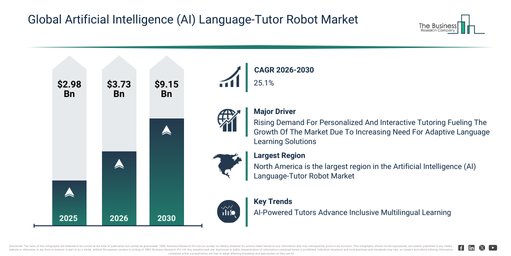
The market for artificial intelligence (AI) language-tutor robots has experienced rapid expansion over recent years. Projections indicate its value will increase from $2.98 billion in 2025 to $3.73 billion in 2026, demonstrating a compound annual growth rate (CAGR) of 25.4%. Factors contributing to its historical growth include the wider adoption of smart education tools, a heightened need for tailored language instruction, the increased application of conversational artificial intelligence (AI) in tutoring, the broader integration of robots into K-12 learning environments, and the rising acceptance of automated teaching assistants.
The artificial intelligence (AI) language-tutor robot market size is anticipated to experience substantial growth in the upcoming years. It is projected to expand to $9.15 billion by 2030, demonstrating a compound annual growth rate (CAGR) of 25.1%. The expansion over this period can be attributed to the increasing implementation of AI-driven tutor robots, the escalating demand for training a multilingual workforce, rising investments in adaptive learning robots, the broadening scope of artificial intelligence (AI)-based corporate language training, and a growing inclination towards immersive robotic learning environments. Prominent trends for the forecast period include technological advancements in natural language processing, innovations in multimodal robotic interactions, progress in autonomous tutoring systems, ongoing research and development into generative artificial intelligence (AI) tutors, and the integration of robots with virtual reality (VR) and augmented reality (AR) learning ecosystems.
Download A Free Sample Report For Comprehensive Market Insights:
Artificial Intelligence (AI) Language-Tutor Robot Market Growth Drivers: What Factors Are Accelerating Expansion?
The anticipated expansion of the artificial intelligence (AI) language-tutor robot market going forward is largely attributable to the increasing need for tailored and engaging educational support. This type of tutoring involves teaching methodologies, speeds, and content specifically adapted to individual student requirements, fostering active participation via interactive instruments. The increasing interest in personalized and interactive tutoring stems from its effectiveness in catering to various skill levels within language learning. The artificial intelligence (AI) language-tutor robot market facilitates this by offering smart robotic platforms that provide adaptable language instruction, immediate feedback, and conversational exercises customized for every student. A notable example is data from April 2025 by the Association for the Teaching of the Social Sciences, a UK-based educational organization, which shows that 92% of undergraduates currently utilize AI, a rise from 66% in 2024. Additionally, the application of generative AI for academic purposes has significantly increased, with 88% using it for assignments, compared to 53% in 2023. Consequently, the growing desire for personalized and interactive learning solutions is a key catalyst for the expansion of the artificial intelligence (AI) language-tutor robot market.
Artificial Intelligence (AI) Language-Tutor Robot Market Segment Analysis Highlighting Growth Areas
The artificial intelligence (AI) language-tutor robot market covered in this report is segmented –
1) By Component: Hardware, Software, Services
2) By Deployment Mode: Cloud-Based, On-Premises
3) By Application: Education, Corporate Training, Personal Learning, Special Education, Other Applications
4) By End-User: K-12, Higher Education, Enterprises, Individuals, Other End-Users
Subsegments:
1) By Hardware: Sensor Modules, Processing Units, Robotic Arms, Mobility Systems, Display Interfaces, Power Supply Units
2) By Software: Language Learning Algorithms, Speech Recognition Systems, Natural Language Processing Engines, User Interaction Interfaces, Machine Learning Frameworks, Cloud Integration Platforms
3) By Services: Installation Services, Maintenance And Support Services, Training Services, System Integration Services, Customization Services, Remote Monitoring Services
Artificial Intelligence (AI) Language-Tutor Robot Market Trends: What Is Shaping Future Industry Growth?
Businesses active in the artificial intelligence (AI) language-tutor robot market are prioritizing the creation of sophisticated technologies, including AI-driven educational instruments, with the aim of improving learning results, increasing access, and diminishing educational disparities. These AI-driven educational instruments are intelligent systems within the Web3 ecosystem, utilizing algorithms and machine learning to deliver learning experiences that are personalized, fair, and engaging. An illustrative instance is the introduction of the IRIS robot tutor by BSG Technologies Inc., a South Africa-based science and technology firm, in August 2025. This innovative educational robot is designed to instruct students from grade R through tertiary levels across all 11 official South African languages. Equipped with sophisticated natural language processing and emotional recognition, IRIS facilitates interactive, customized lessons, thereby transforming linguistic diversity into a valuable learning advantage. This government-supported launch, intended to complement educators instead of replacing them, signifies a crucial advancement in leveraging indigenous Web3 and AI innovation for educational transformation throughout the continent.
Artificial Intelligence (AI) Language-Tutor Robot Market Leading Companies: Who Holds Significant Market Presence?
Major companies operating in the artificial intelligence (AI) language-tutor robot market are iFLYTEK Co. Ltd., Cambly Inc., UBTECH Robotics Corp Ltd., Duolingo Inc., Babbel GmbH, Embodied Inc., PAL Robotics S.L., SoftBank Robotics Group Corp., Miko AI Private Limited, Busuu Limited, ELECFREAKS Technology Co. Ltd., Lingoda GmbH, italki HK Limited, Roybi Robot Inc., Memrise Limited, LuxAI S.A., Chatterbug GmbH, ELSA Corp., Promova Inc., LingQ Inc.
Access The Complete Artificial Intelligence (AI) Language-Tutor Robot Market Report:
Artificial Intelligence (AI) Language-Tutor Robot Market Geographic Landscape: Which Region Dominates Industry Growth?
North America was the largest region in the artificial intelligence (AI) language-tutor robot market in 2025. Asia-Pacific is expected to be the fastest-growing region in the forecast period. The regions covered in the artificial intelligence (AI) language-tutor robot market report are Asia-Pacific, South East Asia, Western Europe, Eastern Europe, North America, South America, Middle East, Africa.
Get in touch with us:
The Business Research Company: https://www.thebusinessresearchcompany.com/
Americas: +1 310-496-7795
Asia: +44 7882 955267 & +91 8897263534
Europe: +44 7882 955267
Email us at: marketing@tbrc.info
Follow us on:
LinkedIn: https://in.linkedin.com/company/the-business-research-company
YouTube: https://www.youtube.com/channel/UC24_fI0rV8cR5DxlCpgmyFQ
Global Market Model: https://www.thebusinessresearchcompany.com/global-market-model

Wasay has over a decade of experience in market research, data modelling, and analytics, with prior experience at GlobalData and Decision Tree Consulting Services. At The Business Research Company , he leads research operations across syndicated studies, customized consulting engagements, and the Global Market Model platform. His professional experience includes supporting organizations such as Boston Consulting Group, KPMG, and Ernst & Young. Wasay holds a degree in Electronics and Communications Engineering, postgraduate management qualifications from International Management Institute Belgium and Indian School of Business and Entrepreneurship, and completed the Integrated Program in Business Analytics from Indian Institute of Management Indore.