
Enhanced with market attractiveness analysis, total addressable market evaluation, company benchmarking matrices, interactive Excel dashboards, expanded supply chain intelligence, emerging startup coverage, and detailed product insights, The Business Research Company’s 2026 market reports deliver more actionable and strategically valuable research.
Artificial Intelligence (AI) Safety Market Forecast Highlighting Growth From $4.9 Billion To $16.56 Billion
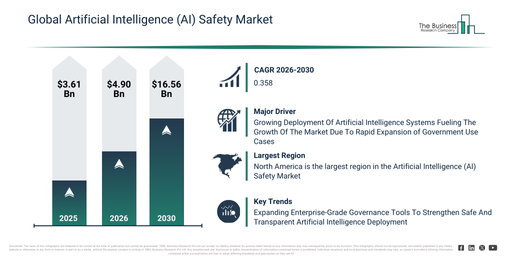
The artificial intelligence (AI) safety market has experienced rapid expansion in its size over recent years. This market is projected to expand from $3.61 billion in 2025 to $4.90 billion by 2026, demonstrating a compound annual growth rate (CAGR) of 35.8 %. Factors contributing to this historical growth include an escalating regulatory emphasis on secure AI practices, a heightened enterprise demand for risk-managed AI deployments, increasing worries regarding unforeseen AI conduct, the broader embrace of ethical AI frameworks, and increased funding for AI oversight.
The market for artificial intelligence (AI) safety solutions is projected to experience rapid expansion over the coming years. This market is set to reach a valuation of $16.56 billion by 2030, demonstrating a compound annual growth rate (CAGR) of 35.6%. The expansion during this projection period stems from several factors, including an increasing need for AI systems that are both explainable and trustworthy, the rising adoption of AI governance standards, the broader integration of AI safety measures across various sectors, a heightened emphasis on minimizing bias in AI models, and an increasing focus on managing the AI lifecycle securely. Key trends anticipated during the forecast period involve technological progress in detecting AI risks, novel approaches in explainable AI modeling, the evolution of safety protocols for autonomous systems, ongoing research and development in aligning human and AI objectives, and improvements in tools for AI governance and auditing.
Download A Free Sample Report For Comprehensive Market Insights:
Artificial Intelligence (AI) Safety Market Growth Momentum: Which Factors Are Influencing Demand?
The expanding implementation of artificial intelligence systems is projected to fuel the expansion of the artificial intelligence (AI) safety market in the coming years. These AI systems are defined as intelligent models or applications with the potential to significantly impact safety, civil rights, public services, or vital infrastructure if they fail or behave unexpectedly. The surge in deploying artificial intelligence systems stems from the increasing demand for automation and operational efficiency across various sectors. The adoption of artificial intelligence systems bolsters artificial intelligence (AI) safety by necessitating strong safeguards, continuous monitoring, and effective governance to guarantee reliable, transparent, and ethical AI operation, particularly in critical applications. For example, the U.S. Government Accountability Office, a US-based government agency, reported in July 2025 that documented AI use cases experienced a significant increase, rising from 571 in 2023 to 1,110 in 2024. During this same timeframe, generative AI use cases saw nearly a ninefold increase, escalating from a mere 32 to 282. Consequently, the rising deployment of artificial intelligence systems is a key driver for the growth of the artificial intelligence (AI) safety market.
Artificial Intelligence (AI) Safety Market Segment Landscape: Which Areas Lead Market Development?
The artificial intelligence (AI) safety market covered in this report is segmented –
1) By Component: Software, Hardware, Services
2) By Deployment Mode: On-Premises, Cloud
3) By Technology: Machine Learning Safety Systems, Deep Learning Safety Systems, Natural Language Processing Safety Systems, Computer Vision Safety Systems, Reinforcement Learning Safety Systems
4) By Organization Size: Large Enterprises, Medium Enterprises, Small Enterprises, Micro Enterprises, Public Sector Organizations
5) By End-User: Banking, Financial Services And Insurance (BFSI), Healthcare, Automotive, Information Technology And Telecommunications, Government, Other End Users
Subsegments:
1) By Software: AI Safety Platforms, Robustness And Monitoring Tools, Alignment And Oversight Software, Data Security And Privacy Software
2) By Hardware: Specialized AI Safety Chips, Secure Enclaves And Trusted Execution Environments, Hardware For Controlled Testing Environments, Biometric And Physical Access Systems
3) By Services: AI Safety Consulting And Auditing, Red Teaming And Adversarial Testing, Incident Response And Management, Training And Certification
Artificial Intelligence (AI) Safety Market Trends Reshaping Industry Growth
Leading companies in the artificial intelligence (AI) safety market are concentrating on developing advanced solutions, such as open-source model frameworks and enhanced governance capabilities, aiming to improve transparency, ensure safety compliance, and manage risks in enterprise AI deployments. Open-source model frameworks and governance solutions integrate collaborative development, interpretability tools, and community-driven safeguards to empower organizations to build, monitor, and align AI systems while mitigating unintended or harmful behaviors. For instance, in May 2024, International Business Machines Corporation, a US-based technology corporation, unveiled the next chapter of its WatsonX platform, featuring open-source product and ecosystem innovations, which included the release of a family of Granite open-source models and the launch of InstructLab, a model alignment technique that invites community contributions and supports safer model development and deployment practices. These enhancements are designed to improve visibility, governance, and safety oversight across open and hybrid Artificial Intelligence environments. Consequently, the trend toward open-source model releases and safety-focused governance innovations is shaping the Artificial Intelligence safety market.
Artificial Intelligence (AI) Safety Market Industry Leaders And Market Competition
Major companies operating in the artificial intelligence (AI) safety market are Microsoft Corporation, OpenAI LLC, MITRE Corporation, Anthropic PBC, DeepMind Technologies Limited, HiddenLayer Inc., Fiddler AI Inc., Arthur AI Inc., ModelOp Center Inc., CalypsoAI Corp., Credo AI Inc., Truera Inc., WhyLabs Inc., Robust Intelligence Inc., Aequitas AI Inc., Fairly AI Inc., Holistic AI Ltd., Goodfire AI Inc., Giskard AI Inc., Center for AI Safety Inc.
Access The Complete Artificial Intelligence (AI) Safety Market Report:
Artificial Intelligence (AI) Safety Market Regional Analysis And Leading Geography
North America was the largest region in the artificial intelligence (AI) safety market in 2025. Asia-Pacific is expected to be the fastest-growing region in the forecast period. The regions covered in the artificial intelligence (AI) safety market report are Asia-Pacific, South East Asia, Western Europe, Eastern Europe, North America, South America, Middle East, Africa.
Get in touch with us:
The Business Research Company: https://www.thebusinessresearchcompany.com/
Americas: +1 310-496-7795
Asia: +44 7882 955267 & +91 8897263534
Europe: +44 7882 955267
Email us at: marketing@tbrc.info
Follow us on:
LinkedIn: https://in.linkedin.com/company/the-business-research-company
YouTube: https://www.youtube.com/channel/UC24_fI0rV8cR5DxlCpgmyFQ
Global Market Model: https://www.thebusinessresearchcompany.com/global-market-model

Wasay has over a decade of experience in market research, data modelling, and analytics, with prior experience at GlobalData and Decision Tree Consulting Services. At The Business Research Company , he leads research operations across syndicated studies, customized consulting engagements, and the Global Market Model platform. His professional experience includes supporting organizations such as Boston Consulting Group, KPMG, and Ernst & Young. Wasay holds a degree in Electronics and Communications Engineering, postgraduate management qualifications from International Management Institute Belgium and Indian School of Business and Entrepreneurship, and completed the Integrated Program in Business Analytics from Indian Institute of Management Indore.