Featuring market attractiveness scoring, total addressable market sizing, company benchmarking matrices, interactive Excel dashboards, deeper supply chain intelligence, emerging startup tracking, and granular product-level insights, The Business Research Company’s 2026 market reports are built to deliver research that is both more actionable and more strategically valuable.
Augmented Reality Gaming Market Revenue Growth On Track For A 29.4% CAGR Through 2030
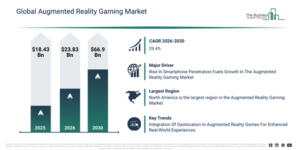
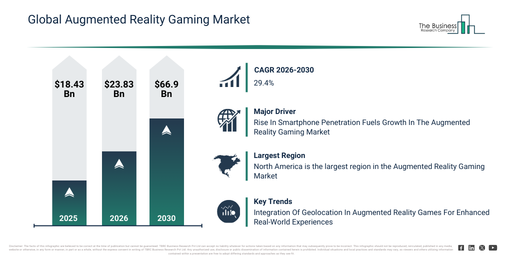
The augmented reality gaming market has witnessed significant expansion in recent years. This market is expected to surge from $18.43 billion in 2025 to $23.83 billion in 2026, recording a compound annual growth rate (CAGR) of 29.3%. The historical increase can be attributed to increased smartphone adoption, advancements in AR hardware and software, the growing popularity of mobile gaming, rising consumer demand for immersive entertainment, and the expansion of app stores and gaming platforms.
The augmented reality gaming market size is poised for substantial growth over the next few years. It is forecast to expand to $66.9 billion in 2030, exhibiting a compound annual growth rate (CAGR) of 29.4%. This anticipated growth is driven by the integration of artificial intelligence for adaptive gameplay, the adoption of 5G networks providing low-latency experiences, the proliferation of cloud-based AR gaming platforms, increasing investments in AR game development, and the wider availability of wearable AR devices such as smart glasses. Notable trends expected during this period encompass location-based AR gaming experiences, advanced AR game monetization strategies, the emergence of social and multiplayer AR gaming platforms, seamless integration with mobile and smart devices, and the gamification of real-world environments.
Get A Free Sample Report With In-Depth Market Insights:
Augmented Reality Gaming Market Growth Factors Behind Sustained Expansion
The rising prevalence of smartphone ownership is anticipated to fuel the expansion of the augmented reality gaming market moving forward. A smartphone is a compact mobile device characterized by advanced computing capabilities, a touchscreen interface, internet connectivity, and various applications designed for communication, multimedia, and productivity. Smartphones enable augmented reality (AR) gaming by leveraging their integrated cameras and sensors to superimpose virtual elements onto the real-world environment, thereby providing users with an interactive and immersive gaming experience. For instance, in October 2025, Demandsage, a US-based software company, reported that there were approximately 6.8 billion smartphone users globally as of 2023, a figure projected to increase to about 7.34 billion by 2025. Therefore, the growing penetration of smartphones is driving the growth of the augmented reality gaming market.
Augmented Reality Gaming Market Segment Analysis Spotlighting Growth Areas
The augmented reality gaming market covered in this report is segmented –
1) By Product: Head Mounted Display (HMD), Handheld Display, Spatial Display
2) By Component: Software, Hardware
3) By Device: Mobiles, Smart Glasses
4) By Application: Commercial Use, Home Use
Subsegments:
1) By Head Mounted Display (HMD): VR Headsets, AR Glasses
2) By Handheld Display: Mobile Devices, Tablets
3) By Spatial Display: Projection-Based Systems, Desktop Monitors
Augmented Reality Gaming Market Industry Trends Fueling Future Revenue Growth
Leading companies in the augmented reality gaming market are introducing new offerings, such as geolocation-based augmented reality games, to gain a competitive advantage. Geolocation describes the process or technology of identifying and determining the actual geographic location of a person, device, or object using various methods like GPS (Global Positioning System), Wi-Fi, cellular networks, or sensors. For instance, in January 2023, Niantic Inc., a US-based software development company, launched NBA All-World, a free-to-play augmented reality basketball game. This game is designed to celebrate basketball culture, allowing players to find and challenge opponents on a map, recruit NBA players for their teams, and compete in real-world settings such as neighborhood courts and branded drop zones. The game encourages physical activity, exploration, and engagement with basketball culture through challenges, gear drops from popular brands, and opportunities to showcase teams.
Augmented Reality Gaming Market Leading Companies: Who Holds The Strongest Market Presence?
Major companies operating in the augmented reality gaming market are Apple Inc.; Alphabet Inc.; Microsoft Corporation; Sony Group Corporation; Qualcomm Technologies Inc.; Niantic Inc.; Magic Leap Inc.; Meta Platforms Inc.; Sixense Enterprises Inc.; Zappar Ltd.; Blippar Limited; Resolution Games; Tencent; Ubisoft; Snap Inc.; Nintendo; Unity Technologies; Spatial (platform); Cluetivity; EyeClick
View The Full Augmented Reality Gaming Market Report:
Augmented Reality Gaming Market Largest Region: Which Geography Holds The Biggest Share?
North America was the largest region in the augmented reality gaming market in 2025. Asia-Pacific is expected to be the fastest-growing region in the forecast period. The regions covered in the augmented reality gaming market report are Asia-Pacific, South East Asia, Western Europe, Eastern Europe, North America, South America, Middle East, Africa.
Reach Out To Our Team:
The Business Research Company: https://www.thebusinessresearchcompany.com/
Americas: +1 310-496-7795
Asia: +44 7882 955267 & +91 8897263534
Europe: +44 7882 955267
Email us at: marketing@tbrc.info
Follow us on:
LinkedIn: https://in.linkedin.com/company/the-business-research-company
YouTube: https://www.youtube.com/channel/UC24_fI0rV8cR5DxlCpgmyFQ
Global Market Model: https://www.thebusinessresearchcompany.com/global-market-model

Wasay has over a decade of experience in market research, data modelling, and analytics, with prior experience at GlobalData and Decision Tree Consulting Services. At The Business Research Company , he leads research operations across syndicated studies, customized consulting engagements, and the Global Market Model platform. His professional experience includes supporting organizations such as Boston Consulting Group, KPMG, and Ernst & Young. Wasay holds a degree in Electronics and Communications Engineering, postgraduate management qualifications from International Management Institute Belgium and Indian School of Business and Entrepreneurship, and completed the Integrated Program in Business Analytics from Indian Institute of Management Indore.