Featuring market attractiveness scoring, total addressable market sizing, company benchmarking matrices, interactive Excel dashboards, deeper supply chain intelligence, emerging startup tracking, and granular product-level insights, The Business Research Company’s 2026 market reports are built to deliver research that is both more actionable and more strategically valuable.
Automotive Quantum Computing Market Set To Climb From $0.32 Billion In 2026 To $0.81 Billion By 2030
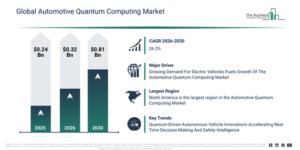
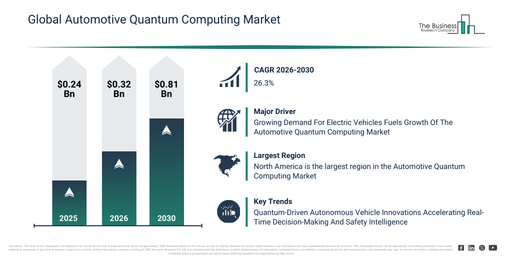
The automotive quantum computing market size has experienced significant expansion in recent years. It is anticipated to increase from $0.24 billion in 2025 to $0.32 billion in 2026, achieving a compound annual growth rate (CAGR) of 31.4%. The expansion observed in the past can be linked to the early uptake of fundamental computational optimization tools, the rising complexity of vehicles, an increased emphasis on autonomous driving, greater research and development investments in automotive technology, and the initial application of cloud computing in vehicle simulations.
The automotive quantum computing market is poised for substantial expansion over the next few years. It is projected to achieve a value of $0.81 billion by 2030, exhibiting a compound annual growth rate (CAGR) of 26.3%. This growth during the forecast period is fueled by the incorporation of quantum processors into automotive research and development, the implementation of quantum algorithms for optimizing materials and batteries, the increased utilization of quantum machine learning for predictive maintenance, the deployment of quantum communication systems for connected vehicles, and the broadened application of quantum simulation software for electromechanical systems. Noteworthy trends for this period include quantum-enhanced vehicle routing, sophisticated optimization for autonomous driving, predictive maintenance leveraging quantum computing, enhanced battery material simulation, and advancements in fluid dynamics and heat transfer optimization.
Get A Free Sample Report With In-Depth Market Insights:
Automotive Quantum Computing Market Growth Factors Behind Sustained Expansion
The increasing requirement for electric vehicles is projected to boost the expansion of automotive quantum computing moving forward. Electric vehicles are defined as automobiles powered by electric motors, which utilize rechargeable batteries or alternative energy storage systems rather than conventional internal combustion engines. This rising demand for electric vehicles is primarily fueled by concerns for environmental sustainability and ongoing advancements in battery technology. Automotive quantum computing enhances the efficiency of electric vehicles through sophisticated optimization algorithms and improved battery management. Furthermore, quantum algorithms possess the capability to analyze traffic patterns, population density, and energy demand to pinpoint ideal locations for charging stations. For instance, in April 2024, the International Energy Agency, an autonomous intergovernmental organization based in France, reported that in 2023, nearly 14 million new electric cars were registered worldwide, bringing the total number on the roads to 40 million. Electric vehicles accounted for about 18% of all car sales, a rise from 14% in 2022. Thus, the escalating demand for electric vehicles is a significant factor driving the growth of the automotive quantum computing market.
Automotive Quantum Computing Market Breakdown By Product Type And Application
The automotive quantum computing market covered in this report is segmented –
1) By Component: Hardware, Software, Services
2) By Deployment: Cloud, On Premises
3) By Stakeholder Type: Tier 1 And Tier 2, Warehouse And Distribution, Original Equipment Manufacturer (OEM)
4) By Application: Vehicle Routing, Heat And Mass transfer, Fluid Dynamics, Electromechanical Systems, Route Optimization, Improved Battery Materials, Material Durability, Fuel-Cell Optimization, Autonomous Driving, Predictive Maintenance
Subsegments:
1) By Hardware: Quantum Processors, Quantum Sensors, Quantum Communication Systems, Quantum Storage Devices, Quantum Dots
2) By Software: Quantum Algorithms, Quantum Simulation Software, Quantum Cryptography Software, Quantum Machine Learning Software, Quantum Programming Tools
3) By Services: Consulting, Integration Services, Maintenance And Support, Training And Education
Automotive Quantum Computing Market Industry Trends Fueling Future Revenue Growth
Key companies in the automotive quantum computing market are concentrating on developing advanced solutions, such as quantum computing applications for autonomous vehicles, to enhance processing efficiency, decision-making speed, and overall vehicle intelligence. Quantum computing applications utilize the principles of quantum mechanics to perform complex computations at unparalleled speeds, enabling autonomous vehicles to process immense volumes of data from sensors, cameras, and connected infrastructure in real time. For instance, in October 2023, Vicone Technologies, a US-based company, emphasized its progress in quantum computing for autonomous vehicle navigation and safety systems, introducing a cloud-based platform that integrates quantum algorithms with vehicle sensor networks. This platform allows autonomous vehicles to optimize routing, predict traffic patterns, and make swift safety-critical decisions. It also improves the vehicle’s capability to learn from environmental data, enhance obstacle detection, and perform real-time risk assessments. These innovations enable automakers to deploy more dependable and intelligent autonomous driving solutions, thereby boosting passenger safety, operational efficiency, and responsiveness, while accelerating the adoption of advanced cloud-based automotive technologies.
Automotive Quantum Computing Market Company Landscape And Competitive Strategy
Major companies operating in the automotive quantum computing market are Google LLC; Amazon Web Services Inc.; International Business Machine Corporation; Anyon Systems Inc.; PsiQuantum; Xanadu Quantum Technologies; Quantum Machines; PASQAL SAS; Terra Quantum; Rigetti Computing; IonQ; Cambridge Quantum Computing CQC; QC Ware Forge; Classiq Technologies; D-Wave Systems Inc.; Quantinuum Ltd; Zapata Computing; Multiverse Computing; QuEra Computing; Alice & Bob; IQM Quantum Computers; planqc
View The Full Automotive Quantum Computing Market Report:
Automotive Quantum Computing Market Top Region: Where Does Most Revenue Come From?
North America was the largest region in the automotive quantum computing market in 2025. Europe is expected to be the fastest-growing region in the forecast period. The regions covered in the automotive quantum computing market report are Asia-Pacific, South East Asia, Western Europe, Eastern Europe, North America, South America, Middle East, Africa.
Reach Out To Our Team:
The Business Research Company: https://www.thebusinessresearchcompany.com/
Americas: +1 310-496-7795
Asia: +44 7882 955267 & +91 8897263534
Europe: +44 7882 955267
Email us at: marketing@tbrc.info
Follow us on:
LinkedIn: https://in.linkedin.com/company/the-business-research-company
YouTube: https://www.youtube.com/channel/UC24_fI0rV8cR5DxlCpgmyFQ
Global Market Model: https://www.thebusinessresearchcompany.com/global-market-model

Wasay has over a decade of experience in market research, data modelling, and analytics, with prior experience at GlobalData and Decision Tree Consulting Services. At The Business Research Company , he leads research operations across syndicated studies, customized consulting engagements, and the Global Market Model platform. His professional experience includes supporting organizations such as Boston Consulting Group, KPMG, and Ernst & Young. Wasay holds a degree in Electronics and Communications Engineering, postgraduate management qualifications from International Management Institute Belgium and Indian School of Business and Entrepreneurship, and completed the Integrated Program in Business Analytics from Indian Institute of Management Indore.