Backed by market attractiveness analysis, total addressable market sizing, company benchmarking matrices, interactive Excel dashboards, wider supply chain intelligence, emerging startup coverage, and detailed product-level insights, The Business Research Company’s 2026 market reports are designed to offer research that is more actionable and strategically valuable than ever.
Benefits Administration Software Market Revenue Outlook: What CAGR Lies Ahead Through 2030?
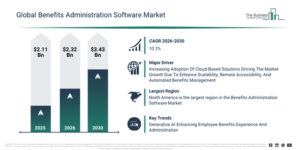
The benefits administration software market size has experienced rapid growth recently. Its value is expected to rise from $2.11 billion in 2025 to $2.32 billion in 2026, reflecting a compound annual growth rate (CAGR) of 10.0%. This historical expansion can be attributed to several factors, including the increasing adoption of digital HR management solutions, the rising intricacy in administering employee benefits, an increasing focus on ensuring employee engagement and retention, the wider expansion of cloud-based enterprise software, and the escalating requirements for regulatory compliance in workforce management.
The benefits administration software market is projected to experience substantial expansion in the coming years. This market is set to reach $3.43 billion by 2030, exhibiting a compound annual growth rate (CAGR) of 10.3%. This anticipated growth during the forecast period stems from several factors, including the escalating demand for AI-powered benefits personalization, the increasing embrace of predictive analytics within HR operations, the expanding integration of mobile-centric employee benefits platforms, the proliferation of solutions for managing remote and hybrid workforces, and heightened investments in robust, scalable cloud infrastructure. Key trends shaping this period encompass the wider acceptance of employee self-service platforms for benefits, a surging need for automated solutions for compliance and regulatory reporting, the deepening integration between payroll and benefits administration systems, the broadening of personalized employee wellness and health benefit initiatives, and ongoing innovations in real-time benefits enrollment and eligibility tracking capabilities.
Get A Free Sample Report With In-Depth Market Insights:
Benefits Administration Software Market Growth Drivers: What’s Behind The Acceleration?
The expanding implementation of cloud-based solutions is anticipated to stimulate the growth of the benefits administration software market moving forward. These solutions refer to the provision of computing services, including storage, software, and processing, via the internet rather than through local servers or personal devices. The uptake of cloud-based solutions is escalating due to the rising demand for scalable, cost-effective, and remotely accessible digital infrastructure that supports agile and efficient business operations. Cloud-based solutions bolster benefits administration software by providing centralized, secure, and real-time access to employee benefits data while streamlining processes such as enrollment, updates, compliance, and communication, thereby enhancing operational efficiency and accuracy. For instance, in March 2024, Flexera, a US-based computer software company, observed that multi-cloud usage climbed from 87% in 2023 to 89% in 2024, signifying continued enterprise reliance on cloud environments that also support HR and benefits management systems. Thus, the increased adoption of cloud-based solutions is propelling the expansion of the benefits administration software market.
Benefits Administration Software Market Segment Breakdown: Which Categories Lead On Revenue?
The benefits administration software market covered in this report is segmented –
1) By Component: Software, Services
2) By Deployment Mode: On-Premises, Cloud-Based
3) By Organization Size: Small And Medium Enterprises, Large Enterprises
4) By Application: Health Benefits Management, Retirement Benefits Management, Compensation And Payroll Integration, Employee Wellness Programs
5) By End-User: Banking, Financial Services, And Insurance, Healthcare, Information Technology And Telecommunications, Government, Manufacturing, Other End-Users
Subsegments:
1) By Software: Benefits Enrollment Software, Claims Management Software, Payroll And Benefits Integration Software, Compliance And Reporting Software, Employee Self Service Portal Software
2) By Services: Implementation And Integration Services, Consulting And Advisory Services, Maintenance And Support Services, Training And Education Services, Data Migration And Management Services
Benefits Administration Software Market Trends: What’s Defining The Industry’s Next Phase?
Leading companies in the benefits administration software market are prioritizing the development of innovative solutions, such as generative artificial intelligence (AI)-powered benefits assistants, to deliver personalized employee support, automate benefits queries, and simplify enrollment and plan management. These generative AI benefits assistants are interactive digital tools that employ advanced machine learning and natural language processing to comprehend employee questions, generate human-like responses, and guide users through benefits enrollment, plan selection, and issue resolution in real time. This approach aids in customizing support, reducing HR workload, and streamlining complex benefits administration processes. For example, in November 2024, WEX Inc., a US-based commerce platform and intelligent payment solutions company, launched two AI pilot programs, Benefit Assistant and BeneFITwise Premier, within its My Benefit Express platform. The Benefit Assistant functions as a generative AI agent, assisting employees with more than 1,500 benefits-related queries, including enrollment guidance, dependent management, and plan navigation, via an intuitive chat-based interface that reduces HR team dependency and optimizes employee support workflows. BeneFITwise Premier, on the other hand, leverages AI and claims data analytics to offer year-round personalized financial and healthcare insights, enabling employees to better understand their benefits usage patterns, evaluate plan suitability, and make cost-effective healthcare decisions, thereby improving overall benefits engagement. These solutions are intended to enhance decision-making accuracy, decrease the administrative workload for HR departments, and increase employee satisfaction by providing real-time, data-driven guidance within a cohesive benefits administration ecosystem.
Benefits Administration Software Market Leading Companies And Competitive Benchmarking
Major companies operating in the benefits administration software market are Automatic Data Processing Inc., Workday Inc., Paychex Inc., Conduent Incorporated, UKG Inc., WEX Inc., Paycom Software Inc., Rippling, Gusto Inc., isolved Inc., Optavise LLC, Businessolver.com Inc., PlanSource Benefits Administration Inc., Empyrean Benefit Solutions Inc., Namely Inc., Selerix Systems Inc., Nayya, Apprize Technology Inc., Zenefits, BenefitElect LLC
View The Full Benefits Administration Software Market Report:
Benefits Administration Software Market Top Region By Revenue And Market Share
North America was the largest region in the benefits administration software market in 2025. Asia-Pacific is expected to be the fastest-growing region in the forecast period. The regions covered in the benefits administration software market report are Asia-Pacific, South East Asia, Western Europe, Eastern Europe, North America, South America, Middle East, Africa.
Reach Out To Our Team:
The Business Research Company: https://www.thebusinessresearchcompany.com/
Americas: +1 310-496-7795
Asia: +44 7882 955267 & +91 8897263534
Europe: +44 7882 955267
Email us at: marketing@tbrc.info
Follow us on:
LinkedIn: https://in.linkedin.com/company/the-business-research-company
YouTube: https://www.youtube.com/channel/UC24_fI0rV8cR5DxlCpgmyFQ
Global Market Model: https://www.thebusinessresearchcompany.com/global-market-model

Wasay has over a decade of experience in market research, data modelling, and analytics, with prior experience at GlobalData and Decision Tree Consulting Services. At The Business Research Company , he leads research operations across syndicated studies, customized consulting engagements, and the Global Market Model platform. His professional experience includes supporting organizations such as Boston Consulting Group, KPMG, and Ernst & Young. Wasay holds a degree in Electronics and Communications Engineering, postgraduate management qualifications from International Management Institute Belgium and Indian School of Business and Entrepreneurship, and completed the Integrated Program in Business Analytics from Indian Institute of Management Indore.