Designed to make market research more actionable and strategically valuable, The Business Research Company’s 2026 market reports feature market attractiveness scoring, total addressable market sizing, company benchmarking matrices, interactive Excel dashboards, deeper supply chain intelligence, emerging startup tracking, and granular product-level insights.
Biological Data Visualization Market Forecast 2026–2030: Size, Value And Compound Annual Growth Rate
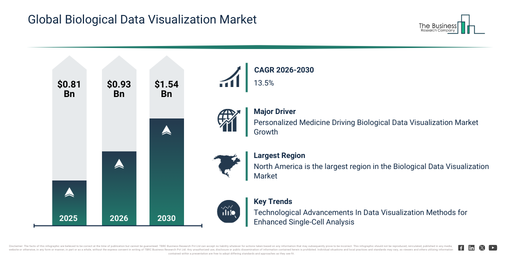
The biological data visualization market has seen substantial growth over recent years. It is projected to expand from $0.81 billion in 2025 to $0.93 billion in 2026, demonstrating a compound annual growth rate (CAGR) of 15.2%. This historical growth can be attributed to several factors such as increased biological data generation, the expansion of genomic and proteomic research, the rising use of imaging technologies, the increasing adoption of computational biology tools, and the availability of advanced research datasets.
The biological data visualization market size is projected to experience significant growth over the next few years, with expectations to reach $1.54 billion in 2030 at a compound annual growth rate (CAGR) of 13.5%. This growth during the forecast period is primarily driven by increasing investments in precision medicine research, a rising demand for advanced visualization in drug discovery, the expansion of multi-omics analysis, the growing integration of visualization with AI analytics, and enhanced collaboration across digital research platforms. Key trends for this period include the increasing adoption of interactive biological visualization tools, a rising use of multi-dimensional data representation, the expanding integration of AI-assisted data interpretation, the proliferation of cloud-based visualization platforms, and a greater focus on user-friendly scientific interfaces.
Try Before You Buy: Free Sample Of The Biological Data Visualization Market Report:
Biological Data Visualization Market Growth Engine: The Factor Boosting Demand Globally
The increasing demand for personalized medicine is projected to stimulate the expansion of the biological data visualization market moving forward. Personalized medicine involves customizing medical treatment and healthcare interventions for individual patients, taking into account their unique characteristics such as genetic composition, lifestyle, and preferences. The impetus behind this demand arises from breakthroughs in genomics, enhanced patient empowerment, and a rising awareness of the significance of individualized treatment approaches. Biological data visualization assists personalized medicine by providing visual representations of genetic, molecular, and clinical data specific to each patient, thereby informing customized treatment strategies. For instance, in February 2024, the Personalized Medicine Coalition, a US-based non-profit organization, reported that in 2023, the FDA sanctioned 16 new personalized treatments for rare disease patients, an increase from six in 2022. The personalized treatments approved in 2023 further included seven cancer drugs and three for other diseases and conditions. As a result, the growing need for personalized medicine is fueling the growth of the biological data visualization market.
Which Categories And Subcategories Shape The Biological Data Visualization Market?
The biological data visualization market covered in this report is segmented –
1) By Technique: Microscopy, Magnetic Resonance Imaging, Sequencing, X-Ray Crystallography, Other Techniques
2) By Platform: Windows, Mac Operating System, Linux, Other Platforms
3) By Application: Cell And Organism Imaging, Structural Biology And Molecular Modeling, Genomic Analysis, Alignments, Phylogeny, And Evolution, Systems Biology
4) By End Use: Academic Research, Pharmaceutical And Biological Centers, Hospitals And Clinics, Other End Uses
Subsegments:
1) By Microscopy: Fluorescence Microscopy, Electron Microscopy, Confocal Microscopy
2) By Magnetic Resonance Imaging (Mri): Functional Mri (Fmri), Structural Mri, Diffusion Tensor Imaging (DTI)
3) By Sequencing: Next-Generation Sequencing (Ngs), Sanger Sequencing
4) By X-ray Crystallography: Protein Crystallography, Dna Or Rna Crystallography
5) By Other Techniques: Mass Spectrometry Imaging, Cryo-Electron Microscopy (Cryo-Em), Surface Plasmon Resonance (SPR)
Biological Data Visualization Market Trend Insights: Strategic Focus Areas Of Leading Companies
Leading firms within the biological data visualization market are concentrating on creating sophisticated solutions, like AI-driven single-cell analysis systems, to overcome the shortcomings of current tools and achieve a market advantage. This type of system represents an advanced technological approach, combining artificial intelligence (AI) and machine learning (ML) with single-cell sequencing and analysis methodologies. Its purpose is to perform high-resolution data analysis on individual cells, offering deep understanding into aspects such as cellular diversity, gene activity, and how cells interact within intricate biological environments. As an illustration, in May 2023, the US-based biotechnology firm Deepcell introduced its REM-I Platform. This AI-powered single-cell analysis system aims to transform biological research through its scalable single-cell imaging, high-dimensional analytical capabilities, and cell sorting functions. Notable features of this platform include its capacity to categorize and separate cells based on their morphological and phenotypic characteristics without requiring labels, alongside real-time, high-resolution visualization of cellular diversity. This innovation is anticipated to expedite discoveries in cell biology and advance the emerging field of morpholomics, equipping researchers with a robust instrument to unravel the complexities of individual cells.
Leading Organizations In The Biological Data Visualization Market
Major companies operating in the biological data visualization market are Thermo Fisher Scientific Inc., Danaher Corporation, Becton Dickinson and Company (BD), GE HealthCare Technologies Inc., Agilent Technologies Inc., PerkinElmer Inc., Illumina Inc., Sartorius AG, Nikon Corporation, Waters Corporation, Bio-Rad Laboratories Inc., Bruker Corporation, Carl Zeiss Meditec AG, QIAGEN N.V., Bio-Techne Corporation, Leica Microsystems, Promega Corporation, 10x Genomic Inc., Luminex Corporation, Abcam plc, Oxford Nanopore Technologies Ltd., Cell Signaling Technology Inc., Pacific Biosciences of California Inc., NanoString Technologies Inc., Fluidigm Corporation
Continue Reading: The Full Biological Data Visualization Market Report:
Biological Data Visualization Market Regional Spotlight: Top Geography And Report Coverage
North America was the largest region in the biological data visualization market in 2025. Asia-Pacific is expected to be the fastest-growing region in the forecast period. The regions covered in the biological data visualization market report are Asia-Pacific, South East Asia, Western Europe, Eastern Europe, North America, South America, Middle East, Africa.
Reach Out To Our Team:
The Business Research Company: https://www.thebusinessresearchcompany.com/
Americas: +1 310-496-7795
Asia: +44 7882 955267 & +91 8897263534
Europe: +44 7882 955267
Email us at: marketing@tbrc.info
Follow us on:
LinkedIn: https://in.linkedin.com/company/the-business-research-company
YouTube: https://www.youtube.com/channel/UC24_fI0rV8cR5DxlCpgmyFQ
Global Market Model: https://www.thebusinessresearchcompany.com/global-market-model

Wasay has over a decade of experience in market research, data modelling, and analytics, with prior experience at GlobalData and Decision Tree Consulting Services. At The Business Research Company , he leads research operations across syndicated studies, customized consulting engagements, and the Global Market Model platform. His professional experience includes supporting organizations such as Boston Consulting Group, KPMG, and Ernst & Young. Wasay holds a degree in Electronics and Communications Engineering, postgraduate management qualifications from International Management Institute Belgium and Indian School of Business and Entrepreneurship, and completed the Integrated Program in Business Analytics from Indian Institute of Management Indore.