Featuring market attractiveness scoring, total addressable market sizing, company benchmarking matrices, interactive Excel dashboards, deeper supply chain intelligence, emerging startup tracking, and granular product-level insights, The Business Research Company’s 2026 market reports are built to deliver research that is both more actionable and more strategically valuable.
Blockchain In Agriculture And Food Supply Chain Market Growth From $1.23 Billion In 2026 To $5.83 Billion By 2030 At A CAGR Of 47.5%
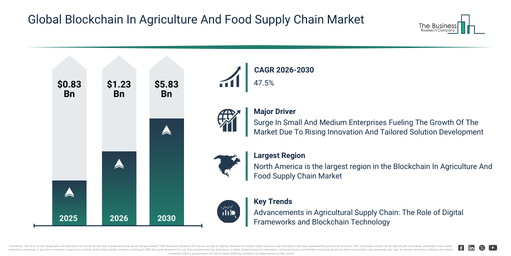
The market size for blockchain in agriculture and food supply chains has experienced substantial growth over recent years. This market is projected to expand from $0.83 billion in 2025 to $1.23 billion by 2026, exhibiting a compound annual growth rate (CAGR) of 48.1%. Historically, this expansion has been driven by factors such as a rise in food safety incidents, the escalating intricacy of global food supply chains, the prompt integration of digital traceability solutions, a heightened need for transparency in agricultural trade, and initial blockchain initiatives by agricultural businesses.
The blockchain in agriculture and food supply chain market is anticipated to undergo significant expansion in the coming years, with its size expected to reach $5.83 billion in 2030, reflecting a compound annual growth rate (CAGR) of 47.5%. This projected growth during the forecast period is attributed to several factors including the expansion of smart agriculture ecosystems, a rising demand for dependable food provenance data, increased adoption of index-based crop insurance, the proliferation of digital marketplaces for farm produce, and a heightened regulatory focus on food traceability. Notable trends in the forecast period include the increasing uptake of end-to-end food traceability platforms, the growing utilization of smart contracts for crop insurance, enhanced integration of blockchain with IoT sensors, the development of transparent farm-to-fork supply chains, and a stronger emphasis on data integrity and compliance with food safety regulations.
Get A Free Sample Report With In-Depth Market Insights:
Blockchain In Agriculture And Food Supply Chain Market Growth Catalysts And Demand Drivers
The expanding influence of small and medium enterprises (SMEs) is anticipated to fuel the expansion of the blockchain in agriculture and food supply chain market. These businesses, characterized by their smaller workforce and revenue compared to larger corporations, are vital for fostering innovation, competitiveness, and economic activity across diverse industries. The increased involvement of SMEs stems from significant investments by larger entities to improve their current blockchain systems, coupled with smaller, newer firms introducing niche solutions adapted to specific national and regional market demands. When SMEs embrace blockchain, it aids sectoral advancement by enhancing traceability, boosting operational clarity, and improving the efficiency of supply chains within agricultural and food systems. As an illustration, in October 2025, the UK’s Department for Business and Trade reported an annual increase in SME employment from 16.6 million to 16.9 million, with their contribution to the private-sector workforce holding at 60%. Consequently, the increasing significance of small and medium enterprises is a primary factor driving the growth of the blockchain in agriculture and food supply chain market. The incorporation of Internet of Things (IoT) devices is projected to stimulate the expansion of the blockchain-in-agriculture and food-supply-chain market in the future. IoT systems, comprising interconnected devices with unique identifiers (UIDs) that transmit data autonomously, significantly enhance real-time oversight and data gathering within agricultural and food supply chains. This, in turn, boosts transparency, improves traceability, refines quality control, and increases overall supply chain efficiency. For example, in April 2025, the Switzerland-based Economic and Social Council, via the United Nations Commission on Science and Technology for Development, indicated that the number of connected IoT devices surpassed 18 billion in 2024 and is forecast to exceed 40 billion by 2030, thereby solidifying the data infrastructure essential for blockchain-enabled traceability. Therefore, the increasing integration of IoT devices actively supports and propels the wider adoption of blockchain applications within agriculture and food supply chains.
Blockchain In Agriculture And Food Supply Chain Market Segment Breakdown: Which Categories Lead On Revenue?
The blockchain in agriculture and food supply chain market covered in this report is segmented –
1) By Type: Public Blockchain, Private Blockchain, Consortium Or Hybrid Blockchain
2) By Stakeholder: Growers, Food Manufacturers Or Processors, Retailers
3) By Application: Product Traceability, Tracking, And Visibility, Payment And Settlement, Smart Contracts, Governance, Risk And Compliance Management
Subsegments:
1) By Public Blockchain: Fully Decentralized Public Blockchain, Open Source Blockchain Solutions
2) By Private Blockchain: Permissioned Private Blockchain, Centralized Blockchain Solutions
3) By Consortium Or Hybrid Blockchain: Consortium Blockchains, Hybrid Blockchains
Blockchain In Agriculture And Food Supply Chain Market Trends Shaping Long-Term Demand
Leading companies engaged in the blockchain in agriculture and food supply chain market are concentrating on developing sophisticated solutions, such as blockchain-powered crop traceability systems, to boost transparency, strengthen consumer confidence, and improve the integrity of agricultural supply chains. Blockchain-enabled crop traceability represents a digital mechanism that logs immutable data at every stage of the agricultural production and distribution process, allowing both stakeholders and consumers to verify the origin, quality, and handling of food products in real time. For instance, in October 2023, Silal, an agri-food company based in the UAE, introduced a pioneering blockchain technology crafted to enhance crop transparency by securely tracking produce from farm to retailer. This solution offers end-to-end visibility throughout the supply chain, supports data-driven quality assurance, and elevates consumer trust by providing verifiable information on farming practices and product provenance. Consequently, the adoption of blockchain-enabled crop traceability systems is driving innovation and raising transparency standards across the agriculture and food supply chain ecosystem.
Blockchain In Agriculture And Food Supply Chain Market Leading Players And Competitive Positioning
Major companies operating in the blockchain in agriculture and food supply chain market are International Business Machines Corporation; Microsoft Corporation; SAP SE; Ambrosus AG; Arc-net; OriginTrail Ltd.; Rip. io; Provenance Ltd.; Chainvine Limited (ChainVine); AgriDigital Pty Ltd.; Riiot Labs SA; VeChain Foundation; BlockGrain; AgriChain Pty Ltd.; TE-FOOD International GmbH; Agri 10x LLC; AgriLedger Ltd.; AgroChain Ltd.; Bext Holdings Inc.; Cargill Incorporated; CropIn Technology Solutions Pvt. Ltd.; Deere & Company; Eka Software Solutions Pvt. Ltd.; Emerson Electric Co.; FoodLogiQ LLC; Full Profile Pty Ltd; GrainChain Inc.; Kisan Network; Modi Infosol Pvt. Ltd.; Nestlé S. A.; Ripe Technology Inc.; The Seam LLC; Topl LLC; Trace Genomics Inc.; Unilever PLC; Viant Technology LLC; Walmart Inc.; Yara International ASA; Zume Inc.
View The Full Blockchain In Agriculture And Food Supply Chain Market Report:
Blockchain In Agriculture And Food Supply Chain Market Regional Split: Which Areas Are Fueling Growth?
North America was the largest region in the blockchain in agriculture and food supply chain market in 2025. The regions covered in the blockchain in agriculture and food supply chain market report are Asia-Pacific, South East Asia, Western Europe, Eastern Europe, North America, South America, Middle East, Africa.
Reach Out To Our Team:
The Business Research Company: https://www.thebusinessresearchcompany.com/
Americas: +1 310-496-7795
Asia: +44 7882 955267 & +91 8897263534
Europe: +44 7882 955267
Email us at: marketing@tbrc.info
Follow us on:
LinkedIn: https://in.linkedin.com/company/the-business-research-company
YouTube: https://www.youtube.com/channel/UC24_fI0rV8cR5DxlCpgmyFQ
Global Market Model: https://www.thebusinessresearchcompany.com/global-market-model

Wasay has over a decade of experience in market research, data modelling, and analytics, with prior experience at GlobalData and Decision Tree Consulting Services. At The Business Research Company , he leads research operations across syndicated studies, customized consulting engagements, and the Global Market Model platform. His professional experience includes supporting organizations such as Boston Consulting Group, KPMG, and Ernst & Young. Wasay holds a degree in Electronics and Communications Engineering, postgraduate management qualifications from International Management Institute Belgium and Indian School of Business and Entrepreneurship, and completed the Integrated Program in Business Analytics from Indian Institute of Management Indore.