Market attractiveness scoring, total addressable market sizing, company benchmarking matrices, interactive Excel dashboards, deeper supply chain intelligence, emerging startup tracking, and granular product-level insights are among the key offerings featured in The Business Research Company’s 2026 market reports, designed to deliver more actionable and strategically valuable research.
Building Energy Simulation Software Market Size Estimate For 2026 And Revenue Forecast Through 2030
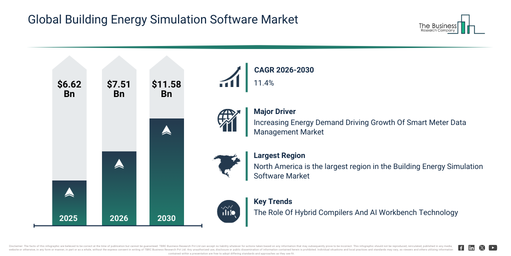
The building energy simulation software market size has experienced rapid growth in recent years. This market is projected to increase from $6.62 billion in 2025 to $7.51 billion in 2026, at a compound annual growth rate (CAGR) of 13.5%. The expansion witnessed in the historic period is attributable to stricter building energy efficiency regulations, the adoption of HVAC optimization practices, an increase in green building construction, the growing utilization of simulation in design planning, and the broader implementation of sustainable construction methods.
The building energy simulation software market size is expected to undergo substantial expansion in the coming years. It is projected to grow to $11.58 billion in 2030, achieving a compound annual growth rate (CAGR) of 11.4%. This anticipated growth during the forecast period is driven by increasing investments in smart building technologies, a rising demand for net-zero energy structures, the broadening application of digital twins in construction, greater adoption of cloud-based engineering tools, and the integration of AI-driven energy optimization. Key trends anticipated over the forecast timeframe include the expanding utilization of digital building energy modeling tools, increased acceptance of cloud-based simulation platforms, deeper integration of real-time energy performance analytics, broader application of simulation in retrofit projects, and a heightened emphasis on meeting regulatory standards and optimizing energy consumption.
Free Building Energy Simulation Software Market Report Sample Available For Download:
Why Is Demand In The Building Energy Simulation Software Market Expected To Keep Rising?
The building energy simulation software market is anticipated to grow in the future, propelled by an increase in energy demand. This elevated energy demand arises as cities become central locations for activities reliant on electricity, such as transportation, heating, cooling, and the operation of electronic devices. Building energy simulation software supports the optimization of energy usage and the improvement of grid efficiency by offering critical insights into consumption patterns and enabling well-informed decision-making. For example, in 2024, data centre electricity demand, which was estimated at 176 TWh in 2023, is expected to expand by 8–55 TWh in 2024, corresponding to a 5%–31% increase, according to Ember-Energy.Org, a UK-based an independent global energy think tank. Consequently, the rising energy demand is a primary factor driving the growth of the building energy simulation software market.
How Is The Building Energy Simulation Software Market Divided Across Segments And Subsegments?
The building energy simulation software market covered in this report is segmented –
1) By Component: Software, Services
2) By Deployment Model: On-Premise, Cloud-Based
3) By Organization Size: Small And Medium Enterprises (SMEs), Large Enterprises
4) By End-User: Architecture And Construction, Government And Defense, Other End Users
Subsegments:
1) By Software: Building Energy Modeling Software, Hvac Simulation Software, Lighting Simulation Software, Building Performance Simulation Software
2) By Services: Installation And Integration Services, Consulting And Advisory Services, Training And Support Services, Maintenance And Upgrades Services, Customization Services
Building Energy Simulation Software Market Trends Reshaping Customer Demand And Business Strategies
Leading companies in the building energy simulation software market are advancing technologies such as hybrid compilers (HyCo) to improve the accuracy and efficiency of energy modeling, enhance building designs for energy performance, and enable real-time analysis of energy consumption patterns. A hybrid compiler (HyCo) is a technology that integrates various modeling approaches to boost the efficiency and precision of energy simulations in building design. For instance, in December 2023, Renesas Electronics, a Japan-based semiconductor manufacturing company, launched the AI Workbench. This AI Workbench is designed to empower automotive AI engineers by offering an integrated virtual environment where they can develop, simulate, and fine-tune their software directly in the cloud. This platform utilizes Microsoft Azure services, providing engineers with access to powerful tools without requiring local installations or physical evaluation boards.
Building Energy Simulation Software Market Major Players: Companies At The Forefront Of The Industry
Major companies operating in the building energy simulation software market are Siemens AG, Dassault Systèmes, Honeywell International Inc., Schneider Electric, Johnson Controls International plc, Autodesk Inc., Trimble Inc., UL Solutions, Integrated Environmental Solutions Ltd., ANSYS Inc., Bentley Systems Incorporated, DesignBuilder Software Ltd., EnergyPlus, EnergySoft LLC, Carmel Software Corporation, eQUEST Software Inc., IESVE Ltd., IDA ICE AB, Sefaira Inc., BSim AS
Read More About The Building Energy Simulation Software Market In The Full Report:
Building Energy Simulation Software Market Regional Share Analysis For 2025
North America was the largest region in the Building Energy Simulation Software market in 2025. Asia-Pacific is expected to be the fastest-growing region in the forecast period. The regions covered in the building energy simulation software market report are Asia-Pacific, South East Asia, Western Europe, Eastern Europe, North America, South America, Middle East, Africa.
Reach Out To Our Team:
The Business Research Company: https://www.thebusinessresearchcompany.com/
Americas: +1 310-496-7795
Asia: +44 7882 955267 & +91 8897263534
Europe: +44 7882 955267
Email us at: marketing@tbrc.info
Follow us on:
LinkedIn: https://in.linkedin.com/company/the-business-research-company
YouTube: https://www.youtube.com/channel/UC24_fI0rV8cR5DxlCpgmyFQ
Global Market Model: https://www.thebusinessresearchcompany.com/global-market-model

Wasay has over a decade of experience in market research, data modelling, and analytics, with prior experience at GlobalData and Decision Tree Consulting Services. At The Business Research Company , he leads research operations across syndicated studies, customized consulting engagements, and the Global Market Model platform. His professional experience includes supporting organizations such as Boston Consulting Group, KPMG, and Ernst & Young. Wasay holds a degree in Electronics and Communications Engineering, postgraduate management qualifications from International Management Institute Belgium and Indian School of Business and Entrepreneurship, and completed the Integrated Program in Business Analytics from Indian Institute of Management Indore.