
Backed by market attractiveness analysis, total addressable market sizing, company benchmarking matrices, interactive Excel dashboards, wider supply chain intelligence, emerging startup coverage, and detailed product-level insights, The Business Research Company’s 2026 market reports are designed to offer research that is more actionable and strategically valuable than ever.
Business-To-Business Middleware (B2B Integration) Market Forecast: What Value Will The Market Reach By 2030?
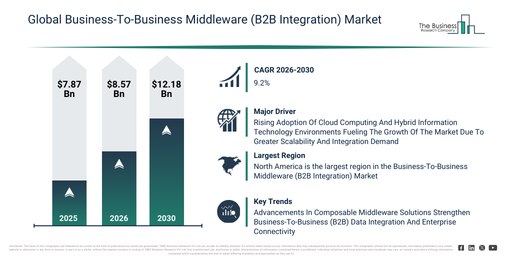
The business-to-business middleware (b2b integration) market size has experienced strong expansion in recent years. It is projected to increase from $7.87 billion in 2025 to $8.57 billion in 2026, progressing at a compound annual growth rate (CAGR) of 8.9%. This historical growth can be linked to the increasing digitization of business operations, a rising demand for secure data exchange, an increase in supply chain complexity, the adoption of enterprise system connectivity solutions, and the growing need for financial transaction automation.
The market for business-to-business middleware (b2b integration) is projected to experience substantial expansion over the coming years. This market is predicted to reach $12.18 billion in 2030, exhibiting a compound annual growth rate (CAGR) of 9.2%. Factors driving this growth during the forecast period include the increasing uptake of cloud and hybrid deployment models, the growing incorporation of AI into middleware solutions, a surge in the use of managed file transfer services, the broadening scope of business process automation, and a heightened emphasis on customer data integration and ensuring interoperability. Key trends anticipated during this period encompass the growing popularity of cloud-based b2b middleware, an escalating need for API management and integration tools, an increase in services for onboarding and managing trading partners, the expanded utilization of data mapping and transformation software, and a heightened focus on managed integration and implementation offerings.
Get A Free Sample Report With In-Depth Market Insights:
Business-To-Business Middleware (B2B Integration) Market Industry Drivers: What’s Behind The Revenue Growth?
The increasing integration of cloud computing and hybrid information technology environments is projected to fuel the expansion of the business-to-business middleware (B2B integration) market. Cloud computing involves the provision of computing services via the internet, allowing companies to pay for usage rather than owning physical infrastructure, while hybrid information technology environments merge on-premises computing resources with cloud services to facilitate flexible deployment of applications and workloads. The uptake of cloud computing and hybrid information technology environments is rising as organizations seek scalable infrastructure that reduces initial capital expenditure, enhances operational agility, and supports digital transformation at a lower overall cost. Business-to-business middleware (B2B integration) aids the adoption of cloud computing and hybrid information technology environments by enabling secure, standardized, and automated data exchange across on-premises and cloud systems between partners, thereby decreasing integration complexity and boosting real-time collaboration. For instance, in September 2025, ITDesk UK, a UK-based technology insight platform, reported widespread enterprise adoption of cloud strategies, with 92 percent of businesses having implemented hybrid or multi-cloud environments to improve resilience and flexibility, over 50 percent of enterprise information technology spending shifting toward cloud technologies by the end of 2025, and 78 percent of cloud users noting faster deployment and improved disaster recovery capabilities. Hence, the growing adoption of cloud computing and hybrid information technology environments is a key driver for the business-to-business middleware (B2B integration) market’s growth.
Business-To-Business Middleware (B2B Integration) Market Segments: Where Is Growth Concentrated?
The business-to-business middleware (b2b integration) market covered in this report is segmented –
1) By Component: Software, Services
2) By Deployment Type: On-Premises, Cloud-Based, Hybrid
3) By Organization Size: Small And Medium Enterprises, Large Enterprises
4) By Application: Supply Chain Integration, Financial Transactions, Customer Data Integration, Enterprise System Connectivity, Business Process Automation
Subsegments:
1) By Software: Integration Platform Software, Electronic Data Interchange Software, Application Programming Interface Integration Software, Data Mapping And Transformation Software, Trading Partner Mnagement Software, Managed File Transfer Software
2) By Services: Consulting Services, Implementation Services, System Integration Services, Support And Maintenance Services, Managed Integration Services, Training And Education Services
#Business-To-Business Middleware (B2B Integration) Market Growth Trends: What’s Shaping The Future Outlook?
Companies operating within the business-to-business middleware (B2B integration) market are actively pursuing the creation of advanced solutions, such as low-code integration middleware, to streamline data orchestration and mitigate enterprise integration complexity. A low-code integration middleware is defined as a customizable software layer that facilitates efficient, scalable data exchange among multiple enterprise systems with minimal development effort. For instance, in November 2023, Spryker, a Germany-based provider of composable commerce platforms, introduced Spryker Middleware, powered by Alumio. This middleware provides low-code, composable data integration capabilities that can significantly decrease enterprise data exchange implementation and maintenance efforts by up to ninety percent. It also enables seamless connectivity across commerce, product information management, taxation, search, and backend enterprise systems, thereby enhancing scalability and flexibility within modern B2B digital architectures.
Business-To-Business Middleware (B2B Integration) Market Competitive Landscape: Who Leads The Industry?
Major companies operating in the business-to-business middleware (B2B integration) market are (b2b integration) market are Microsoft Corporation, Dell Technologies Inc., International Business Machines Corporation, Oracle Corporation, SAP SE, Salesforce inc., HCL Technologies Limited, Open Text Corporation, SAS Institute Inc., Epicor Software Corporation, Appian Corporation, Magic Software Enterprises Ltd., Axway Software SA, SEEBURGER AG, TrueCommerce Inc., Workato Inc., Jitterbit Inc., Cleo Communications US LLC, SnapLogic Inc., Adeptia Inc., and Fiorano Software Inc.
View The Full Business-To-Business Middleware (B2B Integration) Market Report:
Business-To-Business Middleware (B2B Integration) Market Geographic Landscape: Which Region Dominates Industry Growth?
North America was the largest region in the business-to-business middleware (B2B integration) market in 2025. Asia-Pacific is expected to be the fastest-growing region in the forecast period. The regions covered in the business-to-business middleware (B2B integration) market report are Asia-Pacific, South East Asia, Western Europe, Eastern Europe, North America, South America, Middle East, Africa.
Reach Out To Our Team:
The Business Research Company: https://www.thebusinessresearchcompany.com/
Americas: +1 310-496-7795
Asia: +44 7882 955267 & +91 8897263534
Europe: +44 7882 955267
Email us at: marketing@tbrc.info
Follow us on:
LinkedIn: https://in.linkedin.com/company/the-business-research-company
YouTube: https://www.youtube.com/channel/UC24_fI0rV8cR5DxlCpgmyFQ
Global Market Model: https://www.thebusinessresearchcompany.com/global-market-model

Wasay has over a decade of experience in market research, data modelling, and analytics, with prior experience at GlobalData and Decision Tree Consulting Services. At The Business Research Company , he leads research operations across syndicated studies, customized consulting engagements, and the Global Market Model platform. His professional experience includes supporting organizations such as Boston Consulting Group, KPMG, and Ernst & Young. Wasay holds a degree in Electronics and Communications Engineering, postgraduate management qualifications from International Management Institute Belgium and Indian School of Business and Entrepreneurship, and completed the Integrated Program in Business Analytics from Indian Institute of Management Indore.