The Business Research Company’s 2026 market reports combine market attractiveness scoring, total addressable market sizing, company benchmarking matrices, interactive Excel dashboards, deeper supply chain intelligence, emerging startup tracking, and granular product-level insights to deliver research that is more actionable and strategically valuable.
Carbon Accounting Software Market Value Projected To Grow At A 23% Compound Annual Growth Rate Through 2030
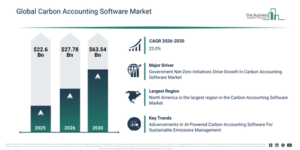
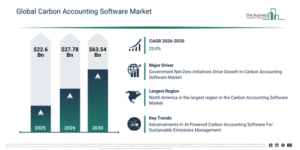
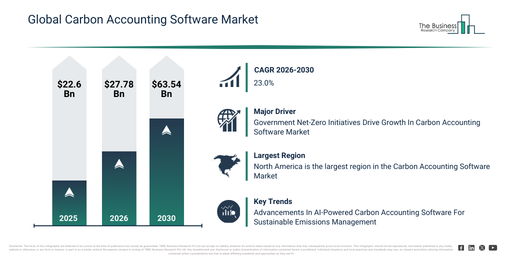
The carbon accounting software market size has experienced significant expansion in recent years. It is anticipated to increase from $22.6 billion in 2025 to $27.78 billion in 2026, demonstrating a compound annual growth rate (CAGR) of 22.9%. Historically, this market’s growth has been fueled by factors such as a rise in environmental regulations, an increase in corporate sustainability efforts, heightened awareness concerning carbon emissions, the adoption of tools for monitoring emissions, and the demand for optimizing energy efficiency.
The carbon accounting software market is projected to experience substantial growth in the coming years. This market is anticipated to reach $63.54 billion by 2030, demonstrating a compound annual growth rate (CAGR) of 23.0%. The expansion during this forecast period is driven by factors such as the integration of AI for emission analytics, the proliferation of cloud-based carbon accounting platforms, the uptake of carbon offset management solutions, the rise in renewable energy tracking software, and the growing application of energy management within industrial sectors. Key trends projected for this period encompass carbon footprint assessment and reporting, tracking and monitoring of emissions, managing carbon credits and offset portfolios, analyzing and tracking energy consumption, and implementing renewable energy integration along with smart grid management.
Evaluate The Carbon Accounting Software Market Report Before You Buy With A Free Sample:
Carbon Accounting Software Market Growth Driver Analysis For The 2026–2030 Forecast Period
Government efforts to achieve net-zero emissions are anticipated to fuel the expansion of the carbon accounting software market in the future. These government initiatives towards net-zero emissions encompass actions, policies, and programs implemented by major countries’ governments, aiming for a state where total greenhouse gas (GHG) emissions produced are balanced by the amount removed from the atmosphere, thus achieving a net-zero carbon footprint. The rise in such government efforts stems from mounting worries regarding climate change and its detrimental impacts on the environment, ecosystems, and human well-being. Carbon accounting software assists businesses in meeting these regulatory requirements by offering tools to precisely measure, track, and report their emissions data. For example, a December 2023 report from the White House, a US-based governmental body, indicated that the U.S. government intends to reach net-zero emissions in its operations by 2050, including a specific goal of a 65% emissions reduction by 2030. Furthermore, the government plans for a net-zero emissions building portfolio by 2045, with an intermediate objective of cutting emissions by 50% by 2032. Consequently, the expanding government initiatives towards net-zero emissions are driving the growth of the carbon accounting software market.
Carbon Accounting Software Market Segmentation Breakdown: Primary And Secondary Categories
The carbon accounting software market covered in this report is segmented –
1) By Software Type: Emission Management Software, Software For Carbon Offsetting, Software For Energy Management
2) By Deployment: Cloud-Based, On-Premise
3) By Industry: Energy And Utilities, IT And Telecom, Healthcare, Transportation And Logistics, Retail, Construction And Infrastructure, Food And Beverages, Chemicals, Other Industry
Subsegments:
1) By Emission Management Software: Carbon Footprint Calculation And Reporting, Emission Tracking And Monitoring, Emission Reduction Target Setting, Emission Data Analytics, Regulatory Compliance Management, Carbon Reporting For Stakeholders
2) By Software For Carbon Offsetting: Carbon Credit Management, Carbon Offset Portfolio Management, Offset Project Tracking, Carbon Offset Validation And Verification, Integration With Carbon Offset Providers, Reporting And Documentation For Offsetting Activities
3) By Software For Energy Management: Energy Consumption Tracking And Analysis, Energy Efficiency Optimization, Renewable Energy Integration, Smart Grid Management, Energy Data Analytics And Reporting, Demand Response Management
Carbon Accounting Software Market Industry Trends: New Developments From Leading Companies
Leading companies operating in the carbon accounting software market are prioritizing the integration of artificial intelligence (AI) to develop advanced solutions, such as CERius, aiming to improve data accuracy, automate analysis, and deliver actionable insights for effective carbon footprint reduction. This involves AI integration that optimizes decarbonization planning, refines emissions tracking, and aids in informed decision-making to achieve sustainability objectives across sectors. For example, in September 2023, GE Vernova, a US-based company focused on carbon emissions management solutions, launched CERius, an AI-driven carbon emissions management software. This software is engineered to help energy companies advance towards their net-zero goals by providing data precision and abatement planning capabilities, empowering organizations to accurately measure, manage, and operationalize the necessary insights for tracking carbon-neutral emissions targets. The software automates greenhouse gas data collection, provides scenario analysis, supports team collaboration, and offers standardized reporting based on greenhouse gas protocols. It intends to assist energy companies with decarbonization planning, multi-team collaboration, emissions tracking, and compliance reporting, ultimately supporting more accurate decision-making for carbon reduction strategies.
Who Are The Top Competitors In The Carbon Accounting Software Market?
Major companies operating in the carbon accounting software market are Persefoni AI Inc.; SAP SE; Net0 Software Limited; IBM Environmental Intelligence Suite; Sphera Solutions Inc.; Envizi; Emitwise Ltd.; OneTrust LLC; Carbon Analytics; Greenly Company; Carbon Clear Limited; SinAI Technologies; CarbonetiX; Salesforce Inc.; Rev-ID International Ltd.; CarbonChain Inc.; Watershed Technology Inc.; eValue8 B.V.; South Pole Group; Ecometrica; Climate Earth Inc.
Access The Carbon Accounting Software Market Report For Complete Segment-Level Analysis:
Which Region Leads The Carbon Accounting Software Market, And Which Regions Are Covered?
North America was the largest region in the carbon accounting software market in 2025. Asia-Pacific is expected to be the fastest-growing region in the forecast period. The regions covered in the carbon accounting software market report are Asia-Pacific, South East Asia, Western Europe, Eastern Europe, North America, South America, Middle East, Africa.
Reach Out To Our Team:
The Business Research Company: https://www.thebusinessresearchcompany.com/
Americas: +1 310-496-7795
Asia: +44 7882 955267 & +91 8897263534
Europe: +44 7882 955267
Email us at: marketing@tbrc.info
Follow us on:
LinkedIn: https://in.linkedin.com/company/the-business-research-company
YouTube: https://www.youtube.com/channel/UC24_fI0rV8cR5DxlCpgmyFQ
Global Market Model: https://www.thebusinessresearchcompany.com/global-market-model

Wasay has over a decade of experience in market research, data modelling, and analytics, with prior experience at GlobalData and Decision Tree Consulting Services. At The Business Research Company , he leads research operations across syndicated studies, customized consulting engagements, and the Global Market Model platform. His professional experience includes supporting organizations such as Boston Consulting Group, KPMG, and Ernst & Young. Wasay holds a degree in Electronics and Communications Engineering, postgraduate management qualifications from International Management Institute Belgium and Indian School of Business and Entrepreneurship, and completed the Integrated Program in Business Analytics from Indian Institute of Management Indore.