Market attractiveness scoring, total addressable market sizing, company benchmarking matrices, interactive Excel dashboards, deeper supply chain intelligence, emerging startup tracking, and granular product-level insights are among the key offerings featured in The Business Research Company’s 2026 market reports, designed to deliver more actionable and strategically valuable research.
Chatbot Market Valued At $13.28 Billion In 2026, Projected To Reach $37.53 Billion By 2030
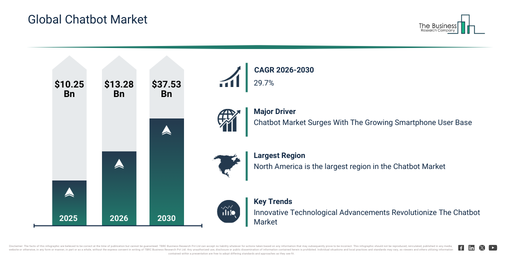
The chatbot market has experienced exponential growth in recent years. It is projected to expand from $10.25 billion in 2025 to $13.28 billion in 2026, achieving a compound annual growth rate (CAGR) of 29.5%. The historic growth of the market can be attributed to several factors, including increasing digital customer engagement initiatives, the growth of online service platforms, a rising demand for instant customer responses, the adoption of rule-based chat solutions, and improvements in natural language processing accuracy.
The size of the chatbot market is projected to experience rapid expansion over the coming years. This market is predicted to reach $37.53 billion by 2030, driven by a compound annual growth rate (CAGR) of 29.7%. This growth during the projection period can be ascribed to several factors, including escalating investments in generative AI technologies, a heightened demand for customized digital assistants, broadened integration of chatbots with enterprise platforms, wider embrace of voice-first interfaces, and a greater emphasis on conversational commerce. Key trends anticipated during the forecast timeframe encompass the expanding uptake of AI-powered conversational interfaces, increased deployment of voice-activated chatbots, a surge in the utilization of multi-channel customer interaction bots, the broadening of context-aware chatbot solutions, and an intensified focus on algorithms for continuous learning.
Request A Complimentary Chatbot Market Research Sample:
Key Factor Propelling The Chatbot Market Forward
The increasing number of smartphone users is projected to fuel the expansion of the chatbot market moving ahead. These electronic devices offer access to cellular networks, enabling chatbots to engage users in natural language conversations via websites, messaging apps, or mobile applications. On mobile phones, chatbots deliver virtual assistance for diverse user requirements. The growth in smartphone ownership is attributed to enhanced connectivity, as these devices facilitate convenient access to the internet, applications, and various digital services for everyday tasks. Furthermore, chatbots themselves accelerate smartphone adoption by offering immediate, interactive support and services through mobile apps, thereby improving user convenience and engagement. For example, Prioridata, a US-based digital statistics platform, stated in January 2025 that there were approximately 4.88 billion smartphone users worldwide, which accounted for roughly 60.4% of the global population. Consequently, the growing prevalence of smartphone users is propelling the development of the chatbot market.
Chatbot Market Segments And Subsegments Explained
The chatbot market covered in this report is segmented –
1) By Type: Text, Voice, Hybrid
2) By Component: Solution, Services
3) By Platform: Standalone, Web-Based, Messenger-Based or Third Party
4) By Deployment: On-Premise, Cloud
Subsegments:
1) By Text: Rule-Based Chatbots, AI-Based Chatbots
2) By Voice: Voice Assistants, IVR Systems
3) By Hybrid: Combined Text And Voice Interfaces, Multi-Channel Chatbots
Emerging Trends Transforming The Chatbot Market
Companies operating within the catboat market are primarily focused on creating technologically advanced solutions and AI-powered shopping assistant chatbots to enhance customer interaction, optimize the shopping journey, and offer tailored suggestions. An AI-powered shopping assistant chatbot is defined as an automated digital tool leveraging artificial intelligence to engage with customers throughout their online shopping experience. For example, in August 2024, Amazon, a US-based e-commerce firm, introduced its AI-powered shopping assistant, Rufus, in India, following its initial debut in the U.S. earlier in the year. Rufus is designed to assist users by providing product recommendations, addressing shopping-related questions, and facilitating product comparisons. This assistant is accessible via the Amazon mobile app, appearing as an icon in the bottom right corner, and is trained on Amazon’s extensive product catalog and web data to deliver customized responses and suggestions based on user inquiries.
Chatbot Market Key Players: Major Companies In The 2026 Report
Major companies operating in the chatbot market are OpenAI Inc; Google LLC; Microsoft Corporation; International Business Machines Corporation; Amazoncom Inc; Meta Platforms Inc; Salesforce Inc; Oracle Corporation; SAP SE; Nuance Communications Inc; KoreAI Inc; Rasa Technologies GmbH; LivePerson Inc; Cognigy GmbH; Ada Support Inc; Driftcom Inc; Intercom Inc; YellowAI Inc; boostAI AS; Avaamo Inc
Explore The Full Chatbot Market Report With Forecasts To 2030:
Chatbot Market By Region: Where Is Demand Strongest?
North America was the largest region in the chatbot market in 2025. Asia-Pacific is expected to be the fastest-growing region in the forecast period. The regions covered in the chatbot market report are Asia-Pacific, South East Asia, Western Europe, Eastern Europe, North America, South America, Middle East, Africa.
Reach Out To Our Team:
The Business Research Company: https://www.thebusinessresearchcompany.com/
Americas: +1 310-496-7795
Asia: +44 7882 955267 & +91 8897263534
Europe: +44 7882 955267
Email us at: marketing@tbrc.info
Follow us on:
LinkedIn: https://in.linkedin.com/company/the-business-research-company
YouTube: https://www.youtube.com/channel/UC24_fI0rV8cR5DxlCpgmyFQ
Global Market Model: https://www.thebusinessresearchcompany.com/global-market-model

Wasay has over a decade of experience in market research, data modelling, and analytics, with prior experience at GlobalData and Decision Tree Consulting Services. At The Business Research Company , he leads research operations across syndicated studies, customized consulting engagements, and the Global Market Model platform. His professional experience includes supporting organizations such as Boston Consulting Group, KPMG, and Ernst & Young. Wasay holds a degree in Electronics and Communications Engineering, postgraduate management qualifications from International Management Institute Belgium and Indian School of Business and Entrepreneurship, and completed the Integrated Program in Business Analytics from Indian Institute of Management Indore.