Featuring market attractiveness scoring, total addressable market sizing, company benchmarking matrices, interactive Excel dashboards, deeper supply chain intelligence, emerging startup tracking, and granular product-level insights, The Business Research Company’s 2026 market reports are built to deliver research that is both more actionable and more strategically valuable.
Cloud Based Workload Scheduling Software Market Revenue Outlook: What CAGR Lies Ahead Through 2030?
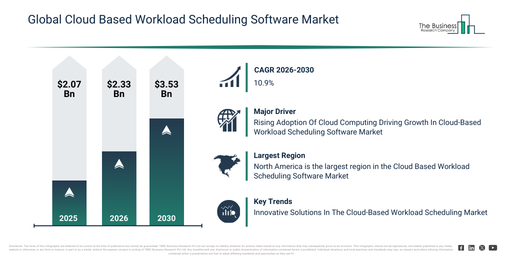
The market size for cloud based workload scheduling software has experienced rapid expansion recently. It is projected to grow from $2.07 billion in 2025 to $2.33 billion in 2026, at a compound annual growth rate (CAGR) of 12.9%. This historical growth can be linked to the increasing adoption of cloud computing, the rising complexity of enterprise workloads, the demand for better resource utilization, the early integration of automation tools, and the push for operational efficiency.
The cloud based workload scheduling software market is projected to experience substantial expansion over the coming years. This market is predicted to reach a valuation of $3.53 billion by 2030, demonstrating a compound annual growth rate (CAGR) of 10.9%. Key factors driving this growth during the forecast period include the increasing adoption of hybrid and multi-cloud environments, a heightened demand for real-time workload optimization, a greater emphasis on cost-effective cloud operations, enterprises’ growing dependency on automated scheduling solutions, and the ongoing requirement for high availability and business continuity. Significant trends anticipated in the same period involve automated job scheduling across diverse cloud setups, centralized orchestration of workloads, dynamic allocation of resources alongside load balancing, prioritization of workloads based on policies, and scalable scheduling capabilities for fluctuating workloads.
Get A Free Sample Report With In-Depth Market Insights:
Cloud Based Workload Scheduling Software Market Growth Factors Behind Sustained Expansion
The future growth of cloud-based workload scheduling software is set to be driven by the rising adoption of cloud computing. Cloud computing itself involves delivering computing services over the internet, providing access to essential resources like servers, storage, databases, networking, and software. This increasing embrace of cloud computing is largely due to its benefits in terms of cost efficiency, scalability, accessibility, security, and environmental impact. Within this framework, cloud computing relies on cloud-based workload scheduling software to effectively allocate and manage computing resources, thereby optimizing the distribution and execution of workloads across the cloud infrastructure. As an illustration, in December 2023, the European Union (EU), a governing body located in Belgium, reported that the adoption of cloud-based solutions across the European Union surged by 4.2% in 2023, with 45.2% of enterprises purchasing cloud computing services, marking a substantial increase compared to 2021. This demonstrates a clear trend of increasing cloud computing adoption, which in turn fuels the expansion of the cloud-based workload scheduling software market.
Cloud Based Workload Scheduling Software Market Segment Trends And Revenue Contributors
The cloud based workload scheduling software market covered in this report is segmented –
1) By Type: Private Cloud, Public Cloud, Hybrid
2) By Pricing Model: Subscription-Based, Pay-As-You-Go
3) By Organization Size: Small And Medium Enterprises, Large Enterprises
4) By Application: Corporate Organizations, Government Institutions, Other Applications
Subsegments:
1) By Private Cloud: On-Premises Cloud Solutions, Dedicated Workload Scheduling Platforms, Customizable Private Cloud Scheduling Software, Private Cloud Integration with Existing Infrastructure, Secure Data Handling and Compliance Tools, Enterprise-Specific Scheduling Solutions
2) By Public Cloud: Multi-Tenant Cloud Scheduling Software, Scalable Public Cloud Scheduling Platforms, Pay-Per-Use Scheduling Solutions, Integration with Cloud Service Providers, Web-Based Workload Management Solutions, Public Cloud Resource Optimization Tools
3) By Hybrid: Combination of Private and Public Cloud Workload Scheduling, Cloud Bursting Scheduling Solutions, Flexible Workload Management across Cloud Environments, Multi-Cloud Scheduling and Orchestration Platforms, Hybrid Cloud Integration with On-Premises Systems, Cross-Cloud Workload Optimization and Monitoring Tools
Cloud Based Workload Scheduling Software Market Industry Trends Fueling Future Revenue Growth
Major companies operating in the cloud-based workload scheduling software market are directing their efforts towards introducing innovative solutions, including resource management and job scheduling platforms, to streamline cloud computing operations. These platforms are instrumental in optimizing resource allocation and enhancing task execution efficiency within cloud computing environments. As an example, in December 2023, Google Cloud, a US-based technology company, launched its Dynamic Workload Scheduler, a cloud-based workload scheduling software specifically engineered for the AI hypercomputer. This tool optimizes the utilization and cost-effectiveness of AI/ML resources, such as TPUs and NVIDIA GPUs, by efficiently scheduling workloads like training and fine-tuning tasks. Its Flex Start Mode enables users to request GPU and TPU capacity for tasks including model fine-tuning and shorter training jobs on demand, automatically provisioning VMs and prioritizing shorter requests to optimize resource usage and costs. The scheduler utilizes Google Borg technology, renowned for its real-time scheduling capabilities within the Google ML Fleet, thereby providing customers with augmented flexibility and efficiency.
Cloud Based Workload Scheduling Software Market Competitive Landscape: Which Companies Lead The Industry?
Major companies operating in the cloud based workload scheduling software market are Microsoft Corporation; Amazon Web Services; International Business Machines Corporation; VMware Inc; Chef Software Inc; BMC Software Inc; HelpSystems LLC; HashiCorp Terraform; Turbonomic Inc; Puppet Inc; OpsRamp Inc; Stonebranch Inc; SaltStack Inc; Adaptive Computing Inc; Redwood Software; Oracle Corporation; SAP SE; ServiceNow Inc; Micro Focus International; HCL Technologies; Advanced Systems Concepts Inc; JAMS Software LLC
View The Full Cloud Based Workload Scheduling Software Market Report:
Cloud Based Workload Scheduling Software Market Geographic Landscape: Which Region Leads Industry Growth?
North America was the largest region in the cloud based workload scheduling software market in 2025. Asia-Pacific is expected to be the fastest-growing region in the forecast period. The regions covered in the cloud based workload scheduling software market report are Asia-Pacific, South East Asia, Western Europe, Eastern Europe, North America, South America, Middle East, Africa.
Reach Out To Our Team:
The Business Research Company: https://www.thebusinessresearchcompany.com/
Americas: +1 310-496-7795
Asia: +44 7882 955267 & +91 8897263534
Europe: +44 7882 955267
Email us at: marketing@tbrc.info
Follow us on:
LinkedIn: https://in.linkedin.com/company/the-business-research-company
YouTube: https://www.youtube.com/channel/UC24_fI0rV8cR5DxlCpgmyFQ
Global Market Model: https://www.thebusinessresearchcompany.com/global-market-model

Wasay has over a decade of experience in market research, data modelling, and analytics, with prior experience at GlobalData and Decision Tree Consulting Services. At The Business Research Company , he leads research operations across syndicated studies, customized consulting engagements, and the Global Market Model platform. His professional experience includes supporting organizations such as Boston Consulting Group, KPMG, and Ernst & Young. Wasay holds a degree in Electronics and Communications Engineering, postgraduate management qualifications from International Management Institute Belgium and Indian School of Business and Entrepreneurship, and completed the Integrated Program in Business Analytics from Indian Institute of Management Indore.