The Business Research Company’s 2026 market reports combine market attractiveness scoring, total addressable market sizing, company benchmarking matrices, interactive Excel dashboards, deeper supply chain intelligence, emerging startup tracking, and granular product-level insights to deliver research that is more actionable and strategically valuable.
Cloud Collaboration Software Market Size Review: What Shaped Past Growth And What Will Drive Future Expansion?
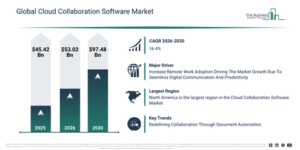
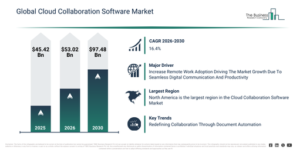
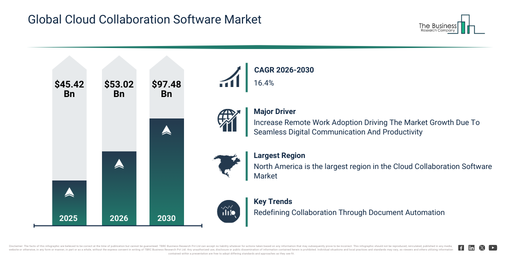
The cloud collaboration software market has experienced considerable growth in recent years. It is projected to expand from $45.42 billion in 2025 to $53.02 billion in 2026, achieving a compound annual growth rate (CAGR) of 16.7%. The historical growth of this market can be attributed to factors such as the rise of distributed teams and remote work, the increasing use of cloud storage and file sharing, the need to reduce email-based collaboration, the growing adoption of SaaS productivity suites, and the demand for faster project execution and coordination.
The cloud collaboration software market is anticipated to experience substantial growth in the upcoming years. It is projected to expand to $97.48 billion by 2030, achieving a compound annual growth rate (CAGR) of 16.4%. This expansion during the forecast period is primarily driven by factors such as the increased adoption of AI copilots for collaboration, a growing need for compliance-ready collaboration tools, expanded integrations with enterprise applications, the broadening of asynchronous collaboration workflows, and a heightened focus on data residency and governance controls. Prominent trends for the forecast period include real-time co-authoring and collaboration, AI-assisted productivity and summarization features, secure cloud file sharing and permissions management, integrated video conferencing and messaging solutions, and advanced workflow automation and task management capabilities.
Access Free Sample Pages From The Cloud Collaboration Software Market Report 2026:
Understanding The Main Driver Of The Cloud Collaboration Software Market
The expanding embrace of remote work is anticipated to fuel the expansion of the cloud collaboration software market in the foreseeable future. This contemporary employment model permits personnel to carry out their professional responsibilities beyond a conventional office setting, typically from their residences or any internet-connected venue, thereby providing adaptability in work locales and schedules. The proliferation of remote work is accelerating because digital collaborative instruments facilitate uninterrupted communication and efficiency, diminishing the requirement for a physical office presence and fostering adaptable employment structures. Cloud-based collaboration platforms underpin the uptake of remote work by empowering teams to communicate, exchange documents, and cooperate on initiatives instantaneously from any place, thereby guaranteeing sustained productivity and uninterrupted workflow irrespective of a physical office. For example, data from March 2025, provided by the U.S. Bureau of Labor Statistics—a key fact-finding entity for the Federal Government in the US—indicated that in the first quarter of 2024, 35.5 million individuals engaged in telework or worked from home for compensation. This figure represents an increase of 5.1 million compared to the prior year, comprising 22.9% of the total workforce, which is an increase from 19.6% recorded a year earlier. Consequently, the expanding embrace of remote work is serving as a primary catalyst for the expansion of the cloud collaboration software market.
Cloud Collaboration Software Market Segment Mapping For 2026 And Beyond
The cloud collaboration software market covered in this report is segmented –
1) By Component: Software, Services
2) By Deployment Mode: Public Cloud, Private Cloud, Hybrid Cloud
3) By Functionality: Document Management, Real-Time Collaboration, File Sharing And Storage, Task Management, Instant Messaging And Communication, Video Conferencing
4) By Organization Size: Small And Medium Enterprises, Large Enterprises
5) By End-User: Banking Financial Services And Insurance (BFSI), Healthcare, Information Technology (IT) And Telecommunications, Retail, Education, Government, Other End-Users
Subsegments:
1) By Software: Document Collaboration Software, Project Management Software, Communication And Messaging Software, File Sharing And Storage Software, Team Productivity And Workflow Software, Video Conferencing And Web Conferencing Software
2) By Services: Consulting And Implementation Services, Integration Services, Training And Support Services, Managed Services, Maintenance And Upgrades Services
What Key Trend Is Expected To Shape The Cloud Collaboration Software Market Over The Forecast Period?
Major companies in the cloud collaboration software market are concentrating on technological breakthroughs, such as generative AI, to enhance real-time collaboration, automate routine operations, improve content creation, and deliver more insightful analytics, thereby boosting overall productivity and user engagement. Generative AI is a form of artificial intelligence that can generate new content, including text, images, audio, or videos, by leveraging patterns learned from existing data. For example, in September 2025, Zoom Communications, Inc., a US-based firm specializing in cloud-based video conferencing and collaboration solutions, launched AI Companion 3.0 at its annual Zoomtopia conference. This updated iteration of Zoom’s AI tool provides intelligent meeting summaries, task monitoring, and advanced customer interaction features, with the goal of improving user experience across its platforms. While these innovations present considerable productivity advantages, difficulties persist in guaranteeing data privacy and seamlessly integrating AI into current workflows. Nevertheless, the adoption of AI-driven document automation is expected to redefine collaborative practices by reducing manual efforts and fostering more streamlined teamwork.
Cloud Collaboration Software Market Major Players And Industry Competition Overview
Major companies operating in the cloud collaboration software market are Huawei Technologies Co. Ltd., Cisco Systems Inc., Oracle Corporation, SAP SE, Salesforce Inc., Tata Consultancy Services Limited., Capgemini SE, Adobe Inc., Infosys Limited, HCL Technologies, Zoom Video Communications Inc., Atlassian Corporation Plc, Dropbox Inc., RingCentral Inc., monday.com Ltd., Gamma Communications PLC, TeamViewer AG, Asana Inc., Lucid Software Inc, iManage LLC, TigerConnect Inc., Zoho Corporation Pvt. Ltd., Symphony Communication Services LLC, Bluescape Inc., Formagrid Inc.
Full Cloud Collaboration Software Market Report: Market Size, Trends, Segments And Key Players:
Cloud Collaboration Software Market Geographic Segmentation: Regions Covered In The Report
North America was the largest region in the cloud collaboration software market in 2025. Asia-Pacific is expected to be the fastest-growing region in the forecast period. The regions covered in the cloud collaboration software market report are Asia-Pacific, South East Asia, Western Europe, Eastern Europe, North America, South America, Middle East, Africa.
Reach Out To Our Team:
The Business Research Company: https://www.thebusinessresearchcompany.com/
Americas: +1 310-496-7795
Asia: +44 7882 955267 & +91 8897263534
Europe: +44 7882 955267
Email us at: marketing@tbrc.info
Follow us on:
LinkedIn: https://in.linkedin.com/company/the-business-research-company
YouTube: https://www.youtube.com/channel/UC24_fI0rV8cR5DxlCpgmyFQ
Global Market Model: https://www.thebusinessresearchcompany.com/global-market-model

Wasay has over a decade of experience in market research, data modelling, and analytics, with prior experience at GlobalData and Decision Tree Consulting Services. At The Business Research Company , he leads research operations across syndicated studies, customized consulting engagements, and the Global Market Model platform. His professional experience includes supporting organizations such as Boston Consulting Group, KPMG, and Ernst & Young. Wasay holds a degree in Electronics and Communications Engineering, postgraduate management qualifications from International Management Institute Belgium and Indian School of Business and Entrepreneurship, and completed the Integrated Program in Business Analytics from Indian Institute of Management Indore.