Enhanced with market attractiveness analysis, total addressable market evaluation, company benchmarking matrices, interactive Excel dashboards, expanded supply chain intelligence, emerging startup coverage, and detailed product insights, The Business Research Company’s 2026 market reports deliver more actionable and strategically valuable research.
Cloud Electronic Design Automation Market Value Analysis: What Growth Is Expected Over The Forecast Period?
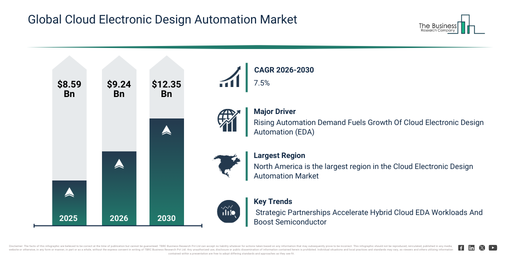
The cloud electronic design automation market has experienced robust growth in recent years. Its size is expected to increase from $8.59 billion in 2025 to $9.24 billion in 2026, representing a compound annual growth rate (CAGR) of 7.6%. This historical expansion is attributable to several factors including the rising demand for semiconductor design automation, the incorporation of cloud computing in engineering workflows, the increasing complexity of IC and PCB designs, the necessity for more rapid design cycles, and the broadening scope of consumer and automotive electronics.
The cloud electronic design automation market is projected to experience substantial expansion over the upcoming years. This market is anticipated to reach $12.35 billion by 2030, exhibiting a compound annual growth rate (CAGR) of 7.5%. Factors driving this growth during the forecast period include the emergence of AI-assisted chip design, the rising implementation of hybrid and private cloud EDA solutions, a need for sophisticated simulation and verification tools, an increase in aerospace and defense electronics, and the broadening of telecommunication and industrial electronics sectors. Key trends for the forecast duration encompass cloud-based tools for simulation and analysis, platforms supporting remote collaboration and design, scalable computing capabilities for EDA, advanced physical design and verification for integrated circuits, and optimized design for PCBs and multi-chip modules.
Download A Free Sample Report For Comprehensive Market Insights:
Cloud Electronic Design Automation Market Industry Drivers: What Is Driving Revenue Growth?
The rising need for automation is anticipated to propel the expansion of the cloud electronic design automation (EDA) market moving forward. Automation encompasses methods where devices, processes, or systems operate independently, leveraging machines and computers that do not require human oversight. Its adoption is surging, driven by its potential to revolutionize productivity, optimize workflows, and reduce costs across diverse industries. In the realm of cloud electronic design automation (EDA), automation proves beneficial by enabling the creation of cloud-native EDA tools and pre-optimized hardware platforms that function autonomously. For example, in March 2025, the European Automobile Manufacturers Association, a Belgium-based non-profit trade association, reported that global car sales in 2024 increased to 74.6 million units, marking a 2.5% rise from 2023. A related survey, which involved 600 CIOs and IT decision-makers from global enterprises, indicated that the most significant demand for automation stemmed from departments such as research and development, administrative/operations, customer service, and marketing. Consequently, the growing requirement for automation is a key factor driving the growth of the cloud electronic design automation (EDA) market.
Cloud Electronic Design Automation Market Segment Analysis Highlighting Growth Areas
The cloud electronic design automation market covered in this report is segmented –
1) By Type: Computer Aided Engineering, Semiconductor Intellectual Property, IC Physical Design And Verification, Printed Circuit Board And Multi-Chip Module
2) By Deployment Model: Public Cloud, Private Cloud, Hybrid Cloud
3) By Vertical: Automotive, Consumer Electronics, Aerospace And Defense, Industrial, Healthcare, Telecommunications
Subsegments:
1) By Computer Aided Engineering (CAE): Simulation And Analysis Tools, Finite Element Analysis (FEA) Software, Computational Fluid Dynamics (CFD) Software, Thermal And Structural Analysis Tools
2) By Semiconductor Intellectual Property (IP): Processor IP, Interface IP, Analog Or Mixed-Signal IP, Security IP
3) By IC Physical Design And Verification: Place And Route Tools, Design Rule Check (DRC) Tools, Layout Versus Schematic (LVS) Tools, Timing Analysis Tools
4) By Printed Circuit Board (PCB) And Multi-Chip Module (MCM): PCB Design Tools, MCM Design Tools, PCB Fabrication And Manufacturing Solutions, Signal Integrity Analysis Tools
#Cloud Electronic Design Automation Market Trends Influencing Long-Term Demand
Leading entities within the cloud electronic design automation (EDA) market are strategically engaging in collaborations to expedite substantial EDA workloads across hybrid cloud setups. Such alliances enable semiconductor firms to reduce their time-to-market, elevate product quality, and bolster reliability. An illustrative instance occurred in March 2024, when HCLTech, an India-headquartered software firm, collaborated with NetApp, a US-based intelligent data infrastructure provider, to introduce an advanced EDA offering designed to speed up workloads within the hybrid cloud. This solution utilizes NetApp’s Design Anywhere technology to optimize the semiconductor design journey, spanning from initial concept through to production, thereby providing enhanced scalability, adaptability, and effective handling of expanding data volumes and intricate workflow challenges. HCLTech assists its clientele by refining IT environments, coordinating infrastructure, and delivering adaptable consumption models customized for enterprise requirements. Consequently, this alliance empowers semiconductor organizations to access a high-performing, secure, and scalable cloud infrastructure, which diminishes the risks of overprovisioning, ultimately fostering innovation and operational effectiveness through a contemporary hybrid cloud methodology.
Cloud Electronic Design Automation Market Leading Companies: Who Holds Significant Market Presence?
Major companies operating in the cloud electronic design automation market are Siemens AG; Sonnet Software Inc.; Dolphin Design; OneSpin Solutions GmbH; Real Intent Inc.; Concept Engineering GmbH; Blue Pearl Software Inc.; Agnisys Inc; Agilent technologies; Dassault Systèmes; Tektronix, Inc.; Keysight Technologies; Synopsys Inc.; Autodesk Inc; Cadenece Design System; Forte Design Systems; Xilinx Inc.; ANSYS Inc.; Frontline PCB Solutions; CircuitSutra Technologies Pvt. Ltd.; JEDA Technologies; Mentor Graphics Corporation; Nimbic Inc.; Lattice Semiconductor Corporation; AWR Corporation; Zuken Inc.; Tanner EDA; Empyrean Software
Access The Complete Cloud Electronic Design Automation Market Report:
Cloud Electronic Design Automation Market Regional Analysis And Leading Geography
North America was the largest region in the cloud electronic design automation market in 2025. Asia-Pacific is expected to be the fastest-growing region in the forecast period. The regions covered in the cloud electronic design automation market report are Asia-Pacific, South East Asia, Western Europe, Eastern Europe, North America, South America, Middle East, Africa.
Get in touch with us:
The Business Research Company: https://www.thebusinessresearchcompany.com/
Americas: +1 310-496-7795
Asia: +44 7882 955267 & +91 8897263534
Europe: +44 7882 955267
Email us at: marketing@tbrc.info
Follow us on:
LinkedIn: https://in.linkedin.com/company/the-business-research-company
YouTube: https://www.youtube.com/channel/UC24_fI0rV8cR5DxlCpgmyFQ
Global Market Model: https://www.thebusinessresearchcompany.com/global-market-model

Wasay has over a decade of experience in market research, data modelling, and analytics, with prior experience at GlobalData and Decision Tree Consulting Services. At The Business Research Company , he leads research operations across syndicated studies, customized consulting engagements, and the Global Market Model platform. His professional experience includes supporting organizations such as Boston Consulting Group, KPMG, and Ernst & Young. Wasay holds a degree in Electronics and Communications Engineering, postgraduate management qualifications from International Management Institute Belgium and Indian School of Business and Entrepreneurship, and completed the Integrated Program in Business Analytics from Indian Institute of Management Indore.