Through market attractiveness analysis, total addressable market evaluation, company benchmarking matrices, interactive Excel dashboards, expanded supply chain intelligence, emerging startup coverage, and detailed product insights, The Business Research Company’s 2026 market reports provide more actionable and strategically valuable research.
Cloud Manufacturing Market Value Analysis: What Growth Is Expected Over The Forecast Period?
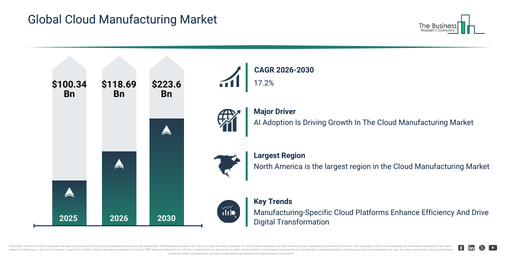
The cloud manufacturing market size has seen rapid expansion in recent years. Its valuation is anticipated to increase from $100.34 billion in 2025 to $118.69 billion in 2026, exhibiting a compound annual growth rate (CAGR) of 18.3%. The historical growth can be ascribed to the adoption of cloud computing in manufacturing, a rising demand for flexible and scalable production, the increasing use of industrial iot devices, a growing need for efficient supply chain management, and the integration of digital tools in production processes.
The cloud manufacturing market is anticipated to experience significant expansion over the coming years. This market is projected to reach $223.6 billion by 2030, exhibiting a compound annual growth rate (CAGR) of 17.2%. This anticipated growth during the forecast period stems from factors such as the deployment of AI-driven manufacturing analytics, the proliferation of digital twin technologies, the broadening of cloud-based ERP and CAD solutions, a heightened emphasis on data security and compliance, and the embrace of hybrid and edge computing within manufacturing operations. Key trends identified for the forecast timeframe encompass cloud-based manufacturing execution systems (MES), cloud-based product lifecycle management (PLM) software, predictive maintenance software, cloud migration services tailored for manufacturing, and remote monitoring and management services.
Download A Free Sample Report For Comprehensive Market Insights:
Cloud Manufacturing Market Growth Factors Supporting Long-Term Expansion
The growing integration of artificial intelligence (AI) into the manufacturing sector is anticipated to drive the expansion of the cloud manufacturing market moving forward. Artificial intelligence (AI) refers to the development of computer systems and algorithms capable of performing tasks that require human-like intelligence, such as learning from data, making predictions, and solving complex problems. This increasing uptake of artificial intelligence (AI) in manufacturing is attributed to its ability to optimize operational processes, enhance overall productivity, and enable proactive maintenance. Within cloud manufacturing, artificial intelligence is employed to analyze vast quantities of production data, refine processes, predict potential equipment failures, and improve decision-making, thereby boosting efficiency and productivity. For instance, in May 2024, data from the National Association of Manufacturers, a US-based non-profit trade association, indicated that around 94% of manufacturers support permitting reforms, with 80–87% suggesting that streamlining these processes would foster increased investment, operational growth, and workforce development. Hence, the increasing adoption of artificial intelligence (AI) in manufacturing is a primary driver for the growth of the cloud manufacturing market.
Cloud Manufacturing Market Segmentation And Category Breakdown
The cloud manufacturing market covered in this report is segmented –
1) By Component: Hardware, Software, Services
2) By Deployment Model: Public Cloud, Private Cloud, Hybrid Cloud
3) By Organization Size: Small And Medium Enterprises (SMEs), Large Enterprises
4) By Industry Vertical: Aerospace And Defense, Healthcare, Semiconductor Electronics, Automotive, Metal And Machinery Manufacturing, Other Industry Verticals
Subsegments:
1) By Hardware: Industrial IoT (Internet of Things) Devices, Sensors and Actuators, Robots and Automated Machinery, Smart Manufacturing Equipment, Edge Computing Devices, Embedded Systems and Controllers, Wearables and AR/VR Devices for Manufacturing
2) By Software: Cloud-Based Manufacturing Execution Systems (MES), Enterprise Resource Planning (ERP) Solutions for Manufacturing, Cloud-Based Product Lifecycle Management (PLM) Software, Supply Chain Management (SCM) Software, Manufacturing Analytics and Reporting Tools, Cloud-Based Computer-Aided Design (CAD) and Simulation Tools, Digital Twin Software, Cloud-Based Quality Management Software, Predictive Maintenance Software
3) By Services: Cloud Integration Services, Cloud Migration Services for Manufacturing, Consulting and Advisory Services for Cloud Manufacturing Solutions, Customization and Personalization Services, Data Security and Compliance Services, Training and Support Services, Managed Services for Cloud-Based Manufacturing Solutions, Remote Monitoring and Management Services
#Cloud Manufacturing Market Growth Trends: What Is Influencing The Future Outlook?
Leading firms within the cloud manufacturing market are creating sophisticated solutions, like cloud platforms tailored for manufacturing, with the aim of increasing operational effectiveness, consolidating data origins, and improving decision-making throughout production workflows. These platforms are crafted uniquely for the manufacturing sector, incorporating data processing engines, analytical capabilities, and supply chain management functionalities to maximize efficiency and rationalize processes. An illustrative case occurred in October 2024 when Salesforce, a US-based software company, introduced Connected Assets for its Manufacturing Cloud, a cloud solution providing a real-time, consolidated perspective on manufacturing assets, encompassing telematics, IoT, customer, and service-history data. This platform assists manufacturers in minimizing downtime, enhancing performance, and boosting customer satisfaction through the utilization of connected-asset data, enabling quicker, insight-driven decisions and proactive service oversight. This demonstrates the strategy of cloud-manufacturing enterprises in employing specialized cloud platforms to propel digital transformation, uplift productivity, and fortify their competitive standing.
Cloud Manufacturing Market Competitive Analysis Of Major Industry Participants
Major companies operating in the cloud manufacturing market are Amazon.com Inc; Google LLC; Microsoft Corporation; Dell Technologies Inc; Siemens AG; International Business Machines Corporation; General Electric Company; Cisco Systems Inc; Oracle Corporation; NetSuite Inc; SAP SE; Hewlett Packard Enterprise Company; DXC Technology Company; VMware Inc; Rockwell Automation Inc; Hitachi Vantara; PTC Inc; Cloudera Inc; Rootstock Software; ABB Ltd; Honeywell International Inc; Dassault Systemes SE
Access The Complete Cloud Manufacturing Market Report:
Cloud Manufacturing Market Regional Distribution: Which Areas Drive Market Expansion?
North America was the largest region in the cloud manufacturing market in 2025. Asia-Pacific is expected to be the fastest-growing region in the forecast period. The regions covered in the cloud manufacturing market report are Asia-Pacific, South East Asia, Western Europe, Eastern Europe, North America, South America, Middle East, Africa.
Get in touch with us:
The Business Research Company: https://www.thebusinessresearchcompany.com/
Americas: +1 310-496-7795
Asia: +44 7882 955267 & +91 8897263534
Europe: +44 7882 955267
Email us at: marketing@tbrc.info
Follow us on:
LinkedIn: https://in.linkedin.com/company/the-business-research-company
YouTube: https://www.youtube.com/channel/UC24_fI0rV8cR5DxlCpgmyFQ
Global Market Model: https://www.thebusinessresearchcompany.com/global-market-model

Wasay has over a decade of experience in market research, data modelling, and analytics, with prior experience at GlobalData and Decision Tree Consulting Services. At The Business Research Company , he leads research operations across syndicated studies, customized consulting engagements, and the Global Market Model platform. His professional experience includes supporting organizations such as Boston Consulting Group, KPMG, and Ernst & Young. Wasay holds a degree in Electronics and Communications Engineering, postgraduate management qualifications from International Management Institute Belgium and Indian School of Business and Entrepreneurship, and completed the Integrated Program in Business Analytics from Indian Institute of Management Indore.