The Business Research Company’s 2026 market reports are designed to deliver research that is more actionable and strategically valuable. Key offerings include market attractiveness scoring, total addressable market sizing, company benchmarking matrices, interactive Excel dashboards, deeper supply chain intelligence, emerging startup tracking, and granular product-level insights.
Code Signing As A Service Market Size 2026: Valuation, Growth Rate And Forecast To 2030
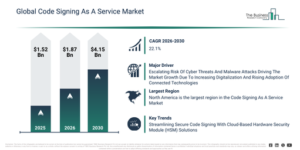
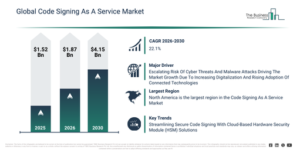
The code signing as a service market size has seen exponential growth in recent years. It is anticipated to expand from $1.52 billion in 2025 to $1.87 billion in 2026, achieving a compound annual growth rate (CAGR) of 22.4%. The expansion observed in the historic period is attributable to an increase in software supply chain attacks, the growing adoption of CI/CD automation, the need to verify software integrity and origin, the rise of cloud-based development environments, and increasing compliance requirements for secure software delivery.
The code signing as a service market size is anticipated to undergo substantial expansion over the next few years. It is predicted to grow to $4.15 billion in 2030, achieving a compound annual growth rate (CAGR) of 22.1%. This expansion during the forecast period can be attributed to the wider adoption of zero-trust software delivery models, an increase in signing requirements for containers and artifacts, a heightened demand for scalable signing across enterprises, the growing implementation of managed PKI and certificate automation, and the increased prevalence of code signing in regulated sectors. Prominent trends for the forecast period include automated code signing within DevSecOps pipelines, centralized certificate and key management, the integration of Hardware Security Modules (HSM), compliance-focused signing audit trails, and signing solutions for IoT and edge software updates.
Get A Free Sample Of The Code Signing As A Service Market Report 2026:
What Is Driving The Growth Of The Code Signing As A Service Market?
The increasing danger from cyber threats and malware attacks is projected to fuel the expansion of the code signing as a service market moving forward. These cyber threats and malware attacks involve harmful activities targeting digital infrastructure to steal information, disrupt operations, or inflict damage through malicious software. The heightened risk of such threats and attacks stems from the growing digitalization across various industries, as organizations move critical functions and sensitive data to digital platforms, thereby creating more vulnerabilities and potential entry points for cybercriminals to exploit. Code signing as a service strengthens cybersecurity by providing trusted digital signatures that verify the legitimacy and integrity of software, effectively stopping cyber threats and malware attacks from executing or spreading by ensuring users and systems can reliably distinguish authentic applications from altered or harmful code. For instance, in November 2024, data from the Australian Signals Directorate, an Australia-based government agency, indicated that in FY2023-24, ASD’s Cyber Security Hotline received over 36,700 calls, a 12% increase, and responded to more than 1,100 incidents, similar to the previous year. Additionally, organizations were notified 930 times of potential malicious activity, and the Australian Protective Domain Name System blocked 82 million malicious domains, marking a 21% rise. Therefore, the escalating risk of cyber threats and malware attacks is stimulating the growth of the code signing as a service market.
How Is The Code Signing As A Service Market Segmented?
The code signing as a service market covered in this report is segmented –
1) By Component: Software, Services
2) By Deployment Mode: Cloud-Based, On-Premises
3) By Organization Size: Small And Medium Enterprises, Large Enterprises
4) By End-User: Banking, Financial Services, And Insurance (BFSI), Information Technology (IT) And Telecom, Healthcare, Government, Retail, Other End-Users
Subsegments:
1) By Software: Code Signing Platforms, Certificate Management Software, Security And Authentication Tools, Integration And Deployment Software
2) By Services: Implementation Services, Consulting Services, Maintenance And Support Services, Training Services
What Are The Latest Trends In The Code Signing As A Service Market?
Leading companies operating within the code signing as a service market are concentrating on developing innovative solutions, such as the integration of cloud-based hardware security modules (HSMs), to enhance security, streamline signing processes, and enable scalable, compliant code signing for distributed teams. Cloud-based hardware security module (HSM) integration involves the utilization of remotely hosted HSMs to securely generate, store, and manage cryptographic keys in the cloud, thereby ensuring high security for these keys, facilitating scalable and centralized code signing, and allowing distributed teams to sign software without the need to manage local hardware. For instance, in November 2023, AppViewX Inc., a U.S.-based software company, launched AppViewX SIGN+, a comprehensive code signing solution aimed at strengthening software supply chain security. This enables DevOps teams to efficiently and securely sign software, firmware, containers, and other components, guaranteeing their authenticity and integrity. AppViewX SIGN+ offers various deployment options, encompassing both on-premises and cloud-based solutions, to cater to diverse organizational needs. A crucial feature is its integration with cloud-based hardware security modules (HSMs) that facilitate secure key generation, storage, and management, while also ensuring compliance with industry standards, such as the CA/Browser Forum’s stipulations for code signing certificates and keys to be stored on secure hardware. The integration of cloud-based HSMs enables centralized, scalable code signing, allowing distributed teams to securely sign software without managing local hardware, simultaneously streamlining workflows and ensuring compliance to safeguard software supply chains and maintain user trust.
Who Are The Key Players In The Code Signing As A Service Market?
Major companies operating in the code signing as a service market are Amazon Web Services Inc., Microsoft Corporation, Thales S.A., Asseco Systems S.A., HID Global Corporation, Entrust Corporation, DigiCert Inc., GlobalSign N.V., Aruba S.p.A., Fortanix Inc., Futurex Inc., Buildkite Pty Ltd., WISeKey International Holding Ltd., IdenTrust LLC, AppViewX Inc., SignMyCode LLC, Keyfactor Inc., SSL.com Inc., SignPath Labs Inc., Codemagic Ltd., Appdome Ltd., Buypass AS
Read The Complete Code Signing As A Service Market Report 2026:
Which Region Is The Largest In The Code Signing As A Service Market?
North America was the largest region in the code signing as a service market in 2025. Asia-Pacific is expected to be the fastest-growing region in the forecast period. The regions covered in the code signing as a service market report are Asia-Pacific, South East Asia, Western Europe, Eastern Europe, North America, South America, Middle East, Africa.
Reach Out To Our Team:
The Business Research Company: https://www.thebusinessresearchcompany.com/
Americas: +1 310-496-7795
Asia: +44 7882 955267 & +91 8897263534
Europe: +44 7882 955267
Email us at: marketing@tbrc.info
Follow us on:
LinkedIn: https://in.linkedin.com/company/the-business-research-company
YouTube: https://www.youtube.com/channel/UC24_fI0rV8cR5DxlCpgmyFQ
Global Market Model: https://www.thebusinessresearchcompany.com/global-market-model

Wasay has over a decade of experience in market research, data modelling, and analytics, with prior experience at GlobalData and Decision Tree Consulting Services. At The Business Research Company , he leads research operations across syndicated studies, customized consulting engagements, and the Global Market Model platform. His professional experience includes supporting organizations such as Boston Consulting Group, KPMG, and Ernst & Young. Wasay holds a degree in Electronics and Communications Engineering, postgraduate management qualifications from International Management Institute Belgium and Indian School of Business and Entrepreneurship, and completed the Integrated Program in Business Analytics from Indian Institute of Management Indore.